
Tool · United Kingdom
Allergen matrix builder for the 14 allergens
An allergen matrix is a grid: your dishes down the side, the 14 allergens of Annex 2 across the top. Paste your dishes with their ingredients and this builds one — then print it, save it as a PDF or copy it as CSV. Free, no sign-up, everything stays in your browser.
One thing before you start, because almost every page on this subject gets it the wrong way round: no law requires a matrix. The law requires the information. A matrix is simply the version of it you can hand to a new member of staff on their first shift.
Building clears the ticks and starts again from the list above. Edit the ticks after you build, not before.
Every tick is a suggestion read out of the words you typed, not a declaration. Amber means the wording is ambiguous — decide it yourself. A clear column is no guarantee: it cannot see a processing aid, a carrier inside a flavouring, or what a supplier changed last week. Check each row against the actual recipe before you put the sheet on the counter.
What the law asks for, and what it leaves to you
For food sold without prepackaging — a plate, a counter, a buffet — Article 44(1)(a) of the retained Regulation (EU) No 1169/2011 is short:
“the provision of the particulars specified in point (c) of Article 9(1) is mandatory”
Those particulars are wider than a recipe card, and this is the sentence that decides what belongs in your grid — Article 9(1)(c):
“any ingredient or processing aid listed in Annex II or derived from a substance or product listed in Annex II causing allergies or intolerances used in the manufacture or preparation of a food and still present in the finished product, even if in an altered form”
Three words in there do the work. Processing aid — so the flour a baker dusts the bench with counts, even though it never appears in a recipe. Derived from — so semolina is wheat. Even if in an altered form — so a reduced, baked or fermented ingredient stays in the column.
And then comes the part that almost no page about matrices quotes, regulation 5(1) of the Food Information Regulations 2014:
“A food business operator … may make available the particulars specified in Article 9(1)(c) … in relation to that food by any means the operator chooses, including, subject to paragraph (3), orally.”
That is why “you must have an allergen matrix” is not a true sentence. The choice of means is yours. What a written matrix buys you is not compliance — it is that the answer does not change when the person who knows the recipes is off sick.
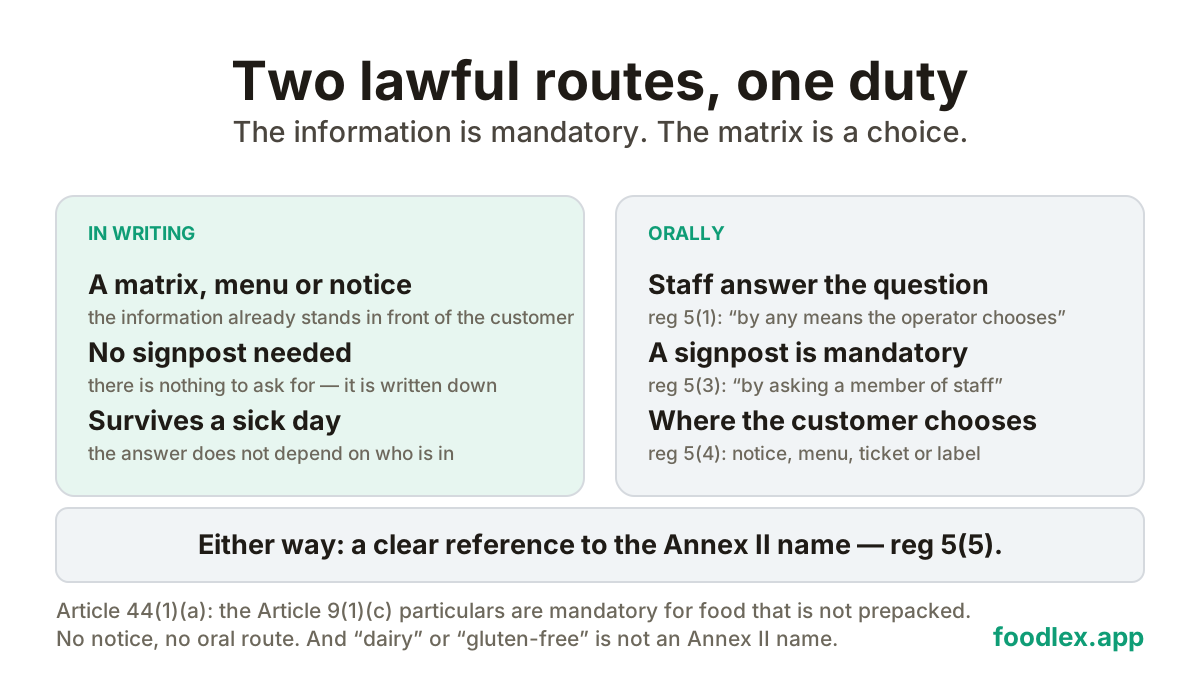
Diagram: Foodlex. The Food Information Regulations 2014 (S.I. 2014/1855), regulation 5, and the retained Regulation (EU) No 1169/2011, Article 44(1)(a), as they apply in Great Britain.
If you answer orally, the notice is not optional
This is the half of regulation 5 that gets missed, and it is the one an environmental health officer can see from the door. Paragraph (3):
“the operator must indicate that details of that substance or product can be obtained by asking a member of staff.”
And paragraph (4) says where it has to be:
“(a) on a label attached to the food, or (b) on a notice, menu, ticket or label that is readily discernible by an intending purchaser at the place where the intending purchaser chooses that food.”
So: no notice, no oral route. Here is a sentence that carries the two things paragraph (3) asks for — that details exist, and that staff are who you ask:
🟡 The wording is ours, not the regulation’s — paragraph (3) sets the content, not the phrasing. Put it where the customer chooses, which is the menu or the counter, not the back of the till receipt.
Name the Annex 2 substance, not your word for it
Regulation 5(5) is the reason the column headings on this page are the Annex 2 words and not kitchen words:
“the Article 9(1)(c) particulars … must be made available with a clear reference to the name of the substance or product listed in Annex II”
A grid headed dairy, nuts, gluten fails this quietly: none of those three is an Annex 2 name. The usual slips:
| On the menu | The column it belongs in | Why |
|---|---|---|
| Semolina, spelt, couscous | Cereals containing gluten | All wheat — entry 1 names spelt expressly |
| Quark, ghee, whey | Milk | Entry 7 covers products thereof, including lactose |
| Surimi, Worcestershire sauce | Fish | Anchovy in the sauce; entry 4 |
| Tahini | Sesame seeds | Entry 11 |
| Marzipan, praline | Nuts | Almond is one of the eight nuts in entry 8 |
| “Dairy”, “gluten-free”, “nut traces” | — | Not Annex 2 names at all — the first two describe a diet, the third is voluntary |
And the ticks above do not know all of these. Measured against the detector on this page: couscous, surimi, marzipan, quark, whey, tahini, anchovy and parmesan are found — ghee and Worcestershire sauce are not. The table above is the law; the ticks are a reading of the words you typed. It is also right that pine nuts stay clear: entry 8 does not name them.
Two entries are narrower than their everyday word, and a matrix that widens them is wrong in the other direction. Entry 8 is a closed list of eight named nuts, so pine nut and coconut have no column; peanut is its own entry 5. And entry 12 is the only one with a threshold — sulphites count at more than 10 mg/kg. Our guide to the fourteen goes through each entry and its exceptions, and the allergen checker works on a single ingredient list rather than a whole menu.
What a matrix needs besides the ticks
🟡 Interpretation, not law: the regulations say nothing about layout, review dates or signatures. They do say, in regulation 5(6), what the duty hangs on — a food
“in which an ingredient or processing aid listed in Annex II … has been used in its manufacture or preparation and that is still present in the finished product (even if in an altered form)”
That is about the dish as it leaves the kitchen today. Which is why the three fields above the grid are worth filling in: a sheet that cannot say when it was last checked, and by whom, cannot tell you whether it still describes the food. Nothing in the regulations names an interval — the trigger is a change, not a date. A new supplier, a substituted ingredient, a special that stayed on the menu.
Frequently asked questions
Is an allergen matrix required by law in the UK?
No. The information is mandatory under Article 44(1)(a); regulation 5(1) lets you provide it “by any means the operator chooses”. A matrix is one of those means.
Can I just tell customers verbally?
Yes — but then the notice in regulation 5(3) is mandatory, and paragraph (4) says where it has to sit.
Which names belong in the columns?
The Annex 2 names. Regulation 5(5) wants “a clear reference to the name of the substance or product listed in Annex II” — so wheat, not gluten-free.
How often should an allergen matrix be reviewed?
The regulations name no interval. What they tie the duty to is the finished product, so a changed recipe or supplier dates the sheet on the day it changes.
Does this page give me an Excel or Word file?
Not as a file. It prints (which is how you save a PDF) and copies as CSV, which Excel, Numbers and Google Sheets open directly.
What about food prepacked for direct sale?
Different rules — PPDS food needs a full ingredient list on the pack. See Natasha’s Law.
Wording quoted from the retained Regulation (EU) No 1169/2011 as it applies in Great Britain (Article 9(1)(c), Article 44(1)(a), Annex II) and from The Food Information Regulations 2014 (S.I. 2014/1855), regulation 5, in the “Latest available (Revised)” version on legislation.gov.uk. Regulation 5 is the England version; Scotland, Wales and Northern Ireland have their own instruments, and Northern Ireland follows the EU version of the Regulation. The ticks are produced from word patterns in the text you type and make no statement about your food. This page is information, not legal advice — responsibility for the information given to a customer stays with the food business operator.