
Guide · Allergens
The 14 allergens — the list Great Britain works from, and what the law does with it
The list itself is short and nobody argues about it. What costs businesses money is everything around it: which nuts are in, which derivatives are out, how the name has to look inside the ingredient list, and the fact that loose food is caught too. Here is the list in full, from Annex 2 as it applies in Great Britain, with the rest of the rules attached to it.
The fourteen, in the order the Annex lists them
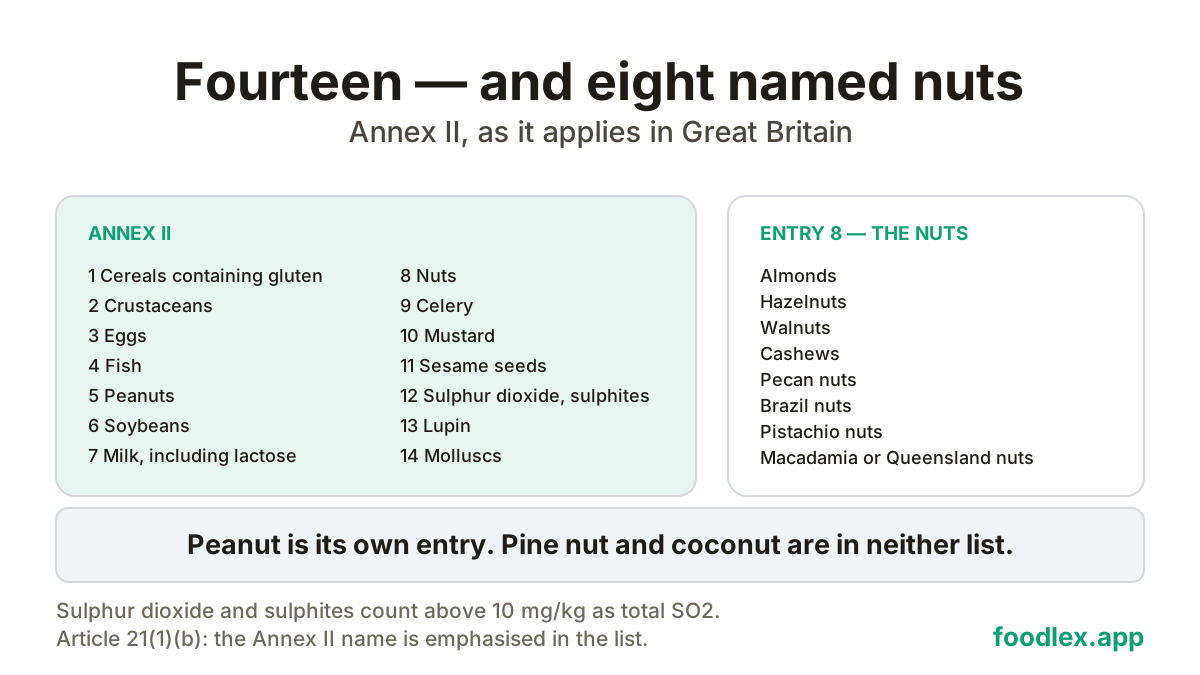
Diagram: Foodlex. Regulation (EU) No 1169/2011, Annex II, as it applies in Great Britain.
| # | Entry in Annex 2 |
|---|---|
| 1 | Cereals containing gluten, namely wheat (such as spelt and khorasan wheat), rye, barley, oats or their hybridised strains, and products thereof |
| 2 | Crustaceans and products thereof |
| 3 | Eggs and products thereof |
| 4 | Fish and products thereof |
| 5 | Peanuts and products thereof |
| 6 | Soybeans and products thereof |
| 7 | Milk and products thereof, including lactose |
| 8 | Nuts — almonds, hazelnuts, walnuts, cashews, pecan nuts, Brazil nuts, pistachio nuts, macadamia or Queensland nuts, and products thereof |
| 9 | Celery and products thereof |
| 10 | Mustard and products thereof |
| 11 | Sesame seeds and products thereof |
| 12 | Sulphur dioxide and sulphites at concentrations of more than 10 mg/kg or 10 mg/litre in terms of the total SO2, calculated for products as proposed ready for consumption or as reconstituted |
| 13 | Lupin and products thereof |
| 14 | Molluscs and products thereof |
Two details in that table do more work than the rest. Entry 12 is the only one with a threshold, and it is measured as total SO2 in the product as eaten. And nine of the fourteen end in “and products thereof” — the derivative, not just the raw food, is caught.
Entry 8: eight named nuts, and what is not one
The nuts entry is a closed list of eight, and that is where most homemade allergen matrices go wrong:
- Peanut is not in it. It is entry 5 in its own right — botanically a legume, legally a separate declaration.
- Pine nut and coconut are in neither entry. Neither is named in Annex 2 at all, so neither carries a declaration duty, however often a kitchen treats them as nuts.
- “Nuts” on its own is not the declaration. Article 21(1)(a) wants “a clear reference to the name of the substance or product as listed in Annex II”, and the Annex names the species.
The exemptions inside the list
Five of the fourteen carry an except, and they are easy to miss because they sit in the sub-points rather than in the headline:
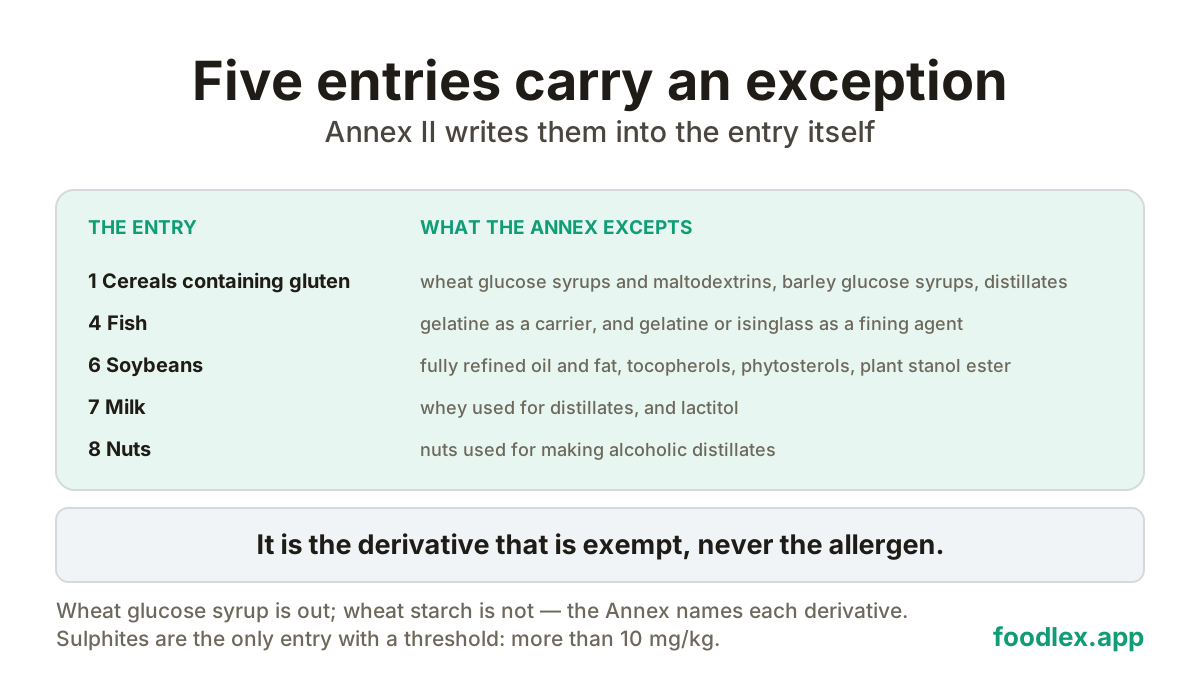
Diagram: Foodlex. Regulation (EU) No 1169/2011, Annex II, as it applies in Great Britain.
| Entry | What Annex 2 excepts |
|---|---|
| 1 Gluten cereals | wheat-based glucose syrups including dextrose; wheat-based maltodextrins; glucose syrups based on barley; cereals used for making alcoholic distillates including ethyl alcohol of agricultural origin |
| 4 Fish | fish gelatine used as a carrier for vitamin or carotenoid preparations; fish gelatine or isinglass used as a fining agent in beer and wine |
| 6 Soybeans | fully refined soybean oil and fat; natural mixed tocopherols (E306) and the natural D-alpha tocopherols from soybean sources; vegetable-oil-derived phytosterols and phytosterol esters from soybean; plant stanol ester produced from vegetable oil sterols of soybean origin |
| 7 Milk | whey used for making alcoholic distillates including ethyl alcohol of agricultural origin; lactitol |
| 8 Nuts | nuts used for making alcoholic distillates including ethyl alcohol of agricultural origin |
The pattern is the same each time: a derivative processed far enough that the protein is gone. The exemption belongs to that derivative, named precisely. Wheat glucose syrup is out; wheat starch is not.
Where the duty applies — and where it still applies
For prepacked food the allergens are one of the twelve mandatory particulars, under point (c) of Article 9(1). But the duty does not stop at the packet:
| Situation | What the law requires |
|---|---|
| Prepacked, with an ingredient list | the Annex 2 name inside the list, emphasised — Article 21(1) |
| Prepacked, no ingredient list | the word contains followed by the Annex 2 name — Article 21(1), second paragraph |
| Loose, or packed at the customer’s request | the allergen particulars are mandatory — Article 44(1)(a); most other particulars are not |
| Prepacked for direct sale (PPDS) | name of the food and a full ingredient list with the allergens emphasised — see Natasha’s Law |
Article 44 is the one that surprises people: the Regulation lifts almost every other particular for non-prepacked food, and keeps this one.
How the emphasis has to look
Article 21(1)(b) is deliberately open about the means and strict about the result:
“the name of the substance or product as listed in Annex II shall be emphasised through a typeset that clearly distinguishes it from the rest of the list of ingredients, for example by means of the font, style or background colour”
Bold is the usual choice; italics, capitals, underlining or a shaded background are equally lawful. Two further rules sit in the same article: where several ingredients come from one Annex 2 entry, “the labelling shall make it clear for each ingredient or processing aid concerned”; and the declaration is not required “in cases where the name of the food clearly refers to the substance or product concerned” — a tin labelled Peanut butter does not need the word twice.
What is not in Article 21 is any rule about “may contain”. Precautionary statements are a separate decision about unintended cross-contact; they never discharge the duty for an allergen that is actually in the recipe.
How this differs from Australia and the United States
| Great Britain | Australia | United States | |
|---|---|---|---|
| How many | 14 entries | named foods in Schedule 9 | 9 major food allergens |
| Tree nuts | eight, named | nine, named — pine nut is one | tree nuts as a group, but the type must be named |
| Celery, mustard, lupin, molluscs | all four are in | lupin is in; celery and mustard are not | none of the four |
| Sulphites | above 10 mg/kg, total SO2 | added, 10 mg/kg or more | not an allergen; labelled as an additive |
| How it is shown | emphasised inside the ingredient list | required name in the list and a Contains statement | Contains line or in-list parentheses |
One recipe, three labels, and none of the three lists is a subset of the others.
Frequently asked questions
What are the 14 allergens?
Cereals containing gluten, crustaceans, eggs, fish, peanuts, soybeans, milk, nuts, celery, mustard, sesame seeds, sulphur dioxide and sulphites above 10 mg/kg, lupin and molluscs.
Which nuts count as one of the 14 allergens?
Eight: almonds, hazelnuts, walnuts, cashews, pecan nuts, Brazil nuts, pistachio nuts and macadamia or Queensland nuts. Peanut is a separate entry; pine nut and coconut are in neither.
Do the 14 allergens have to be declared on loose food?
Yes — Article 44(1)(a) keeps the allergen particulars mandatory for food sold without prepackaging, while most other particulars fall away.
Is a ‘may contain’ statement part of the rules?
No. The Regulation deals with allergens used in the manufacture of the food and still present in it. A precautionary statement is a separate decision and never replaces the declaration.
This article is general information and does not replace legal advice. Quoted from Regulation (EU) No 1169/2011 as it applies in Great Britain — Annex II, Article 9(1)(c), Article 21 and Article 44 — in the revised text on legislation.gov.uk, read on 24 October 2026. Enforcement in England is by the Food Information Regulations 2014.