
Guide · Allergens
The Big 9 allergens: what a US label has to say
Nine foods, two permitted ways of declaring them, and three traps that catch people who think they are done. The rules are not in the Code of Federal Regulations but in the statute itself — the Food, Drug, and Cosmetic Act — and they are shorter than their reputation. Here is the wording, quoted from the US Code.
The nine, and where the list lives
The definition sits in 21 U.S.C. § 321(qq)(1), among the definitions at the front of the Act:
“The term ‘major food allergen’ means any of the following: … Milk, egg, fish (e.g., bass, flounder, or cod), Crustacean shellfish (e.g., crab, lobster, or shrimp), tree nuts (e.g., almonds, pecans, or walnuts), wheat, peanuts, soybeans, and sesame.”
Sesame is the newcomer, and the amendment note under the section says exactly how it arrived: “2021—Par. (qq)(1). Pub. L. 117–11 substituted ‘soybeans, and sesame’ for ‘and soybeans’.” That is the FASTER Act of 2021, signed on 23 April 2021, with effect from 1 January 2023. Labels printed before that date called the list the Big 8; anything printed now is nine.
The definition has a second half that matters just as much: paragraph (qq)(2) extends it to “a food ingredient that contains protein derived from” one of the nine. Protein is the test, not provenance — which is why the two exceptions below exist.
Two ways to declare, and you pick one
The labelling duty is in § 343(w)(1). A food is misbranded if it contains a major food allergen unless either:
“(A) the word ‘Contains’, followed by the name of the food source from which the major food allergen is derived, is printed immediately after or is adjacent to the list of ingredients (in a type size no smaller than the type size used in the list of ingredients) … or
(B) the common or usual name of the major food allergen in the list of ingredients … is followed in parentheses by the name of the food source from which the major food allergen is derived”
Both are complete answers. The practical difference:
| “Contains” statement | In the ingredient list | |
|---|---|---|
| Looks like | INGREDIENTS: Wheat flour, whey, lecithin. Contains: Wheat, Milk, Soy. | INGREDIENTS: Wheat flour, whey (milk), lecithin (soy). |
| Must be complete | Yes — if you use it, every allergen in the food belongs in it | Yes, allergen by allergen |
| Type size | No smaller than the ingredient list | Same as the ingredient list |
| Placement | Immediately after or adjacent to the ingredient list | Inside it |
Paragraph (B) also says when the parenthesis may be left off: when the ingredient’s own name already uses the food source (“buttermilk” carries “milk”), or when the source appears elsewhere in the list anyway. That second exception has a carve-out of its own, and reading past it is a common mistake — it does not apply where the other appearance is part of the name of an ingredient that is not a major food allergen.
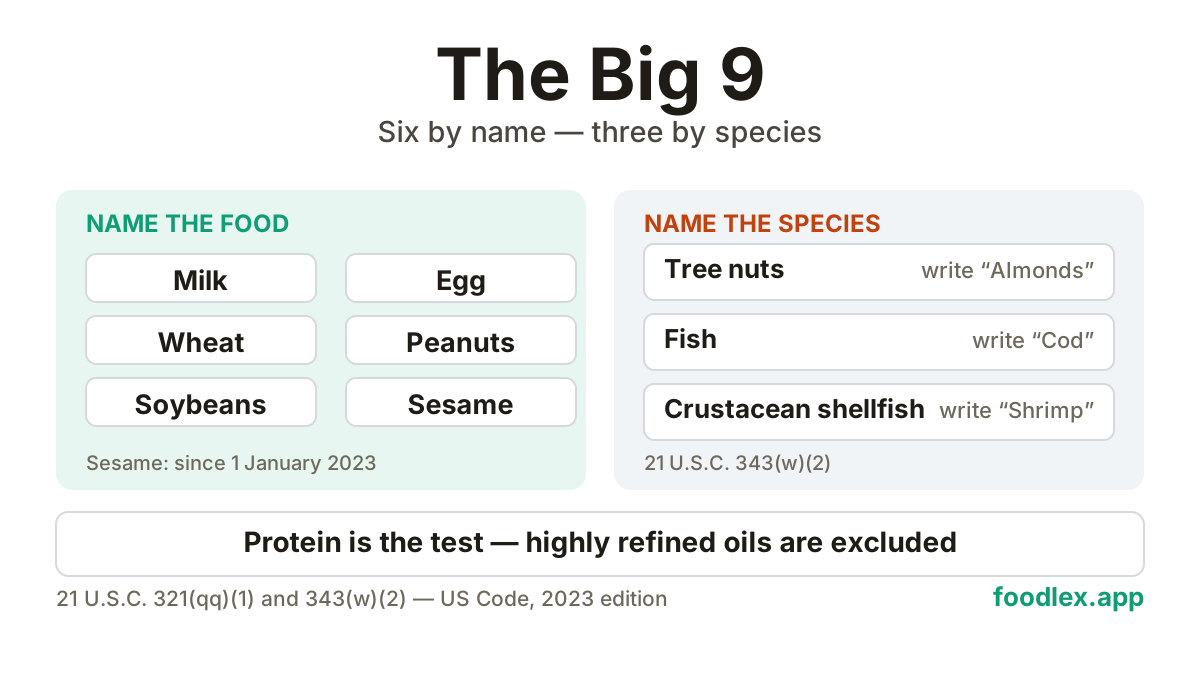
Diagram: Foodlex. 21 U.S.C. § 321(qq)(1) and § 343(w)(2), US Code, 2023 edition.
Three traps
1. “Tree nuts” is not a declaration
§ 343(w)(2) is one sentence and it is the most-missed sentence of the lot:
“… in the case of a tree nut, fish, or Crustacean shellfish, the term ‘name of the food source from which the major food allergen is derived’ means the name of the specific type of nut or species of fish or Crustacean shellfish.”
So “Contains: Almonds”, not “Contains: Tree nuts”; “Cod”, not “Fish”; “Shrimp”, not “Shellfish”. Three of the nine behave differently from the other six, and a label that treats all nine alike is wrong on three of them.
2. Highly refined oils are out — and only those
§ 321(qq)(2)(A) excludes “any highly refined oil derived from a food specified in paragraph (1) and any ingredient derived from such highly refined oil”. Highly refined soybean oil is therefore not a major food allergen. Cold-pressed, expelled or extruded oil is — it still carries protein, and protein is the test. The exclusion is about the process, not the plant.
3. The flavouring rule overrides the flavouring rule
Normally § 343(i) lets you write “natural flavors” without naming what is in them. For allergens that permission is switched off by § 343(w)(4):
“Notwithstanding subsection (g), (i), or (k), or any other law, a flavoring, coloring, or incidental additive that is, or that bears or contains, a major food allergen shall be subject to the labeling requirements of this subsection.”
“Incidental additive” catches processing aids and carriers — the parts of a recipe that do not look like ingredients. If one of them carries milk protein, the label says milk.
What the statute does not say
- Nothing about “may contain”. Precautionary statements for unintended cross-contact are voluntary and are not mentioned in § 343(w) at all. They do not replace the declaration, and they have to be truthful and not misleading like any other label statement.
- Nothing about bold type. The EU requires the allergen to be emphasised inside the ingredient list; US law requires a name, in a given type size, in one of two places. Emphasis is allowed, not required.
- Nothing about raw agricultural commodities. § 343(w)(1) opens with “If it is not a raw agricultural commodity” — a bag of shelled walnuts sold as such is outside the subsection.
- Nothing about gluten. Wheat is on the list; gluten is not the same thing, and “gluten-free” is a separate claim with its own rule in 21 CFR 101.91.
Nine against fourteen: why an EU label does not travel
Businesses that sell on both sides of the Atlantic often assume one list is a subset of the other. It is not.
| Allergen | United States | European Union |
|---|---|---|
| Milk, egg, fish, crustaceans, tree nuts, wheat/cereals, peanuts, soy, sesame | ✅ all nine | ✅ |
| Celery, mustard, lupin, molluscs, sulphites ≥ 10 mg/kg | not covered | ✅ |
| Cereals: which ones | wheat only | wheat, rye, barley, oats, spelt, kamut |
| How it is shown | “Contains” statement or parentheses | emphasised inside the ingredient list |
Two differences, both one-way. A US label is missing five EU allergens; an EU label emphasises its allergens in a way US law neither requires nor recognises as a substitute for the “Contains” statement. There is no single label that is simply correct in both places — there are two labels.
A checklist you can run over a draft
- Go ingredient by ingredient and ask: does this carry protein from one of the nine?
- Include flavours, colours, carriers and processing aids — § 343(w)(4).
- For tree nuts, fish and crustaceans, write the species.
- Pick one route — “Contains” or parentheses — and make it complete.
- Check the type size against the ingredient list.
- Check the placement: immediately after or adjacent to the ingredient list.
Frequently asked questions
What are the Big 9 allergens?
Milk, egg, fish, Crustacean shellfish, tree nuts, wheat, peanuts, soybeans and sesame — 21 U.S.C. § 321(qq)(1). Sesame joined on 1 January 2023 through the FASTER Act.
Do I have to use a “Contains” statement?
No — the parenthetical route inside the ingredient list is equally valid. But if you use a “Contains” statement, it must name every allergen in the food.
Is “tree nuts” enough, or do I need the species?
The species, for tree nuts, fish and Crustacean shellfish — § 343(w)(2).
Are highly refined oils covered?
No, by the express exception in § 321(qq)(2)(A). Cold-pressed or expelled oil from the same plant is covered.
Does a flavouring have to declare its allergen?
Yes — § 343(w)(4) overrides the usual flavouring permission.
Does “may contain” satisfy the law?
No. It is voluntary, it covers cross-contact rather than ingredients, and it does not replace the declaration.
Is the US list the same as the EU list?
No — the EU has fourteen, and five of them are not US allergens at all. The two labels are different documents.
Wording quoted on 21 October 2026 from the US Code on govinfo.gov: 21 U.S.C. § 321(qq) and § 343(w), 2023 edition, including the amendment note recording Pub. L. 117–11 (FASTER Act). This page is information, not legal advice — whether a particular ingredient carries a major food allergen is a question about that ingredient, and the responsibility for a label stays with the business that puts the food on the market.