
For teaching and study
Foodlex for universities — free for students
From a recipe, Foodlex works out the Nutrition Facts panel under 21 CFR 101.9, takes the allergen declarations from the same ingredient list and turns both into a finished label. Students of food science, nutrition and food technology use it free of charge — unlocked through their university email address.
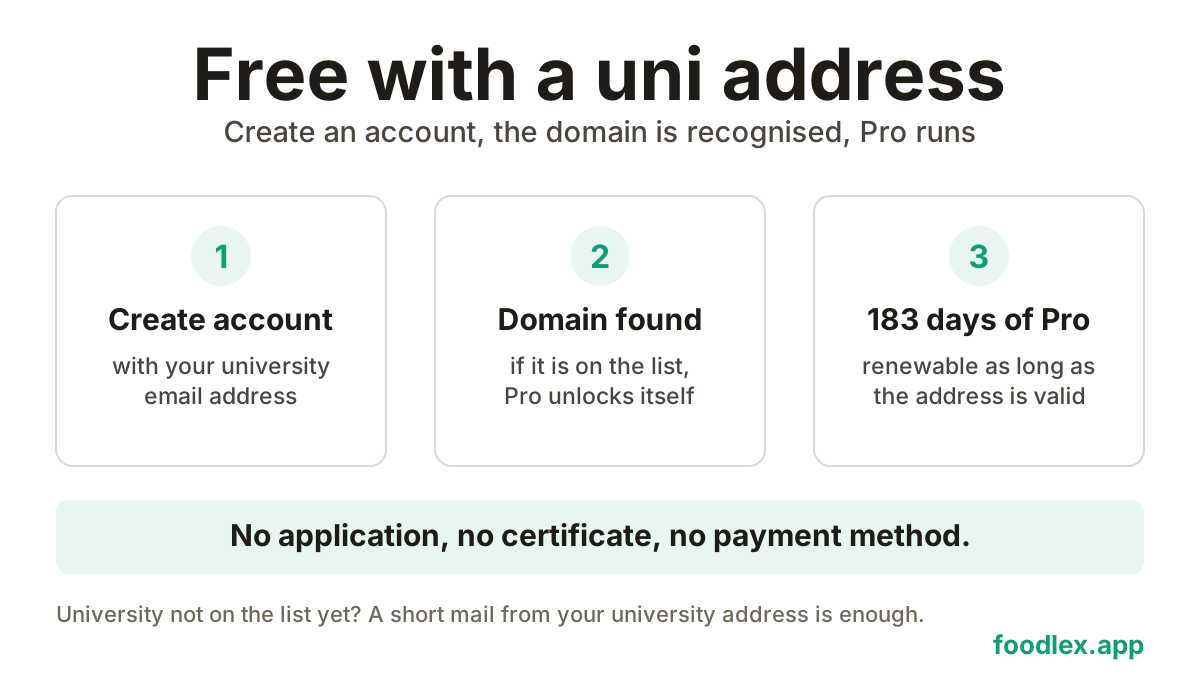
Unlocked in three steps
-
Create an account with your university email address — the one
your school gave you, e.g.
firstname.lastname@iastate.edu. - That’s it. If your school’s domain is enabled, full access unlocks automatically. No application, no questions, no proof of enrolment.
- 183 days, renewable. After that, unlock once more, as long as the address is still valid.
What students use it for
Set to the US market, Foodlex follows Title 21 of the Code of Federal Regulations rather than the European rules:
- Nutrition Facts panel — the fifteen lines 21 CFR 101.9 requires, with the type sizes and hairlines of 101.9(d) and the choice between the standard, tabular and linear formats.
- Serving sizes from the RACC tables in 21 CFR 101.12(b) — 151 official product categories, not an estimate.
-
The nine major food allergens with the
Containsstatement under 21 U.S.C. 343(w), set from the same ingredient list. - US composition data. In the US market the default source is the USDA database, not the European tables.
- Net quantity of contents in pounds and ounces as 101.7(b)(1) requires, and name and address of the responsible firm under 101.5(d).
- Print-ready label as a PDF — for coursework, internships and theses.
Where the US label differs from the European one
This is the part that catches out anyone who learned the European rules first. Four differences, each with the wording that creates it.
Calories, not kilojoules — and %DV instead of reference intakes
21 CFR 101.9(c) opens by saying what the panel must carry: the declaration “shall contain information about the level of the following nutrients”, and it adds that “no nutrients or food components other than those listed in this paragraph as either mandatory or voluntary may be included”. The list is closed, it is counted in Calories, and the percentages refer to the Daily Values of 101.9(c)(8)(iv) and (c)(9) — not to the European reference intakes. The numbers are not interchangeable.
The serving size is prescribed, not chosen
On an EU label the portion is the manufacturer’s to pick. In the US it is not: 21 CFR 101.12(b) states that “the following reference amounts shall be used as the basis for determining serving sizes for specific products”. Which category a product falls into therefore decides the serving size, and with it every number in the panel.
Nine allergens — and tree nuts as a group
21 U.S.C. 321(qq)(1) defines the term. In its own words, a “major food allergen” means “Milk, egg, fish (e.g., bass, flounder, or cod), Crustacean shellfish (e.g., crab, lobster, or shrimp), tree nuts (e.g., almonds, pecans, or walnuts), wheat, peanuts, soybeans, and sesame” — nine, where the EU list has fourteen. Sesame is the ninth; the FASTER Act (Pub. L. 117-11) added it with effect from 1 January 2023.
Note the direction, because it is the opposite of the Australian rule: the US names tree nuts as a group, with examples. Australia’s Schedule 9 asks for the species instead and names nine tree nuts individually. A label is not portable between those two either.
A Contains statement, not emphasis in the ingredient list
An EU label emphasises the allergen inside the list of ingredients. US law asks for something else. 21 U.S.C. 343(w)(1) gives two permitted forms, and food is misbranded unless one of them is used: either “the word ‘Contains’, followed by the name of the food source from which the major food allergen is derived, is printed immediately after or is adjacent to the list of ingredients (in a type size no smaller than the type size used in the list of ingredients)”, or “the common or usual name of the major food allergen in the list of ingredients … is followed in parentheses by the name of the food source”. Foodlex builds both forms from the same ingredient list — and it does not carry the European emphasis over into a US label.
Quoted wording taken from the primary sources on 20 October 2026: 21 CFR 101.9 and 101.12 from the Electronic Code of Federal Regulations (ecfr.gov, part 101), and 21 U.S.C. 321(qq) and 343(w) from the United States Code, 2023 edition (govinfo.gov).
For lecturers and program directors
The institution has nothing to do. There is no campus licence, no paperwork, no installation and no user administration. Students unlock access themselves; there are no costs and no administrative effort.
If you would like to use Foodlex in a course, you can reach me directly at kontakt@foodlex.app. I come from the industry — product management, product development and quality management — and built Foodlex myself. I am happy to answer questions about the calculation logic or about how individual requirements are interpreted.
Access applies to every address on an unlocked domain, so faculty and staff are included too. Anyone preparing a course needs the same range of functions as the students. The app itself is in English and German.
Try it without an account
Two tools run in the browser without signing in — good for a first look, or as an exercise during a class:
- Nutrition calculator — enter the ingredients and amounts, and the values per 100 g are worked out.
- Allergen checker — paste an ingredient list and see which allergens it declares.
These US schools are unlocked
As of 20 October 2026 — the 42 undergraduate programs approved by the IFT Higher Education Review Board, at 43 institutions, reachable from 48 email domains. Institutions in Europe are listed on the European page, Australian ones on the Australian page.
- Alabama A&M University (AL)
- Brigham Young University (UT)
- California Polytechnic State University (CA)
- California State Polytechnic University, Pomona (CA)
- California State University, Fresno (CA)
- Clemson University (SC)
- Colorado State University (CO)
- Cornell University (NY)
- Iowa State University (IA)
- Kansas State University (KS)
- Louisiana State University (LA)
- Michigan State University (MI)
- Mississippi State University (MS)
- North Carolina A&T University (NC)
- North Carolina State University (NC)
- North Dakota State University (ND)
- Oregon State University (OR)
- Pennsylvania State University (PA)
- Purdue University (IN)
- Rutgers University (NJ)
- South Dakota State University (SD)
- Texas A&M University (TX)
- The Ohio State University (OH)
- Tuskegee University (AL)
- University of Arkansas (AR)
- University of California-Davis (CA)
- University of Delaware (DE)
- University of Florida (FL)
- University of Georgia (GA)
- University of Idaho (ID)
- University of Illinois (IL)
- University of Maine (ME)
- University of Maryland (MD)
- University of Massachusetts (MA)
- University of Minnesota (MN)
- University of Missouri (MO)
- University of Nebraska-Lincoln (NE)
- University of Tennessee (TN)
- University of Wisconsin-Madison (WI)
- University of Wisconsin-Stout (WI)
- Utah State University (UT)
- Virginia Tech (VA)
- Washington State University (WA)
Yours missing? A short email from your university address to kontakt@foodlex.app is enough — the list is extended continuously.
Some schools hand out a different mail domain than the obvious
one. At Tennessee the student address is @vols.utk.edu, at
UW-Stout @my.uwstout.edu, at Nebraska @huskers.unl.edu; Texas
A&M delivers to @email.tamu.edu, and Maryland undergraduates use
TERPmail at @terpmail.umd.edu. All of those are unlocked, so use whichever
address your school actually gave you.
Frequently asked questions
What does Foodlex cost for students?
Nothing. Students at an unlocked university get full Pro access for 183 days, renewable. No payment method is required.
How is access unlocked?
Create an account with your university email address. If the domain is on the list, access unlocks automatically — no application, no questions, no proof of enrolment.
Does the university have to set anything up or pay anything?
No. There is no campus licence, no paperwork and no installation. The institution has nothing to do; students unlock access themselves.
What if my school is not on the list?
A short email to kontakt@foodlex.app from your university address is enough. The domain is then added, and everyone there can unlock access themselves.
How many major food allergens does Foodlex declare?
Nine. 21 U.S.C. 321(qq)(1) names milk, egg, fish, Crustacean shellfish, tree nuts, wheat, peanuts, soybeans and sesame — sesame since the FASTER Act took effect on 1 January 2023. Foodlex sets the Contains statement under 343(w)(1)(A) and the parenthetical form under 343(w)(1)(B) from the same ingredient list.
Where does the serving size come from?
From the RACC tables in 21 CFR 101.12(b), which are built into Foodlex with 151 official product categories. The regulation is explicit about their role: the reference amounts shall be used as the basis for determining serving sizes for specific products.
Can I use Foodlex for coursework, an internship or a thesis?
Yes. The panel and the label export as a print-ready PDF, which is what most coursework asks for. Foodlex is a tool, not an approval: it calculates and lays out according to the wording of the regulation, and a product that actually goes on sale still needs a qualified person to check its label.