
Guide · Additives
Sulphites and preservative 220 — what an Australian label has to say
Two different lines on a pack are about the same substance, and the Code asks for
them for two different reasons. Preservative (220) names an additive.
sulphites is an allergen declaration. One does not replace the other,
and the second one starts at 10 mg/kg.
Two duties, one substance
The additive duty is in section 1.2.4—7. A substance used as a food additive is listed in the statement of ingredients by:
“if the substance can be classified into a class of additives listed in Schedule 7 (whether prescribed or optional)—that class name, followed in brackets by the name or *code number of the substance as indicated in Schedule 8”
That is where Preservative (220) comes from: the class name
Preservative, then the code number from Schedule 8. Because the Code
says “the name or code number”,
Preservative (sulphur dioxide) is equally correct.
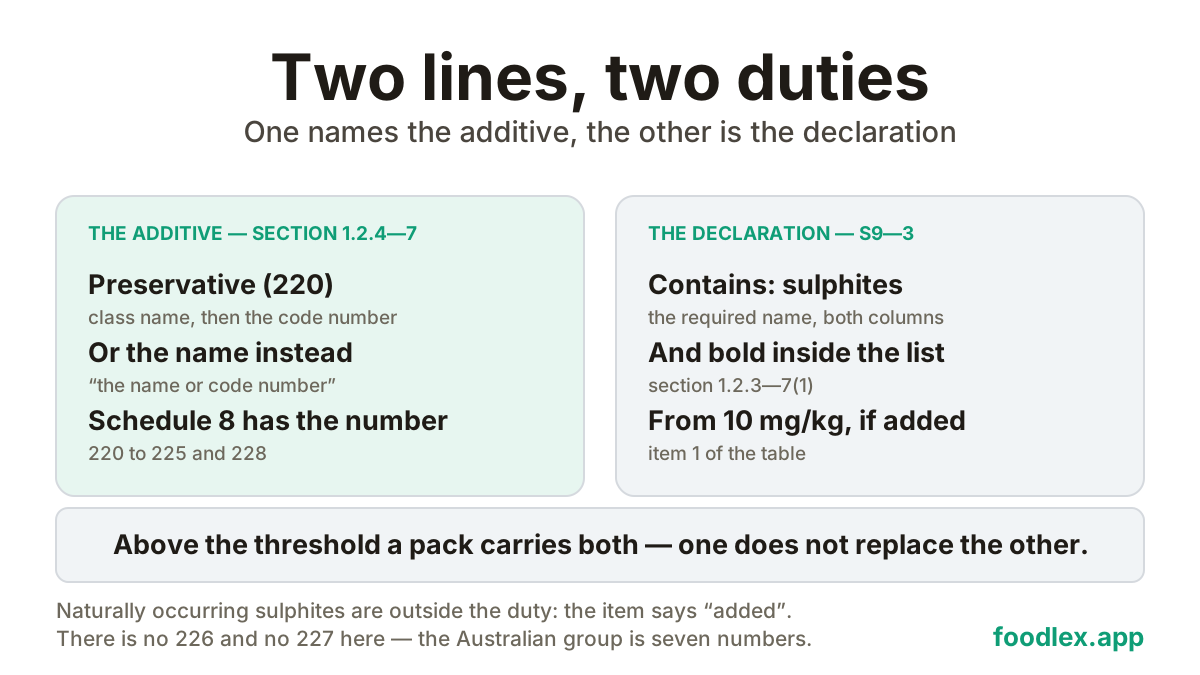
Diagram: Foodlex. Australia New Zealand Food Standards Code, sections 1.2.4—7, 1.2.3—6 and Schedule 9, section S9—3.
The second duty is the mandatory declaration in Division 3 of Standard 1.2.3, the same division that carries the allergen rules. It does not care what the additive is called. It asks for one word.
The trigger: added sulphites, 10 mg/kg or more
Item 1 of the table to section S9—3 reads, in full:
“added sulphites in concentrations of 10 mg/kg or more”
Two words in that line do a lot of work. Added — sulphites that occur naturally in a food are outside the duty. And or more — a product at exactly 10 mg/kg is inside it. The exemption column of the table is empty for this item: there is no food, and no process, that escapes it.
The trigger in section 1.2.3—4(5) is wider than the ingredient list. Sulphites count when they are present as an ingredient, as an ingredient of a compound ingredient, as a substance used as a food additive, or as a substance used as a processing aid. A sulphited dried fruit that goes into a muesli bar brings its declaration with it.
Where the word has to stand
Section 1.2.3—6(2) puts the declaration in two places at once,
and section 1.2.3—5 gives the required name for each: Column 3 of the
table for the statement of ingredients, Column 4 for everywhere else. For
sulphites both columns say the same thing — sulphites.
- In the statement of ingredients, in a bold font that “provides a distinct contrast” and never smaller than the rest of the list (section 1.2.3—7(1)).
- In the summary statement, which must “commence with the word Contains” and “contain no other words”, in the same field of view as the ingredient list and directly next to it (section 1.2.3—7(3) and (4)).
So a biscuit with sulphited apricots reads
Preservative (sulphites, 223) in the list and
Contains: Sulphites underneath it. The same mechanism as every other
declarable food — set out in
allergen labelling in Australia.
The numbers: seven, not nine
Schedule 8 gives each additive its code number. The sulphite family is seven entries:
| Code number | Name in Schedule 8 |
|---|---|
220 | Sulphur dioxide |
221 | Sodium sulphite |
222 | Sodium bisulphite |
223 | Sodium metabisulphite |
224 | Potassium metabisulphite |
225 | Potassium sulphite |
228 | Potassium bisulphite |
There is a gap where other jurisdictions have two more. 226 and
227, the calcium sulphites, have no entry in Schedule 8 and do
not appear in the sulphite group of Schedule 15 either — every permission
there is written as “220 221 222 223 224 225 228”. A label printed for
the European market that says E226 has no Australian counterpart to
fall back on.
How much is allowed
The declaration threshold and the permitted level are different numbers with different jobs. Schedule 15 sets the maximum permitted level per food category; the figures are milligrams per kilogram:
| Food category (Schedule 15) | Maximum permitted level |
|---|---|
| 4.3.1 Dried fruits and vegetables — other than desiccated coconut | 3 000 |
| 4.3.1 Desiccated coconut | 50 |
| 4.3.2 Fruits and vegetables in vinegar, oil, brine or alcohol | 750 |
| 4.1.3.2 Peeled and cut root and tuber vegetables | 50 |
| 4.3.0.1 Ginger | 20 |
| 7.2 Biscuits, cakes and pastries | 300 |
| 8.3.2 Sausage and sausage meat containing raw, unprocessed meat | 500 |
| 9.1.2 Uncooked crustacea | 100 |
| 9.2.1 Cooked crustacea | 30 |
| 14.1.2 Fruit and vegetable juices | 115 |
| 14.2.2 Wine — more than 35 g/L residual sugars | 400 |
| 14.2.2 Wine — less than 35 g/L residual sugars | 250 |
| 14.2.4 Cider, perry, fruit wine — more than 5 g/L residual sugars | 300 |
| 14.2.4 Cider, perry, fruit wine — less than 5 g/L residual sugars | 200 |
Dried fruit is the outlier, and that is why a bag of dried apricots is the product people ask about. At 3 000 mg/kg the permitted level is three hundred times the declaration threshold.
Wine, where there is no ingredient list
Section 1.2.4—2(3) says a statement of ingredients is not required for a standardised alcoholic beverage. The note under it is the part that matters:
“Despite subsection (3), the presence of some ingredients must be declared—see Standard 1.2.3.”
Section 1.2.3—6(3) then switches off the two-place mechanism for exactly these
foods, which leaves subsection (1): the declaration “must be made by
stating the *required name of the food to be declared”. For a label without an
ingredient list the required name comes from Column 4 — and that word is
sulphites.
Preservative (220) on its own is therefore the additive’s name,
not the required name. Australian wine labels that carry both —
Preservative (220) and Contains sulphites — are doing
the straightforward thing.
How this differs from the EU and Great Britain
The threshold looks the same at a glance and is not:
| Australia | EU and Great Britain | |
|---|---|---|
| Wording | “added sulphites in concentrations of 10 mg/kg or more” | “Sulphur dioxide and sulphites at concentrations of more than 10 mg/kg or 10 mg/litre” |
| At exactly 10 mg/kg | declare | no declaration |
| Naturally occurring | outside the duty — only added counts | no such limitation in the wording |
| Basis | mg/kg | total SO2, as ready for consumption or reconstituted |
| Required wording | sulphites, in the list and in the Contains statement |
the Annex II name, emphasised inside the list |
One recipe, two labels, and the difference is a single word in each direction. If you sell into both markets, the allergen checker shows what each one asks for.
Frequently asked questions
Is preservative 220 the same as sulphites?
220 is the code number for sulphur dioxide in Schedule 8. It is one of the
sulphites and the one used most often. Writing Preservative (220) names
the additive; the required name for the mandatory declaration is
sulphites.
At what level do sulphites have to be declared in Australia?
At 10 mg/kg or more, and only for sulphites that were added. Ten milligrams per kilogram is inside the duty, not outside it.
Does Australian wine have to say sulphites?
Yes, by the word itself. Wine needs no statement of ingredients, but the mandatory
declaration survives that exemption, and the required name for a declaration outside
an ingredient list is sulphites.
How much sulphite may dried apricots contain?
Schedule 15 allows 3 000 mg/kg for dried fruit and vegetables other than desiccated coconut, which is capped at 50. That is the ceiling for the additive, not the point at which the label has to say anything.
This article is general information and does not replace legal advice. Quoted from the Australia New Zealand Food Standards Code on the Federal Register of Legislation: Standard 1.2.3 (F2015L00397, Compilation 6), Standard 1.2.4 (F2015L00392, Compilation 2), Schedule 8 (F2015L00478, Compilation 8), Schedule 9 (F2015L00479, Compilation 2) and Schedule 15 (F2015L00439, Compilation 16). The European wording is Annex II of Regulation (EU) No 1169/2011.