Blog & guides

Australian food labelling, explained plainly

Practical guides to the Australia New Zealand Food Standards Code — for anyone who makes, packs or sells packaged food here. Working out a panel rather than reading about one? The nutrition information panel calculator does the arithmetic. Every requirement is quoted from the Code as registered on the Federal Register of Legislation, with the compilation number, so you can check it.

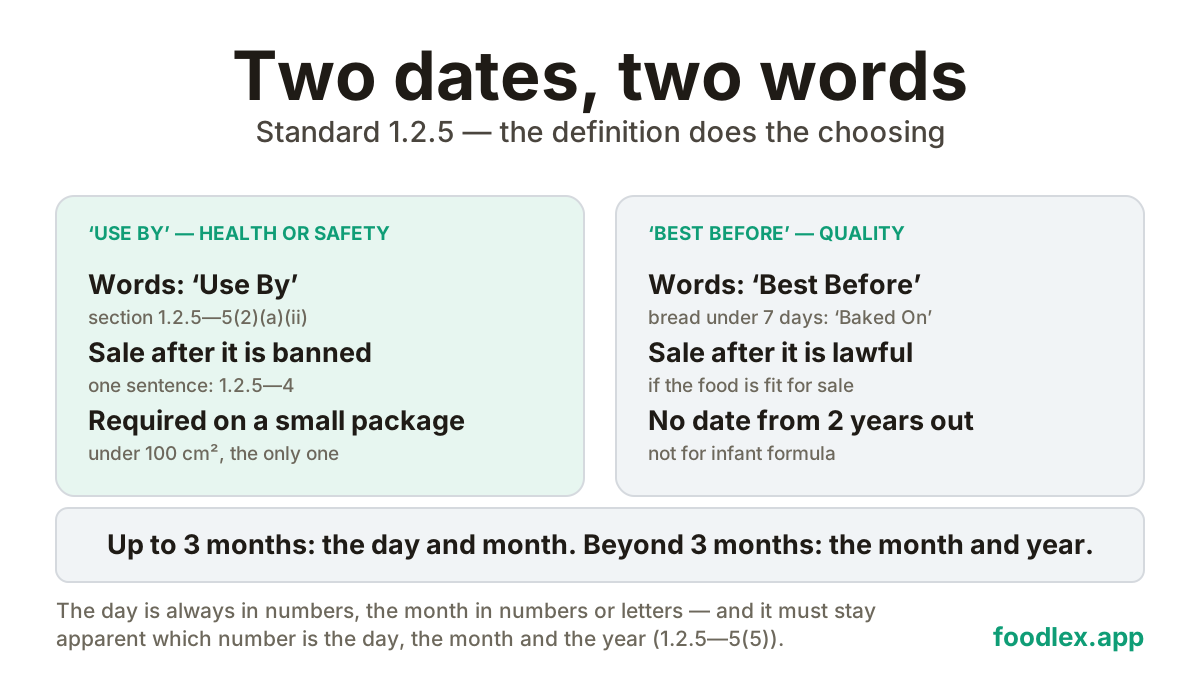
Diagram: the two Australian date marks. On the left the use-by date — the date after which the food should not be consumed for health or safety reasons, printed as the words Use By, and sale after it is prohibited by section 1.2.5—4. On the right the best-before date — the date up to which the food remains fully marketable, printed as the words Best Before, with sale after it still permitted. Beneath both: for a date not more than three months away the day and month suffice, beyond three months the month and year.
The most-searched question first: which of the two dates goes on the pack, and what the Code lets you write. In full in date marking in Australia.
Diagram: Foodlex. Australia New Zealand Food Standards Code, Standard 1.2.5 (F2015L00401, Compilation 3).

Selling into the European Union as well? The English blog covers Regulation (EU) No 1169/2011 — the fourteen allergens, the nutrition declaration, minimum font size and date marking — across thirty-four guides.

Labelling in Australia, from the Code

Packaged food sold in Australia and New Zealand is labelled under the Australia New Zealand Food Standards Code, administered by Food Standards Australia New Zealand. Three parts of it come up almost every time. Standard 1.2.8 with Schedule 12 sets the nutrition information panel and the format it has to follow. Standard 1.2.3 with Schedule 9 governs the allergen declarations, including the required names and the Contains statement. Standard 1.2.10 asks for the percentage of a characterising ingredient where one is named or pictured.

These guides are written for bakeries, small manufacturers, caterers and anyone putting a first packaged product on the shelf — not for lawyers. Each one works through a single requirement, says what it means for a real label, and quotes the Code as registered on the Federal Register of Legislation, with the compilation number and the date of the version, so you can check every sentence against the source.

Two differences from Europe are worth knowing before you read on. Australia counts sugars and sodium where the EU asks for sugars and salt, and it uses serving-size columns alongside the per-100 g column. The Health Star Rating is voluntary, like the Nutri-Score, but it is calculated differently. If you would rather not do the arithmetic by hand, the panel calculator builds the panel from a recipe.