Food law – simplified

Calculate nutrition values.
Build food labels.
Mark allergens automatically.

Foodlex takes the repetitive part of food information off your desk — for bakeries, caterers and small manufacturers. It calculates from over 7,000 entries of the official German nutrient database (Bundeslebensmittelschlüssel, BLS 4.0) and builds labels in the structure that Regulation (EU) No 1169/2011 on the provision of food information to consumers (FIC Regulation) sets out.

No credit card. Nothing to install. Runs in your browser.
The interface and the labels are available in English, German and French.

  • Bundeslebensmittelschlüssel 4.0
  • EU 1169/2011
  • 14 Annex II allergens

Food information eats hours you do not have

Pulling nutrition figures together in a spreadsheet. Checking every ingredient against the allergen list by hand. Formatting a label that will hold up in an inspection. One miscalculated sugar figure, one allergen missed — and it gets expensive. Those are exactly the steps Foodlex automates.

From recipe to label in 40 seconds

Screen recording from Foodlex, English interface. No sound — every step is on screen.

What Foodlex does for you

Nutrition calculation

7,140 entries of the Bundeslebensmittelschlüssel (BLS 4.0) built in, with the USDA database and the CIQUAL table of the French agency ANSES switchable alongside. Add your own ingredients with your own values. The nutrition declaration is calculated from your recipe.

Labels to the FIC structure

Ingredients in descending order of weight, allergen names emphasised, nutrition values per 100 g — the layout Regulation (EU) No 1169/2011 prescribes. Print-ready at the press of a button.

Allergen marking

All 14 substances and products listed in Annex II of the FIC Regulation are derived from your ingredients and emphasised in the ingredients list — no more manual cross-checking.

Nutri-Score

The Nutri-Score is derived from the calculated nutrition values using the updated 2025 algorithm — with its own rules for beverages, fats and red meat. You confirm the share of fruit and vegetables per ingredient. It is a voluntary additional form of presentation under Article 35 of the FIC Regulation, not a mandatory particular. Included from the Pro plan (and during the trial).

Weekly planning

Plan dishes across the week and generate a consolidated shopping list with quantities — made for catering and large kitchens.

Team & cloud

Work with your team in a shared workspace. Data syncs through the cloud — or stays purely local in your browser if you prefer.

API for your own systems

Nutrition values, allergens and the ingredient list as JSON — for your ERP, your shop or a tool of your own, without anyone retyping figures. Included from the Pro plan. Read the API reference

What ends up on the pack

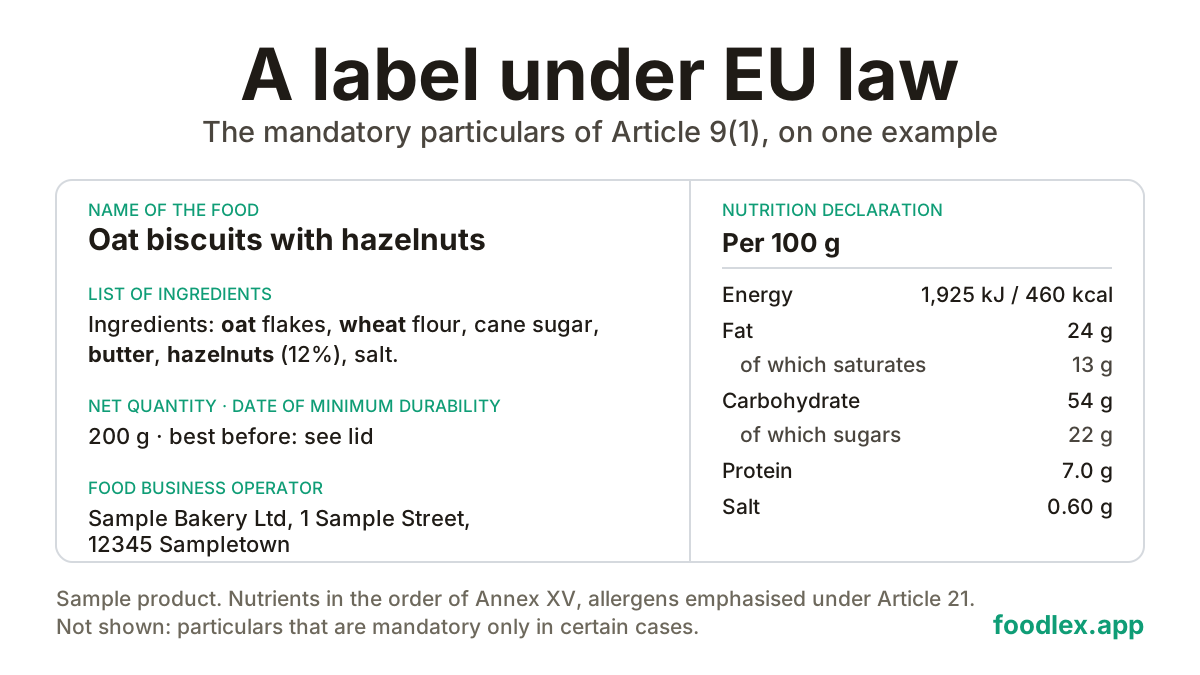
Sample label of an oat biscuit: name of the food, list of ingredients with the
                   allergens oat, wheat, butter and hazelnuts emphasised in bold, net quantity 200 g,
                   date of minimum durability, address of the food business operator and the
                   nutrition declaration per 100 g from energy to salt.
One example carrying everything Article 9(1) of Regulation (EU) No 1169/2011 requires for a prepacked food: name, list of ingredients, quantity, net quantity, date of minimum durability, address and nutrition declaration. The allergens are emphasised under Article 21. This is the label Foodlex builds from your recipe.
Diagram: Foodlex. Sample product, invented figures.

Built for everyday practice

  • Bakeries & patisseries Nutrition and allergen information for baked goods, without an external lab.
  • Restaurants & cafés Allergen information for menus and daily specials — without the spreadsheet chaos.
  • Catering & large kitchens Weekly plans, shopping lists and consistent labelling for every batch.
  • Canteens & institutional catering Menu plans and an allergen matrix for staff restaurants, schools, clinics and care homes.
  • Food manufacturers Labels you can reproduce exactly the same way for the next batch.
  • Universities & teaching Nutrition science, food chemistry and dietetics — as a tool for teaching and coursework. Students use Foodlex free of charge.

Three steps to a finished label

  1. 1

    Pick your ingredients

    Search the Bundeslebensmittelschlüssel or create your own ingredients.

  2. 2

    Build the recipe

    Enter the quantities — nutrition values and allergens are calculated as you go, and the Nutri-Score from the Pro plan.

  3. 3

    Generate the label

    A print-ready label in the FIC structure — ready to stick on the pack.

Frequently asked questions

Is Foodlex available in English?

Yes. The interface and the labels it produces are available in English, and also in German and French. Ingredient names come from the built-in databases — all 7,140 entries of the German Federal Food Code carry an English name, and the USDA and CIQUAL tables are English throughout.

What does Foodlex put on the label?

The ingredients in descending order of weight, the Annex II allergen names emphasised so that they are clearly distinguished from the rest of the list, and a nutrition declaration per 100 g with the energy value and the amounts of fat, saturates, carbohydrate, sugars, protein and salt.

Under Article 8(2) of Regulation (EU) No 1169/2011 the food business operator responsible for the food information “shall ensure the presence and accuracy of the food information”. Foodlex produces the formatted basis; it does not carry that responsibility for you and does not replace a specialist review.

Which data does Foodlex calculate with?

The default is the Bundeslebensmittelschlüssel (BLS 4.0), the official German nutrient reference database, with 7,140 entries. The USDA database (6,860 entries) and the CIQUAL table of the French agency ANSES (3,484) can be switched on alongside it. Ingredients of your own, with values of your own, can be added.

What does Foodlex cost?

There is a free plan at no cost, plus the paid plans Starter (9 € per month), Pro (19 € per month) and Team (39 € per month). The full BLS, USDA and CIQUAL databases are included in every plan, and students at participating universities use Foodlex free of charge — if yours is not on the list yet, one email from a university address is enough to add it. All prices are final prices: Foodlex invoices under the German small-business rule (§ 19 UStG), so no VAT is shown. The full breakdown is on the pricing page.

Do I have to install anything?

No. Foodlex runs in the browser and can optionally be added to the home screen of a tablet or phone. It also works offline.

What happens to my data?

You decide: data can stay purely local in your browser, or sync to a cloud workspace shared with your team. You can export your data as a backup at any time.

Free tools — no sign-up

Three small helpers that run in your browser — a taste of what Foodlex automates for your label.

Nutrition calculator

The nutrition table per 100 g from your recipe, on the official BLS 4.0 data.

Open

Allergen checker

Check an ingredients list against the 14 Annex II allergens — marked instantly.

Open

kJ ↔ kcal converter

Convert energy between kcal and kJ (1 kcal = 4.184 kJ).

Open

Outside the EU?

Foodlex calculates and formats to Regulation (EU) No 1169/2011 — the EU rules — and to three more markets you can switch to. Australia, since 27 September 2026: a Nutrition Information Panel to Schedule 12 on Australian ingredient data. The United States, since 5 October 2026: a Nutrition Facts panel to 21 CFR 101.9 on USDA data. The United Kingdom, also since 5 October 2026: an English label calculated on the UK composition tables (CoFID) — what that means for UK labels. Foodlex does not produce Canadian labels.

Which market we add next is not decided. The honest way to decide it is to ask.

Tell us which rules you need

Pick the rules your labels have to follow. Anonymous — no email, no cookie, nothing but the choice itself.

Rather just write? kontakt@foodlex.app

Start with Foodlex for free

No risk, no credit card — with the free plan that stays free.

Get started