
Guide · Nutrition Facts
How to read a Nutrition Facts label
The panel looks like a table of measurements. It is closer to a legal document: every line has a rule behind it, several of the numbers are not what they appear to be, and four of them carry no percentage for reasons that have nothing to do with nutrition. Here is the panel line by line, with the rule beside each one — quoted from 21 CFR 101.9.
Start at the top, because the top governs everything below
Two lines sit above the bar, and both change the meaning of every number under it.
“8 servings per container”
Required by 101.9(d)(3)(i), in type no smaller than 10 point. It is the only number on the panel that tells you how the package relates to the figures — and the one people skip.
“Serving size 2/3 cup (55g)”
This is not a recommendation, and it is not the manufacturer’s choice. 101.9(b)(2):
“serving size declared on a product label shall be determined from the ‘Reference Amounts Customarily Consumed Per Eating Occasion …’ (reference amounts) that appear in § 101.12(b)”
§ 101.12(b) is a table of roughly 140 food categories with a reference amount for each. The word that does the work is customarily consumed — it describes how much people actually eat at a sitting, not how much they should. That is why some serving sizes look generous: they are descriptive, not aspirational, and they exist so that two competing products can be compared on the same basis.
The household measure comes first and the metric weight in parentheses. Two consequences worth knowing:
- A small package can be one serving whether or not that is convenient. 101.9(b)(6): a product sold individually containing less than 200 % of the reference amount “must be considered to be a single-serving container, and the entire content of the product must be labeled as one serving”.
- Between 200 and 300 % you get two columns. 101.9(b)(12)(i) requires an additional column with the figures for the whole container — the rule behind those dual-column panels on a 20 oz bottle.
Calories, and why they jump in fives and tens
101.9(c)(1), in full:
“Caloric content shall be expressed to the nearest 5-calorie increment up to and including 50 calories, and 10-calorie increment above 50 calories, except that amounts less than 5 calories may be expressed as zero.”
So no panel has ever said 237 calories. It says 240. And a drink with 4.9 calories per serving may say 0 — which is how a “zero calorie” beverage can still carry energy.
The rounding is where the surprises live
Every line has its own increment, and every line has a threshold below which zero is allowed. The thresholds apply to the unrounded value, which is the detail that produces the odd-looking labels.
| Line | Rounded to | May be printed as 0 below |
|---|---|---|
| Calories | 5 up to 50, then 10 | 5 |
| Total Fat, Saturated Fat, Trans Fat | 0.5 g below 5 g, then 1 g | 0.5 g |
| Cholesterol | 5 mg | 2 mg |
| Sodium | 5 mg up to 140 mg, then 10 mg | 5 mg |
| Carbohydrate, Fiber, Sugars, Protein | 1 g | 0.5 g |
“0 g of trans fat” can mean 0.49 g. Three servings of that product carry nearly a gram and a half, and every one of them is labelled zero. That is not a loophole somebody found; it is what 101.9(c)(2)(ii) says.
Cholesterol has a sentence instead of a number in the middle: above 2 mg and below 5 mg, the panel reads less than 5mg rather than a figure.
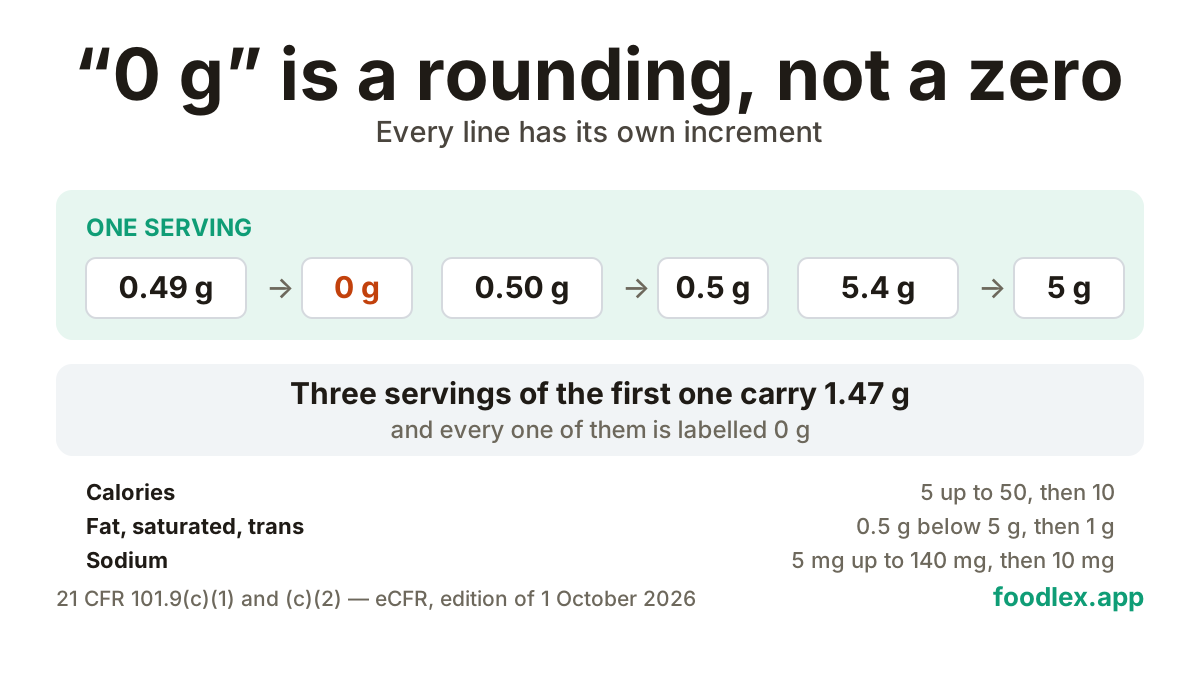
Diagram: Foodlex. 21 CFR 101.9(c)(1) and (c)(2), eCFR edition of 1 October 2026.
The four lines with no percentage
Most lines end in a % Daily Value. Four do not, and each for a different reason:
| Line | Why no percentage |
|---|---|
| Calories | Not a nutrient with a reference value; the footnote carries the 2,000-calorie figure instead |
| Trans Fat | No Daily Reference Value exists — there is no intake level to divide by |
| Total Sugars | Same: a DRV was set for added sugars only |
| Protein | 101.9(c)(7) makes it optional, and it would have to be worked out from a corrected amount (PDCAAS), not a division |
A missing percentage is therefore information in itself: it means no agreed daily amount exists, not that the nutrient does not matter. We work through the column itself in what % Daily Value means.
Total sugars and added sugars are two different measurements
The indented pair confuses more people than anything else on the panel. 101.9(c)(6)(ii) defines total sugars as “the sum of all free mono- and disaccharides (such as glucose, fructose, lactose, and sucrose)” — including the ones that were in the fruit or the milk to begin with.
Added sugars are the ones put in during processing, plus syrups and honey, plus juice concentrates “in excess of what would be expected from the same volume of 100 percent fruit or vegetable juice of the same type”. They get their own line, prefaced by a word the regulation prescribes:
“Added sugars content shall be indented under Total Sugars and shall be prefaced with the word ‘Includes’ followed by the amount (in grams) ‘Added Sugars’”
Hence “Includes 10g Added Sugars”. A plain yoghurt can show 12 g of total sugars and 0 g of added sugars; a sweetened one can show 12 g and 10 g. Same first number, very different product.
The bar near the bottom
Vitamin D, calcium, iron and potassium sit below a bar, separated from everything above — 101.9(d)(8). They are the four mandatory micronutrients, and they behave differently from the lines above them in two ways: the amount is rounded to the significance of the reference value rather than to a fixed increment, and the percentage uses 2/5/10-point steps instead of whole percent.
The vitamins that used to be mandatory — vitamin A and vitamin C — are now voluntary. If you see them, somebody chose to put them there.
The footnote is prescribed word for word
101.9(d)(9) does not describe the footnote, it dictates it:
“*The % Daily Value tells you how much a nutrient in a serving of food contributes to a daily diet. 2,000 calories a day is used for general nutrition advice.”
For a product represented as being for children 1 through 3 years of age, the sentence substitutes “1,000 calories”. The familiar “5 % is low, 20 % is high” rule of thumb is not in the regulation — it is FDA consumer guidance, and a useful one, but it is not part of the label.
Not every food has a panel
101.9(j) lists the exemptions. The one that matters to a small producer is (j)(18) — low-volume products of small businesses:
“… the person claiming the exemption employed fewer than an average of 100 full-time equivalent employees and fewer than 100,000 units of that product were sold in the United States”
Three conditions come with it, and each of them has ended an exemption for somebody: the claim has to be filed before the period it covers; the label, labeling and advertising must not carry a nutrient content or health claim; and if you outgrow the thresholds you have 18 months to comply. A single “good source of fiber” on the front of the pack costs the exemption.
Reading a panel in sixty seconds
- Servings per container — multiply everything else by it if you eat the pack.
- Serving size — compare it with what you actually take.
- Calories — remember the 10-calorie steps above 50.
- Any 0 g — could be up to 0.49 g.
- Total vs. added sugars — the gap is the processing.
- The four lines without a percentage — no reference value exists.
Frequently asked questions
What does the serving size on a label mean?
How much people customarily eat at one sitting, taken from the reference amounts in § 101.12(b) — not a recommendation and not a free choice.
Why does the label say 0 g of fat when there is fat in it?
Below 0.5 g per serving the regulation allows zero. 0.4 g prints as 0 g.
Which lines have no % Daily Value?
Calories, trans fat, total sugars and protein — each for its own reason.
What is the difference between total sugars and added sugars?
Total sugars include what was naturally in the food; added sugars are what was put in. Only added sugars carry a percentage.
Is 5 % a little and 20 % a lot?
That is FDA guidance, not part of the regulation. The prescribed footnote is the 2,000-calorie sentence.
Does every packaged food need a Nutrition Facts panel?
No — 101.9(j) lists the exemptions, including low-volume products of small businesses, which has to be claimed in advance and is lost by making a claim.
Wording quoted from 21 CFR 101.9 and 21 CFR 101.12 in the eCFR edition of 1 October 2026. Where this page mentions FDA consumer guidance, it says so — guidance is not the regulation. This page is information, not legal advice; the responsibility for a label stays with the business that puts the food on the market.