
Guide · Nutrition Facts
% Daily Value: what the right-hand column means
One column, two rounding rules, twelve reference values and four blanks. The % Daily Value is the most-read and least-understood part of a Nutrition Facts panel — and the one that most often comes out wrong when a label is built by hand, because almost everyone applies one rule where the regulation has two.
What it measures
Not your requirement. A fixed reference intake, the same for everyone, so that two products can be compared. The regulation puts the caveat on the label itself, in words it prescribes (101.9(d)(9)):
“*The % Daily Value tells you how much a nutrient in a serving of food contributes to a daily diet. 2,000 calories a day is used for general nutrition advice.”
A 25-year-old bricklayer and a 70-year-old office worker read the same 2,000. That is the point — it is a comparison scale, not personal advice.
🔴 There are two rounding rules, and they run side by side
This is the part that trips up spreadsheets. Which rule applies depends on which table the reference value comes from.
| Applies to | Source | Rounded to |
|---|---|---|
| Everything with a Daily Reference Value (fat, saturated fat, cholesterol, sodium, carbohydrate, fiber, added sugars) | 101.9(d)(7)(ii) | the nearest whole percent |
| Vitamins and minerals with an RDI (vitamin D, calcium, iron, potassium) | 101.9(c)(8)(iii) | 2 % steps up to 10 %, 5 % above 10 up to 50 %, 10 % above 50 % |
The second rule, in the regulation’s own words:
“The percentages for vitamins and minerals shall be expressed to the nearest 2-percent increment up to and including the 10-percent level, the nearest 5-percent increment above 10 percent and up to and including the 50-percent level, and the nearest 10-percent increment above the 50-percent level.”
That two rules exist is not an interpretation — FDA’s own sample label in 101.9(d)(12) only adds up with both. Four of its lines separate them cleanly:
| Line of the sample panel | Unrounded | Steps rule | Whole percent | Printed |
|---|---|---|---|---|
| Sodium 160 mg | 6.96 % | 6 % | 7 % | 7 % |
| Total Carbohydrate 37 g | 13.45 % | 15 % | 13 % | 13 % |
| Iron 8 mg | 44.4 % | 45 % | 44 % | 45 % |
| Potassium 235 mg | 5.00 % | 6 % | 5 % | 6 % |
Two lines need one rule, two need the other. Pick either rule alone and two lines of the regulation’s own label come out wrong.
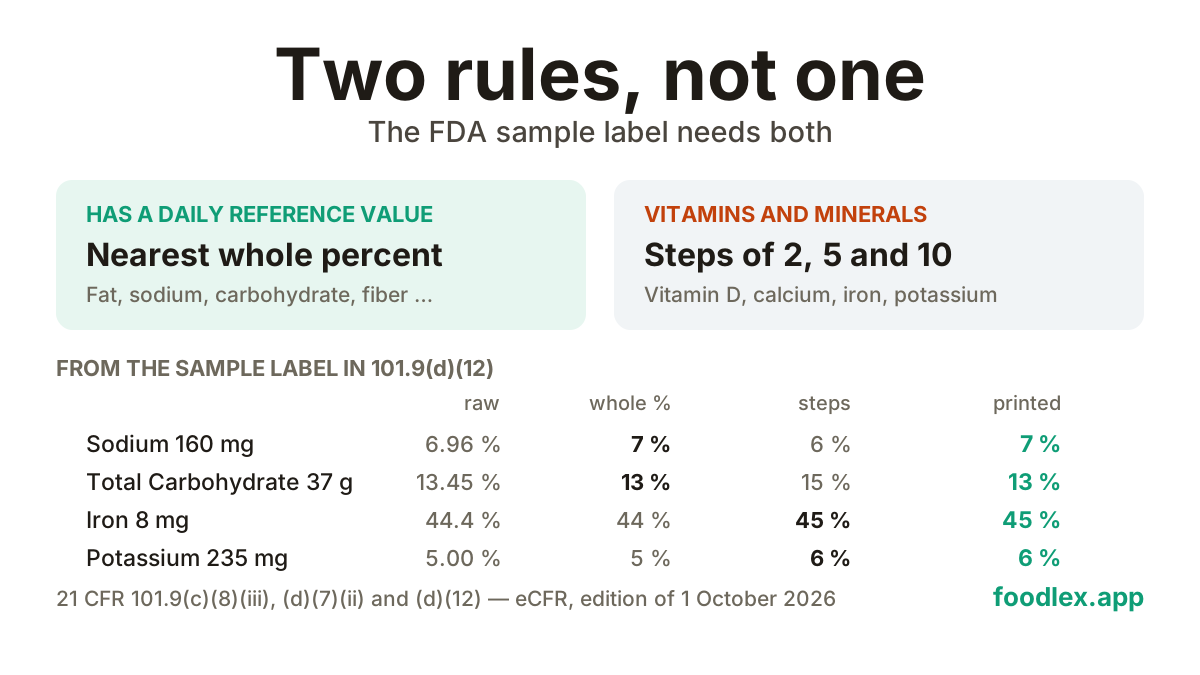
Diagram: Foodlex. 21 CFR 101.9(c)(8)(iii), (d)(7)(ii) and (d)(12), eCFR edition of 1 October 2026.
Calculate from the unrounded amount
101.9(d)(7)(ii) allows both, and then the choice matters:
“The percent shall be calculated by dividing either the amount declared on the label for each nutrient or the actual amount of each nutrient (i.e., before rounding) by the DRV for the nutrient”
Taking the unrounded figure is the better practice, because otherwise one rounding feeds into another. With sodium it is visible straight away: 159.995 mg prints as 160mg, and 159.995 ÷ 2300 is 6.956 %, which rounds to 7 %. Round the milligrams first and you divide 160 by 2300 — 6.957 %, still 7 %. But at 142 mg the two routes part company, because the milligram figure jumps in tens above 140.
The numbers it divides by
Two tables, both in the regulation: the Daily Reference Values in 101.9(c)(9) and the Reference Daily Intakes in 101.9(c)(8)(iv). For adults and children of 4 years and older:
| Nutrient | Reference value | Table |
|---|---|---|
| Total Fat | 78 g | DRV |
| Saturated Fat | 20 g | DRV |
| Cholesterol | 300 mg | DRV |
| Sodium | 2,300 mg | DRV |
| Total Carbohydrate | 275 g | DRV |
| Dietary Fiber | 28 g | DRV |
| Added Sugars | 50 g | DRV |
| Protein | 50 g | DRV |
| Vitamin D | 20 mcg | RDI |
| Calcium | 1,300 mg | RDI |
| Iron | 18 mg | RDI |
| Potassium | 4,700 mg | RDI |
⚠️ Both tables have four columns, not one. Infants through 12 months, children 1 through 3 years, and pregnant or lactating women have their own values, and they differ sharply — potassium is 4,700 mg for adults and 700 mg for infants. A product represented as being for one of those groups uses that group’s column.
The four blanks
A missing percentage is information, not an omission. Four lines carry none, and the reasons differ:
| Line | Why |
|---|---|
| Calories | Not a nutrient with a reference value — the 2,000-calorie figure lives in the footnote instead |
| Trans Fat | No DRV exists; there is no agreed daily amount to divide by |
| Total Sugars | The DRV was set for added sugars only |
| Protein | Optional under (c)(7); the figure would have to come from the corrected amount in (c)(7)(ii), a protein quality calculation rather than a division |
Protein is the interesting one. A DRV of 50 g exists — it is in the table above — but the regulation does not let you simply divide by it. Declaring a protein percentage brings a PDCAAS calculation with it, which is why the great majority of panels leave that cell empty.
The panel this column sits in is itself only one of the things a US package has to carry — the other five are in US food label requirements.
What “below 2 %” does to a micronutrient line
101.9(c)(8)(iii) also sets a floor. Quantitative amounts and percentages of vitamins and minerals present at less than 2 % of the RDI need not be declared at all; instead the panel may carry “Not a significant source of—” followed by the names.
The same paragraph prevents an absurdity in the other direction: it allows “additional levels of significance … when the number of decimal places indicated is not sufficient to express lower amounts”. Without that, a panel could print Vitamin D 0mcg next to 2% — a zero beside a percentage above zero.
Where this goes wrong in practice
- One rule for all fifteen lines. The commonest error, and it shows up on four lines of the FDA’s own sample label.
- Rounding twice. Divide the printed gram figure and the rounding compounds.
- The adult column for a toddler product. Four columns exist; only one of them is yours.
- A percentage next to trans fat or total sugars. There is no reference value to produce one.
Frequently asked questions
What does % Daily Value actually mean?
What one serving contributes to a day’s intake against a fixed reference, not against your own requirement.
Is the percentage worked out from the number printed on the label?
Either is permitted; the unrounded amount is the better practice, because otherwise one rounding feeds into another.
Why do some percentages go 2, 4, 6 and others 1, 2, 3?
Two rules: whole percent for anything with a DRV, 2/5/10-point steps for vitamins and minerals.
Which reference values are used?
The twelve in the table above, for adults and children of 4 years and older.
Why does protein have no percentage?
It is optional, and it would require the corrected amount under (c)(7)(ii).
Is 5 % low and 20 % high?
FDA guidance, not part of the regulation.
Wording and figures quoted from 21 CFR 101.9 in the eCFR edition of 1 October 2026. Where this page refers to FDA consumer guidance it says so — guidance is not the regulation. This page is information, not legal advice; the responsibility for a label stays with the business that puts the food on the market.