
Basics · Labelling
US food label requirements: the five things every package needs
US food labelling law is written backwards from what you might expect. It does not list what a label must have; it lists what makes a food misbranded, and you work out the label from the absences. Five elements come out of that list, each from its own paragraph of the Act. Here they are, with the statutory wording beside them.
The frame: 21 U.S.C. § 343
The section is headed “Misbranded food” and every paragraph begins the same way — a food shall be deemed misbranded if… or unless…. That phrasing is why the rules can feel scattered: the ingredient list is in paragraph (i), the net quantity in (e), allergens in (w), nutrition in (q). Collected, they come to five things plus the panel.
1. The name of the food
§ 343(i) requires a label bearing
“(1) the common or usual name of the food, if any there be”
Not a brand name and not a marketing name. If the food has a standard of identity — mayonnaise, peanut butter, chocolate — § 343(g) requires the name from that standard, and the food has to conform to it. Call something mayonnaise and you have accepted the standard that comes with the word.
2. The net quantity of contents
§ 343(e) covers two of the five in one sentence:
“If in package form unless it bears a label containing (1) the name and place of business of the manufacturer, packer, or distributor; and (2) an accurate statement of the quantity of the contents in terms of weight, measure, or numerical count”
The quantity statement belongs on the principal display panel, in the lower 30 percent, with both US customary and metric units. It is a net quantity — the food, not the packaging.
3. The ingredient list
Same paragraph as the name, § 343(i):
“(2) in case it is fabricated from two or more ingredients, the common or usual name of each such ingredient … except that spices, flavorings, and colors not required to be certified … may be designated as spices, flavorings, and colorings without naming each”
The descending-order-by-weight rule is not in the statute — it is in 21 CFR 101.4(a)(1). Two things about the grouping permission are worth keeping in mind:
- It applies to spices, flavourings and uncertified colours. Certified colours must be named individually — FD&C Yellow No. 5 and the rest.
- It does not survive an allergen. § 343(w)(4) overrides it expressly, so a flavouring carrying milk protein still produces a milk declaration. The detail is in the Big 9 allergens.
4. The allergen declaration
§ 343(w) requires either a “Contains” statement after or adjacent to the ingredient list, or the food source in parentheses inside it. Nine foods are covered, and for tree nuts, fish and crustaceans the species is required rather than the group. The whole subsection is worked through in its own guide; what matters here is that it is a separate duty from the ingredient list, not a part of it.
5. The name and place of business
Also § 343(e)(1), quoted above. Where the firm named is not the manufacturer, the relationship has to be stated — “Distributed by”, “Manufactured for”. A street address may be omitted if the firm is listed in a current city or telephone directory.
And then: the Nutrition Facts panel
Required by § 343(q) and detailed in 21 CFR 101.9: fifteen entries in a prescribed order, with increment rounding and a % Daily Value column. We take it apart in how to read a Nutrition Facts label, and the label maker builds one from your own figures.
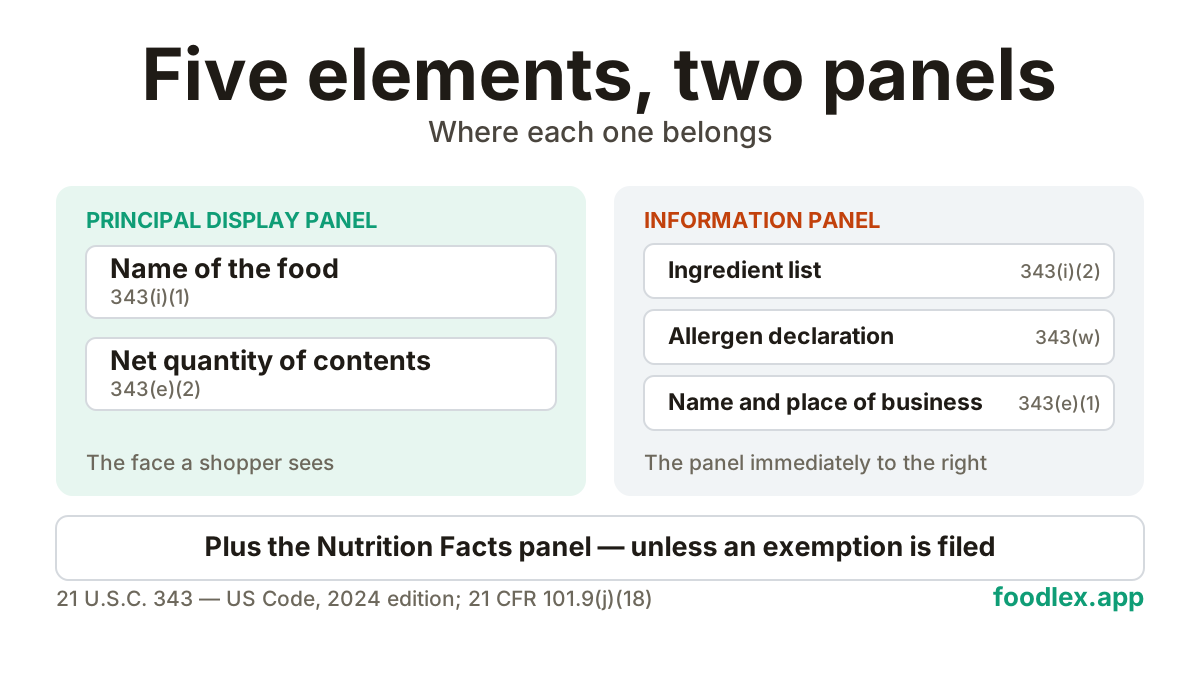
Diagram: Foodlex. 21 U.S.C. § 343, US Code 2024 edition; 21 CFR 101.9(j)(18).
Which panel does what
US labelling divides the package into two named areas, and the division decides where each element goes.
| Panel | What it is | What goes there |
|---|---|---|
| Principal display panel | The part of the label most likely to be displayed to the consumer | Name of the food; net quantity statement |
| Information panel | The panel immediately to the right of the principal display panel | Ingredient list; allergen declaration; Nutrition Facts; name and place of business |
Over all of it sits § 343(f), the prominence rule, which is the one that catches designs rather than content:
“If any word, statement, or other information required … is not prominently placed thereon with such conspicuousness (as compared with other words, statements, designs, or devices, in the labeling) and in such terms as to render it likely to be read and understood by the ordinary individual under customary conditions of purchase and use.”
The exemption that is easier to lose than to get
Small producers often hear that they do not need a nutrition panel. Sometimes true — 21 CFR 101.9(j)(18) exempts low-volume products:
“… the person claiming the exemption employed fewer than an average of 100 full-time equivalent employees and fewer than 100,000 units of that product were sold in the United States”
Three conditions travel with it, and each has ended somebody’s exemption:
- It must be filed in advance — before the 12-month period it covers. There is no retrospective claim.
- No nutrient content or health claim anywhere in the label, labeling or advertising. One “good source of fiber” on the front of the pack ends it.
- Outgrowing it starts a clock. Cross either threshold and you have 18 months to comply.
Note also what the exemption does not touch: name, net quantity, ingredient list, allergens and business address stay mandatory for every packaged food, whatever its volume.
Where a US label and an EU label part company
| United States | European Union | |
|---|---|---|
| Allergens | 9, in a “Contains” statement or parentheses | 14, emphasised inside the ingredient list |
| Nutrition | Per serving, 15 entries, calories | Per 100 g, 7 entries, kJ and kcal |
| Sodium or salt | Sodium, mg | Salt, g |
| Quantitative ingredient declaration | Only where a claim or the name makes it necessary | QUID: percentage for emphasised ingredients |
| Date marking | Not federally required for most foods (infant formula aside) | Mandatory “use by” or “best before” |
| Minimum type size | Set per element by regulation | General x-height of 1.2 mm |
The date line surprises most European producers: there is no general federal requirement for a best-before date on packaged food in the United States. State law and retailer policy fill the gap, which is why the dates you see are not uniform.
A draft-check you can run in ten minutes
- Is the name of the food the common or usual name — and if there is a standard of identity, does the product conform?
- Is the net quantity on the principal display panel, in both unit systems?
- Is the ingredient list in descending order by weight, with certified colours named individually?
- Is the allergen declaration complete, with species for nuts, fish and crustaceans?
- Is the business name and address there, with the relationship stated if it is not the manufacturer?
- Does the product need a Nutrition Facts panel — and if you are relying on an exemption, was it filed, and does the label avoid every claim?
Frequently asked questions
What has to be on a US food label?
Name of the food, net quantity, ingredient list, allergen declaration, and the name and place of business — plus a Nutrition Facts panel unless an exemption applies.
Which information goes on the front of the pack?
Name and net quantity on the principal display panel; the rest may go on the information panel beside it.
In what order do ingredients go?
Descending order of predominance by weight, under 21 CFR 101.4(a)(1).
Do I need a Nutrition Facts panel if I am a small business?
Possibly not — but the exemption has to be filed in advance and is lost by any nutrient content or health claim.
Does a nutrient content claim change anything?
Yes: it ends the exemption, and the claim itself must meet its own regulatory definition.
How prominent does the required information have to be?
Prominent enough to be “likely to be read and understood by the ordinary individual” — § 343(f) — with type sizes set per element by regulation.
Wording quoted on 21 October 2026 from 21 U.S.C. § 343 (US Code, 2024 edition, govinfo.gov) and from 21 CFR 101.9 in the eCFR edition of 1 October 2026. Meat, poultry and egg products are regulated by USDA rather than FDA and follow different rules; alcoholic beverages largely fall to TTB. This page is information, not legal advice — the responsibility for a label stays with the business that puts the food on the market.