
Guide · Date marking
Date marking in Australia — when a use-by date is compulsory, and what the Code lets you write
Two dates, four permitted forms of words, and one sentence that makes a sale unlawful. Standard 1.2.5 is three pages long and settles more than most people expect: not only which date goes on the pack, but the exact wording, how much of the date you have to print, and the three cases where no date is needed at all. Everything below is from the Standard itself.
Where the rule lives
Date marking is one item on the list of things a packaged food label has to carry. Section 1.2.1—8 sets that list, and item (f) of its general requirements is “date marking information (see section 1.2.5—3)”. Everything about what that information is sits in Standard 1.2.5, and that is the Standard quoted throughout this article. The rest of the list is in food labelling requirements in Australia.
The Code defines the two dates — and the definition does the choosing
A frequent misreading is that a business picks between a best-before date and a use-by date. It does not. Section 1.2.5—2 defines both, and the definitions describe two different situations:
“use-by date, for a food for sale, means the date after which it is estimated that the food for sale should not be consumed because of health or safety reasons, if the food for sale: (a) remains in an intact package during its storage; and (b) is stored in accordance with any storage conditions applicable under Standard 1.2.6.”
“best-before date, for a food for sale, means the date up to which the food for sale will remain fully marketable and will retain any specific qualities for which express or implied claims have been made …”
Then section 1.2.5—3(1) says which one goes on the label: “if there is a use-by date for the food—that date; or otherwise—any of: the best-before date of the food; or for bread that has a shelf life of less than 7 days: the best-before date; or the baked-for date; or the baked-on date.”
Read the two provisions together and the order of work becomes clear: first decide whether, for health or safety reasons, your food should not be eaten after a certain date. If it should not, that date is a use-by date, and 1.2.5—3(1)(a) then requires it. There is nothing left to choose. That reading follows from the definition rather than from an express list — the Code names no products that must carry a use-by date. What it does instead is define the term so that the assessment lands with the business that knows the product.
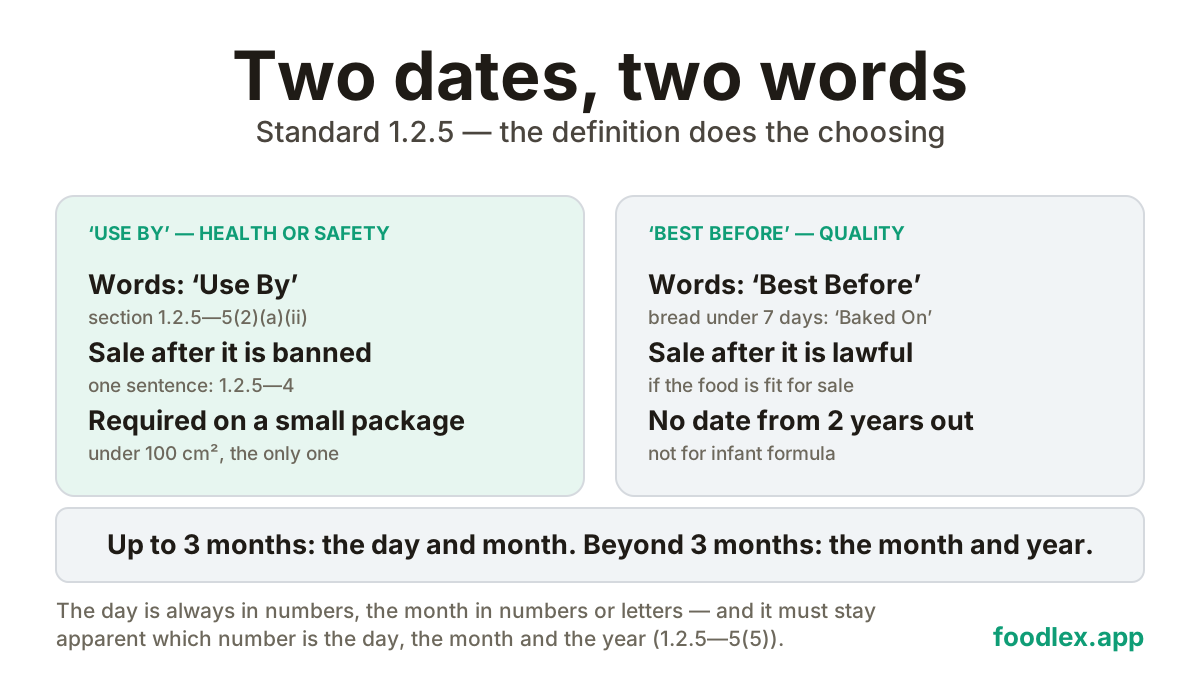
Diagram: Foodlex. Australia New Zealand Food Standards Code, Standard 1.2.5, sections 1.2.5—2 to 1.2.5—5.
Bread gets two extra dates
Bread with a shelf life of less than seven days may be marked with a baked-on or a baked-for date instead of a best-before date. The two are not the same thing, and the Code splits them by the hour of baking:
“baked-for date, in relation to bread, means: (a) if the time at which the bread was baked is before midday—the baked-on date; (b) if the time at which the bread was baked is after midday—the day after the baked-on date.”
So an afternoon bake carries tomorrow’s date as its baked-for date. The Code’s own note spells it out: “bread that is baked after midday on one day may have a ‘baked-for date’ of the following day.”
The words are fixed, and they are capitalised in the Code
Section 1.2.5—5(1) is blunt: “The date marking information may only be expressed in accordance with this section.” Subsection (2) then gives the wording, and nothing else is permitted:
| The date | The words the Code requires |
|---|---|
| Best-before date | Best Before |
| Use-by date | Use By |
| Baked-for date | Baked For or Bkd For |
| Baked-on date | Baked On or Bkd On |
The words must be “accompanied by: the relevant date; or a reference to where the date is located on the label” — which is the provision that makes “Best Before: see base of can” lawful. Note what is not in the list: “expiry date”, “exp”, “sell by” and “consume by” are not permitted forms of words for date marking information under this section.
How much of the date you must print
Section 1.2.5—5(3) governs the form of each element: the day “must be expressed in numerical form”, the month “may be expressed in numerical form” or “in upper or lower case letters”, and the year “must be expressed in numerical form and may be expressed using the full year or only the last 2 digits”. Subsection (4) then sets the minimum, and it turns on a three-month line:
| Distance from the day the date is applied | Minimum content | The Code’s own examples |
|---|---|---|
| Not more than 3 months | Day and month, in that order — or, if the month is in letters, in any order | 23 Dec · 23 12 · Dec 23 |
| More than 3 months | Month and year, in that order | Dec 2015 · 12 2015 · 23 Dec 2015 |
These are minimums, not ceilings: a full date is always acceptable. The one
additional duty is readability of a different kind — subsection (5): “The
day, month and year must be expressed so that it is apparent which number is the
day, the month or the year.” An all-numeric
03 04 05 does not meet that test, and writing the month in letters is
the simplest way to satisfy it.
The three cases that need no date
Section 1.2.5—3(2): “Unless the food is an infant formula product, the date marking information is not required if: (a) the best-before date of the food is 2 years or more after the date it is determined; or (b) the food is an individual portion of ice cream or ice confection.”
And subsection (3) cuts the requirement down for very small packs: “Despite subsection (1), if the food is in a small package the only date-marking information required is the use-by date (if any).” A small package is defined in Standard 1.1.2 as “a package with a surface area of less than 100 cm²”. Two further points worth holding on to: the two-year exemption is measured from the date the best-before date is determined, not from the date of sale; and neither exemption is available for an infant formula product.
After the use-by date the sale itself is unlawful
One sentence, its own section:
“1.2.5—4 Prohibition on sale of food after its use-by date. A food must not be sold after its use-by date.”
There is no equivalent sentence for a best-before date. Food past its best-before date may still be sold — the date speaks to quality, not safety — while every other requirement of the Code, including fitness for sale, continues to apply. That asymmetry is the practical heart of the Standard, and it is why the choice of date is not a labelling preference but a product decision.
Packed-on dates and packer codes stay allowed
Because 1.2.5—5 is exhaustive about date marking information, it would be easy to read it as banning the batch codes that factories print anyway. Section 1.2.5—6 removes the doubt in terms: it “does not prevent the addition of a packed-on date or a manufacturer’s or a packer’s code on the label on a package of food”. A packed-on date is an addition, though, not a substitute for the date marking information.
If you also sell into the United Kingdom or the EU
The two systems ask the same question and answer it with different mechanics. Three differences matter on a shared artwork:
- Three tiers instead of two. Annex X to Regulation (EU) No 1169/2011 asks for the day and month up to three months, the month and year from three to eighteen months, and the year alone beyond eighteen months. Australia has no eighteen-month tier.
- A different exemption technique. Australia exempts by shelf life — two years or more — while Annex X exempts by product, in a closed list that includes fresh unpeeled fruit and vegetables, vinegar, cooking salt, solid sugar and drinks of 10 % alcohol or more.
- A different legal route to the same result. Australia bans the sale outright in 1.2.5—4. In Great Britain the use-by date works through food safety law instead: after it, the food “shall be deemed to be unsafe”, and unsafe food must not be placed on the market.
The British side is set out in use by or best before — which date UK law requires.
Frequently asked questions
Is a use-by date or a best-before date required in Australia?
Whichever the food has. Section 1.2.5—3(1) takes the use-by date if there is one for the food, and otherwise the best-before date. Because a use-by date is defined as the date after which the food should not be consumed for health or safety reasons, a product in that position already has one.
Can food be sold after its best-before date in Australia?
The Code does not prohibit it. The prohibition in section 1.2.5—4 is about the use-by date alone. Food past its best-before date may still be sold if it is fit for sale, and the rest of the Code still applies to it.
How much of the date has to be printed?
Up to three months, the day and the month are enough; beyond three months, the month and the year. The day is always in numbers, the month may be in numbers or letters, and the year may be the full year or its last two digits — as long as it stays apparent which number is which.
Which foods need no date mark at all?
A food whose best-before date is two years or more after the date it is determined, and an individual portion of ice cream or ice confection — neither exemption applying to infant formula products. In a package with a surface area of less than 100 cm², only a use-by date is required, if the food has one.
This article is general information and does not replace legal advice. Quoted from the Australia New Zealand Food Standards Code on the Federal Register of Legislation: Standard 1.2.5 (F2015L00401, Compilation 3, in force 3 June 2021, register version F2021C00660), Standard 1.2.1 (F2015L00386, Compilation 13, in force 9 June 2026) and Standard 1.1.2 (F2015L00385, Compilation 21, in force 9 June 2026) for the definition of a small package. The European comparison is from Annex X to Regulation (EU) No 1169/2011 as it applies in Great Britain on legislation.gov.uk. Retrieved 20 October 2026.