
Guide · Date labelling
Use by or best before — which date UK law requires, and who decides
The two dates look like a pair of options. They are not: the law sets a test, and where the test is met the use-by date is compulsory. The rules around it are also stricter than most labels reflect — a use-by date must carry storage conditions, it cannot be shortened to a month and a year, and on multipacks it belongs on every portion. All of it is in Article 24 and Annex X.
One of the twelve mandatory particulars
Article 9(1) lists what has to appear on prepacked food, and item (f) is “the date of minimum durability or the ‘use by’ date”. The full list is in UK food labelling regulations; this article is about that one item.
Note the wording already: or. One date, not both — and the Regulation, not the business, decides which.
The test for a use-by date
“In the case of foods which, from a microbiological point of view, are highly perishable and are therefore likely after a short period to constitute an immediate danger to human health, the date of minimum durability shall be replaced by the ‘use by’ date.” — Article 24(1), first sentence
Three elements have to come together: the risk is microbiological, the food is highly perishable, and the consequence is an immediate danger to human health after a short period. A biscuit that goes soft is not in scope. A packed sandwich, a fresh soup, a cooked meat or a smoked fish very likely is.
Who applies the test? The food business operator responsible for the information, working from its own shelf-life assessment and challenge testing. The law sets the question and leaves the answer to the party who knows the product. The Food Standards Agency publishes detailed advice on making that judgement — useful, and guidance, not law: the obligation is Article 24(1) itself.
What a use-by date does once it has passed
This is the part that makes the choice of date a food safety decision rather than a labelling preference. The second sentence of Article 24(1):
“After the ‘use by’ date a food shall be deemed to be unsafe in accordance with Article 14(2) to (5) of Regulation (EC) No 178/2002.”
And Article 14(1) of that Regulation, in six words: “Food shall not be placed on the market if it is unsafe.” The chain is complete — the date passes, the food is deemed unsafe, and it may not be sold. Article 14(6) then widens it: where unsafe food is part of a batch, lot or consignment of food of the same class or description, “it shall be presumed that all the food in that batch, lot or consignment is also unsafe” unless a detailed assessment shows otherwise.
A best-before date has no equivalent. It speaks to quality, and food past it may still be sold if it is fit to sell.
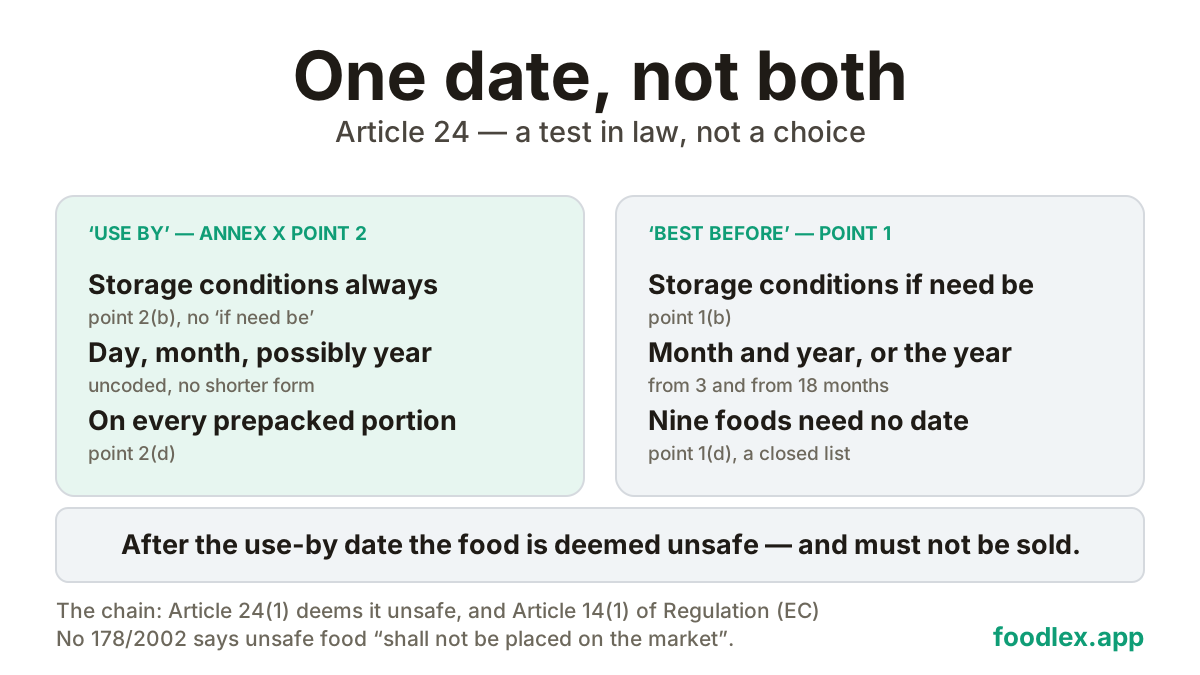
Diagram: Foodlex. Regulation (EU) No 1169/2011, Article 24 and Annex X; Regulation (EC) No 178/2002, Article 14, as they apply in Great Britain.
Four ways the use-by rules are stricter
Annex X gives the two dates their own points — point 1 for the date of minimum durability, point 2 for the use-by date — and they differ in more places than the wording:
| Date of minimum durability (point 1) | ‘Use by’ date (point 2) | |
|---|---|---|
| The words | Best before … with a day, Best before end … otherwise |
use by … |
| Storage conditions | “If need be” — only where needed to keep for the period | Always: the particulars “shall be followed by a description of the storage conditions which must be observed” |
| How much of the date | Day and month up to 3 months; month and year from 3 to 18 months; the year alone beyond 18 months | No reduction: “the day, the month and, possibly, the year, in that order and in uncoded form” |
| Multipacks | No equivalent provision | “The ‘use by’ date shall be indicated on each individual prepacked portion” |
The storage line and the multipack line are the two most often missed. A chilled product with a use-by date and no “Keep refrigerated” is short of Annex X point 2(b); a six-pack of fresh yoghurts with the date only on the outer sleeve is short of point 2(d). Both points allow “a reference to where the date is given on the labelling” instead of the date itself, which is what makes “use by: see lid” lawful.
The three durability tiers, in full
For a best-before date, Annex X point 1(c) requires “the day, the month and possibly, the year, in that order and in uncoded form”, and then allows a reduction by shelf life:
| How long the food keeps | What is sufficient |
|---|---|
| Not more than 3 months | Day and month |
| More than 3 but not more than 18 months | Month and year |
| More than 18 months | The year |
“Uncoded form” rules out the factory date codes that only a production planner can read. A tier is a permission, not an instruction: a full date is always acceptable.
Nine kinds of food need no best-before date
Point 1(d) of Annex X lists them, and the list is closed:
- fresh fruit and vegetables, including potatoes, “which have not been peeled, cut or similarly treated” — but not sprouting seeds and similar products such as legume sprouts;
- wines, liqueur wines, sparkling wines, aromatised wines and similar products obtained from fruit other than grapes, and certain grape-based beverages;
- beverages “containing 10 % or more by volume of alcohol”;
- “bakers’ or pastry cooks’ wares which, given the nature of their content, are normally consumed within 24 hours of their manufacture”;
- vinegar;
- cooking salt;
- solid sugar;
- “confectionery products consisting almost solely of flavoured and/or coloured sugars”;
- “chewing gums and similar chewing products”.
The day-old-bread entry is the one that catches bakeries: it exempts the loaf from a date of minimum durability, and it says nothing about the rest of the label. A sandwich made and wrapped on the premises is a different question again — see Natasha’s Law and the PPDS label.
A third date: ‘Frozen on’
Point 6 of Annex III adds a date that is easy to overlook. Frozen meat, frozen meat preparations and frozen unprocessed fishery products must show “the date of freezing or the date of first freezing in cases where the product has been frozen more than once”. Annex X point 3 sets the form: the words “Frozen on …”, followed by the date or a reference to where it is, as “the day, the month and the year, in that order and in uncoded form” — no tiers and no abbreviation.
And it has to be legible
The date is a mandatory particular, so Article 13 applies to it like the rest: printed “in characters using a font size where the x-height, as defined in Annex IV, is equal to or greater than 1,2 mm”, or 0,9 mm where the largest surface of the pack has an area of less than 80 cm². A date embossed into a dark plastic film in 0,8 mm type meets neither.
Northern Ireland, in one sentence
Everything quoted here is the version as it applies in Great Britain. Under the Windsor Framework, Northern Ireland applies the EU version of these rules, so a label intended for both needs the Northern Ireland position checked separately rather than assumed.
If you also sell into Australia
Australia asks the same question and codes the answer differently, which matters if one artwork serves both markets:
- The words are capitalised and prescribed.
Standard 1.2.5 permits
Best Before,Use By,Baked On/Bkd OnandBaked For/Bkd For— the bread dates have no British counterpart. - Two tiers, not three. Up to three months the day and month; beyond three months the month and year. There is no eighteen-month tier and no year-only form.
- The prohibition is direct. Section 1.2.5—4 states “A food must not be sold after its use-by date”, rather than routing through a deeming provision in food safety law.
- A shelf-life exemption instead of a product list. No date mark is needed where the best-before date is two years or more after it is determined — except for infant formula products.
The Australian side is set out in date marking in Australia.
Frequently asked questions
Who decides whether a food needs a use-by date?
The business, against the test in Article 24(1): microbiologically highly perishable and therefore likely after a short period to constitute an immediate danger to human health. Where the test is met the use-by date replaces the date of minimum durability, and there is nothing left to choose.
Is it illegal to sell food after its use-by date in the UK?
The route runs through food safety law: after the use-by date the food is deemed unsafe, and unsafe food must not be placed on the market. A best-before date carries no such consequence.
How much of the date has to be shown?
A best-before date may shrink to the month and year, or to the year alone beyond eighteen months. A use-by date may not: it is the day, the month and possibly the year, in that order and uncoded.
Which foods need no best-before date?
Nine categories in Annex X point 1(d) — among them unpeeled, uncut fresh fruit and vegetables, drinks of 10 % alcohol or more, bakery wares normally eaten within 24 hours, vinegar, cooking salt, solid sugar and chewing gum.
This article is general information and does not replace legal advice. Quoted from legislation.gov.uk, latest available revised versions as they apply in Great Britain, retrieved 20 October 2026: Regulation (EU) No 1169/2011 Articles 9(1), 13(2) and (3) and 24, Annex III points 6 and Annex X points 1 to 3 — Article 24(3) as amended by S.I. 2019/778 and Annex X point 1(d) as amended by S.I. 2025/82; and Regulation (EC) No 178/2002 Article 14. The Australian comparison is from the Australia New Zealand Food Standards Code, Standard 1.2.5 (F2015L00401, Compilation 3). Advice of the Food Standards Agency is identified in the text as guidance, which explains the law without being the law.