
Basics · The Code
The Food Standards Code — how it is put together, and which standards reach a label
The Australia New Zealand Food Standards Code is not one document you can download and read front to back. It is a set of separately registered standards, each with its own version history, plus 29 schedules that carry most of the detail. Once the shape is clear, finding a rule takes a minute instead of an afternoon. This is the shape, taken from Standard 1.1.1 itself.
One instrument, four chapters, 29 schedules
Standard 1.1.1 is the standard about the standards. Its first operative sentence is the one to remember:
“All the standards of the Code are read together as a single instrument.” — section 1.1.1—2(1)
That is why a labelling question rarely stays inside one standard: the duty to carry a piece of information is in Standard 1.2.1, what the information has to say is in another standard of Part 1.2, and the numbers and lists behind it are in a schedule. Subsection (2) sets out the arrangement, and its note describes the chapters:
- Chapter 1 — “preliminary material” and “provisions that apply to all foods”;
- Chapter 2 — “provisions that apply only to particular foods”;
- Chapter 3 — “food hygiene (applies in Australia only)”;
- Chapter 4 — “the primary production and processing of food (applies in Australia only)”;
- and then, in the Code’s own words, “Schedules 1 to 29 follow Chapter 4”.
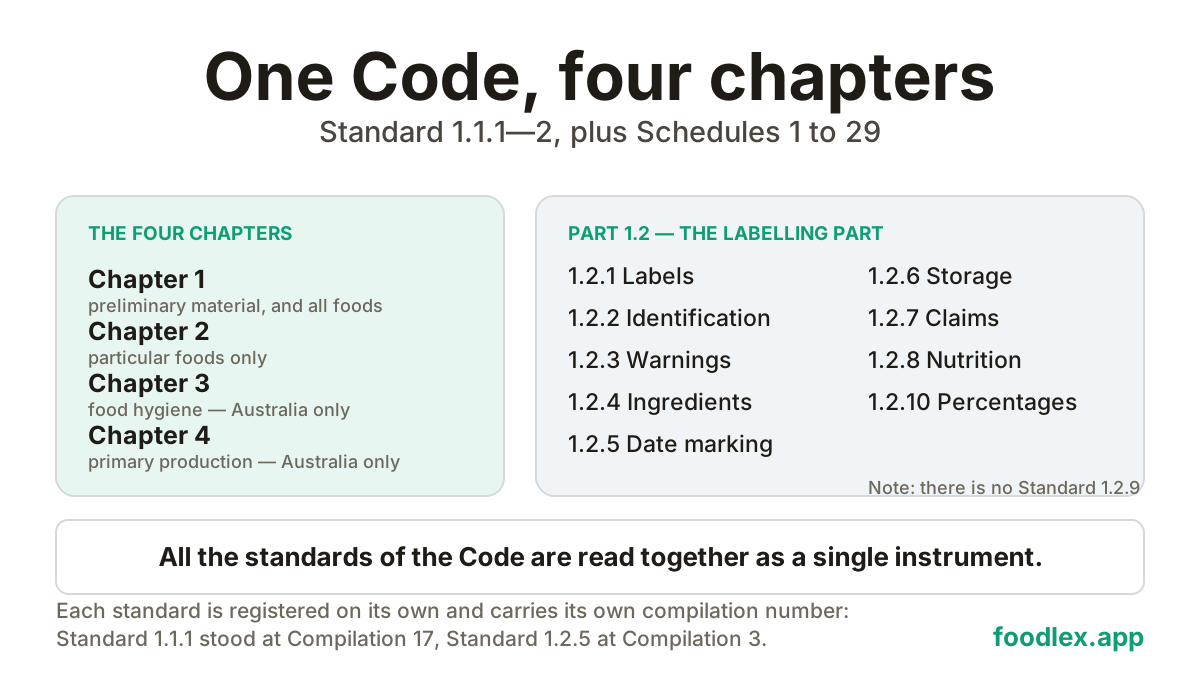
Diagram: Foodlex. Australia New Zealand Food Standards Code, Standard 1.1.1, section 1.1.1—2.
Part 1.2 is the labelling part
Nine standards, and between them they account for almost everything printed on a packaged food in Australia:
| Standard | Title in the Code | What it decides on the pack |
|---|---|---|
1.2.1 | Requirements to have labels or otherwise provide information | Whether a label is needed at all, and the list of what goes on it |
1.2.2 | Information requirements – food identification | Name of the food, lot identification, supplier name and address |
1.2.3 | Information requirements – warning statements, advisory statements and declarations | The allergen declarations and the mandatory warnings |
1.2.4 | Information requirements – statement of ingredients | The ingredient list, in descending order of ingoing weight |
1.2.5 | Information requirements – date marking of food for sale | ‘Use By’ or ‘Best Before’, and the permitted wording |
1.2.6 | Information requirements – directions for use and storage | Storage conditions where they are needed for health or safety |
1.2.7 | Nutrition, health and related claims | What you may claim, and what each claim then obliges you to show |
1.2.8 | Nutrition information requirements | The nutrition information panel |
1.2.10 | Information requirements – characterising ingredients and components of food | Percentage labelling — the Australian counterpart of the European QUID |
There is no typographical error in that table. Between 1.2.8 and 1.2.10 the Code carries its own note: “There is no Standard 1.2.9” — and a second one further down, “There is no Standard 1.4.3”. The numbers were left unused when the Code was restructured, and the notes exist so that nobody goes looking for a standard that was never written.
The schedules carry the detail
A schedule is where the Code keeps its lists and its arithmetic. For label work, nine of the 29 do most of the lifting:
| Schedule | Title in the Code |
|---|---|
Schedule 4 | Nutrition, health and related claims |
Schedule 5 | Nutrient profiling scoring method |
Schedule 7 | Food additive class names (for statement of ingredients) |
Schedule 8 | Food additive names and code numbers (for statement of ingredients) |
Schedule 9 | Mandatory advisory statements and declarations |
Schedule 10 | Generic names of ingredients and conditions for their use |
Schedule 11 | Calculation of values for nutrition information panel |
Schedule 12 | Nutrition information panels |
Schedule 13 | Nutrition information required for food in small packages |
The pattern repeats across the Code: the standard states the obligation, the schedule supplies the content. Standard 1.2.3 requires an allergen declaration; Schedule 9 lists the foods and their required names. Standard 1.2.8 requires a nutrition information panel; Schedule 12 prescribes its layout and Schedule 11 the calculation behind the numbers. Reading a standard without its schedule gives you the duty without the answer.
Where the Code applies — and where it does not
Section 1.1.1—3(1): “Unless this Code provides otherwise, this Code applies to food that is: (a) sold, processed or handled for sale in Australia or New Zealand; or (b) imported into Australia or New Zealand.”
The single-market part is genuine but not total. The note to that section lists the provisions that have not been incorporated into New Zealand food law — among them Standard 1.4.2 on agvet chemicals, Standard 2.2.2 on eggs, Standard 2.9.1 on infant formula products, the thiamin requirement for bread in section 2.1.1—5, and the whole of Chapters 3 and 4. For a label sold on both sides of the Tasman the labelling standards of Part 1.2 are common ground; the hygiene and primary production rules are not.
The asterisks are not typographical dust
Open any standard and you will meet terms like *small package or
*warning statement. Section 1.1.1—16 explains the convention:
“Most of the terms that are defined in subsection 1.1.2—2(3) are
identified by an asterisk appearing at the start of the term”, and “an
asterisk usually identifies the first occurrence of a term in a section …
Later occurrences of the term in the same provision are not usually
asterisked.”
In other words, an asterisk is a cross-reference to Standard 1.1.2 — Definitions used throughout the Code, and that is where a surprising number of arguments end. “Small package”, for instance, is not a matter of judgement: it “means a package with a surface area of less than 100 cm²”. Subsection (5) adds the counter-intuitive half of the rule — if a term is not asterisked, “disregard that fact”; the definition still applies.
Citing it properly: the compilation number, not the year
Each standard is a separately registered legislative instrument on the Federal Register of Legislation, and each is amended on its own timetable. There is no single version of “the Code” to cite. Measured on 20 October 2026, the four standards used in this article stood at four different versions:
| Standard | Register ID | Compilation | In force from |
|---|---|---|---|
| 1.1.1 Structure of the Code | F2015L00383 | 17 | 9 June 2026 |
| 1.1.2 Definitions | F2015L00385 | 21 | 9 June 2026 |
| 1.2.1 Requirements to have labels | F2015L00386 | 13 | 9 June 2026 |
| 1.2.5 Date marking | F2015L00401 | 3 | 3 June 2021 |
Standard 1.2.5 has been amended three times in eleven years; Standard 1.1.2 twenty-one times. A citation that says only “the Food Standards Code” is therefore unverifiable, and a quotation without a compilation number cannot be checked against anything. A usable citation names the standard, the register identifier and the compilation — the form used at the foot of every article in this blog.
FSANZ guidance is not the Code
Food Standards Australia New Zealand publishes user guides, and they are genuinely useful. They are also, by the Code’s own words, not the law:
“Guidelines developed by FSANZ in accordance with paragraph 13(1)(c) of the FSANZ Act are to assist in the interpretation of this Code and are not legally binding.” — section 1.1.1—5(2)
That is worth knowing before an argument with a customer or an auditor runs on a sentence from a guide. The guide explains; the standard decides.
Two general rules that catch people out
Mandatory wording cannot be improved. Section 1.1.1—8(1): if the Code requires a warning statement or specific words, they “must be expressed in the words set out in this Code without modification”. Other statements are treated more gently — subsection (2) allows a modification, but “any modification must not contradict or detract from the effect of the statement”.
A change to the Code comes with twelve months. Section 1.1.1—9(1): where the Code is varied and a food “was compliant for a kind of sale immediately before the variation commenced”, the food “is taken to be compliant for that kind of sale for a period of 12 months beginning on the date of the variation” — unless the Code or the varying instrument says otherwise. It often does say otherwise: the Plain English Allergen Labelling variation ran a three-year transition plus a two-year stock-run period instead, as set out in allergen labelling in Australia.
What the Code does not say about font size
A question that comes up on every artwork review: how small may the print be? For most of the label, the Code sets no measurement at all. Section 1.2.1—24(1) requires that any words be in English and that each word, statement, expression or design “be legible” and “be prominent so as to contrast distinctly with the background of the label”.
A millimetre figure appears in exactly one place. Section 1.2.1—25 requires a warning statement to be written “for a small package—in a size of type of at least 1.5 mm” and “otherwise—in a size of type of at least 3 mm”. If you are working from European habits, note the difference: Article 13(2) of Regulation (EU) No 1169/2011 requires the mandatory particulars to be printed “in characters using a font size where the x-height, as defined in Annex IV, is equal to or greater than 1,2 mm”, dropping to 0,9 mm only where the largest surface of the pack is under 80 cm². Australia has no such general rule — but a label that is hard to read still fails 1.2.1—24 without any ruler being involved.
Frequently asked questions
How is the Australia New Zealand Food Standards Code structured?
Four chapters and 29 schedules. Chapter 1 carries the preliminary material and the provisions that apply to all foods, Chapter 2 the provisions for particular foods, Chapter 3 food hygiene and Chapter 4 primary production and processing — the last two in Australia only. All of the standards are read together as a single instrument.
Why is there no Standard 1.2.9?
Because the Code says there is none. The structure table in Standard 1.1.1 carries the note “There is no Standard 1.2.9” between Standards 1.2.8 and 1.2.10, and a second note records the same for 1.4.3. The numbers are unused.
Is FSANZ guidance legally binding?
No. Section 1.1.1—5(2) says FSANZ guidelines “are to assist in the interpretation of this Code and are not legally binding”.
Is there a minimum font size for Australian food labels?
Only for warning statements: at least 3 mm, or 1.5 mm on a small package. For everything else the test is legibility and distinct contrast with the background, with no measurement given.
This article is general information and does not replace legal advice. Quoted from the Australia New Zealand Food Standards Code on the Federal Register of Legislation: Standard 1.1.1 (F2015L00383, Compilation 17, in force 9 June 2026, register version F2026C00543), Standard 1.1.2 (F2015L00385, Compilation 21), Standard 1.2.1 (F2015L00386, Compilation 13, register version F2026C00538) and Standard 1.2.5 (F2015L00401, Compilation 3). The European comparison is from Article 13(2) and (3) of Regulation (EU) No 1169/2011 as it applies in Great Britain, latest available revised version on legislation.gov.uk. Retrieved 20 October 2026.