
Basics · Labelling
The ingredients list — what Standard 1.2.4 asks for, line by line
It looks like the easiest part of a label: write down what went in. Then come the questions. In which order? Does the marinade have to be broken open? May it say “vegetable oil”? Where does the percentage go? Standard 1.2.4 answers all four, and one of its answers is stricter than the European one.
When you need a list at all
Section 1.2.4—2(3) takes three cases out: packaged water labelled under Standard 2.6.2, a standardised alcoholic beverage, and a food in a small package. The note underneath is the part people miss:
“Despite subsection (3), the presence of some ingredients must be declared—see Standard 1.2.3.”
No ingredient list does not mean no declarations. Allergens and added sulphites survive the exemption and appear by their required name.
Descending order of ingoing weight
Section 1.2.4—5(1): a statement of ingredients must list each ingredient in descending order of ingoing weight. Ingoing is the word that decides — the weight at the mixing bowl, not in the finished food. For water and volatile ingredients the Code gives an equation: the weight added, minus what is removed during manufacture and minus what was used to reconstitute dehydrated ingredients.
Two conveniences sit next to it. A dehydrated or concentrated ingredient that is reconstituted during manufacture may be weighed before dehydration (subsection (2)). And a food meant to be reconstituted by the buyer may be listed in the order of the reconstituted product, if the label says so (subsection (3)).
Compound ingredients and the five per cent line
A compound ingredient — a marinade, a filling, a chocolate coating — can be handled in two ways under subsection (5): list it by name, or break it up and list its parts individually among the rest. If you keep the name, subsection (6) decides what goes in the brackets behind it, and five per cent is the line.
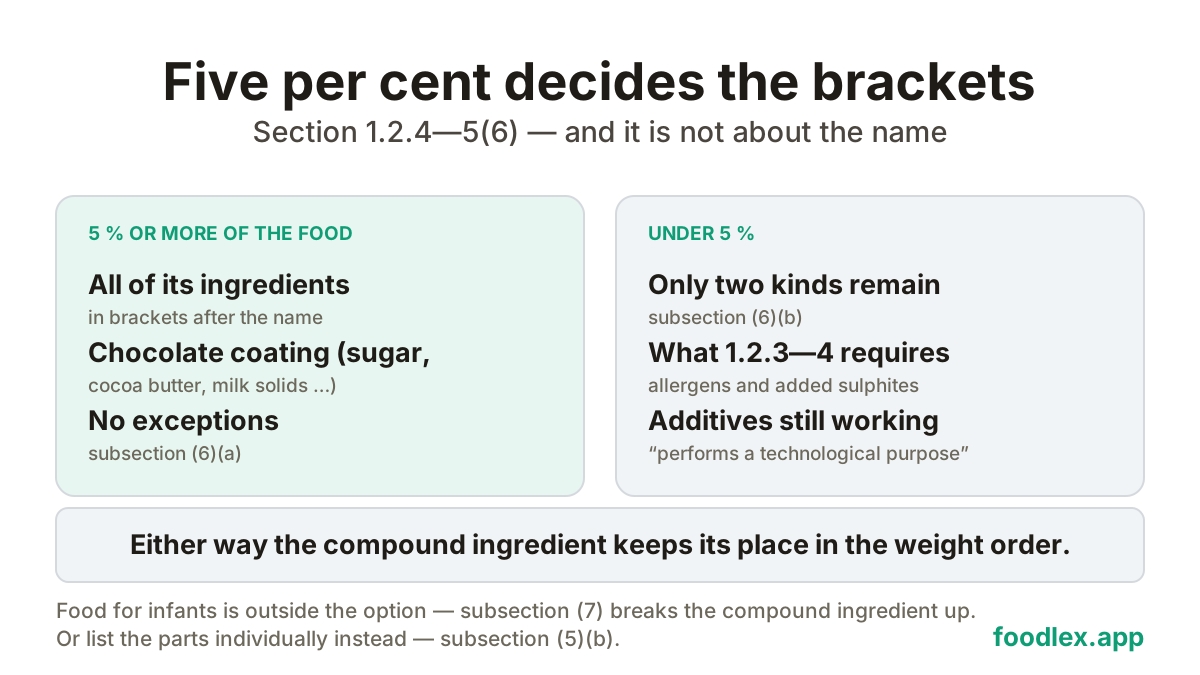
Diagram: Foodlex. Australia New Zealand Food Standards Code, section 1.2.4—5(5) to (7).
Below the line, two kinds never fall away: an ingredient “required to be listed in accordance with section 1.2.3—4” — the allergens and sulphites — and “any substance *used as a food additive in the compound ingredient which performs a technological purpose in the food for sale”. An additive that has done its work and no longer acts in the finished food drops out; one that still preserves or colours stays.
Food for infants is outside the option altogether (subsection (7)): there the compound ingredient has to be broken up.
What you do not have to list
Section 1.2.4—3(2) is a closed list of five:
- an ingredient of a flavouring substance;
- a volatile ingredient completely removed during processing;
- added water that reconstitutes dehydrated ingredients, forms part of a declared broth, brine or syrup, or constitutes less than 5 % of the food;
- a substance used as a processing aid under Standard 1.3.3;
- a food used as a processing aid.
The first and the fourth are traps rather than reliefs. A processing aid that is an allergen is still declared — the exemption is from the list, not from the declaration. The same goes for flavouring substances: subsections 1.2.4—7(5) and (6) pull some of their ingredients back in.
The names: common, descriptive, or one of seventeen generic ones
Section 1.2.4—4 gives three ways to name an ingredient: a name it is commonly known by, a name that describes its true nature, or a generic name from Schedule 10. The generic list is short and closed:
cereals · cheese · cocoa butter · crystallised fruit · fats or oils · fish · fruit · gum base · herbs · meat · milk protein · milk solids · poultry meat · spices · starch · sugar · vegetables
Five of them carry conditions, and these are where labels go wrong:
| Generic name | Condition in Schedule 10 |
|---|---|
fats or oils | the list must say whether the source is animal or vegetable; for a dairy product the specific animal source; never for diacylglycerol oil |
fish | the general definition of fish in 1.1.2—3(2) does not apply here |
milk solids | for milk powder, skim milk powder or dried milk products — or for any two or more of whey, whey powder, whey proteins, lactose, caseinates, milk proteins, milk fat |
starch | unmodified starch, or starch modified by physical means or enzymes — not chemically modified starch |
sugar | for eight named forms from white sugar to raw sugar — and “the name ‘sugars’ must not be used in a statement of ingredients” |
Additives are the fourth way of naming: class name, then the name or the code number
from Schedule 8, under section 1.2.4—7(1). That is where
Preservative (220) comes from, and it has
its own article.
The percentage that has to follow the name
Standard 1.2.10 adds the percentage. It applies to a characterising ingredient, and the definition is wider than most people expect:
“an ingredient or a category of ingredients of the food that: (a) is mentioned in the name of the food; or (b) is usually associated with the name of the food by a consumer; or (c) is emphasised on the label of the food in words, pictures or graphics.”
Limb (c) is the one that catches packaging: a strawberry on the front makes strawberry a characterising ingredient, whether or not the name mentions it. And where a percentage is declared in the list, section 1.2.10—8(2) fixes its place — it “must immediately follow the common, descriptive or generic name of the ingredient”. Not at the end of the line, not in a footnote.
Seven kinds of food are outside it under 1.2.10—3(3), among them prepared filled rolls and sandwiches, food sold at a fund-raising event, food in a small package, infant formula product, and standardised alcoholic beverages.
How this differs from the EU and Great Britain
The two systems look alike and part company in one practical place:
| Australia | EU and Great Britain | |
|---|---|---|
| Order | descending ingoing weight, all the way down | descending weight, but ingredients under 2 % “may be listed in a different order after the other ingredients” |
| Compound ingredients | open the brackets at 5 %, whatever the compound ingredient is | Annex VII Part E: no list below 2 %, but only where the composition is defined in law or the compound ingredient is a mixture of spices or herbs |
| Percentage | characterising ingredient, percentage immediately after the name | QUID under Article 22, in or next to the name of the food |
| Generic names | seventeen, closed, in Schedule 10 | Annex VII Part B, by category, with its own conditions |
An Australian list built from a European one therefore needs re-sorting, not translating: the tail under two per cent has to go back into weight order.
Frequently asked questions
In what order do ingredients go on an Australian label?
In descending order of ingoing weight — section 1.2.4—5(1). There is no Australian equivalent of the British rule that lets ingredients under two per cent be moved to the end.
Do I have to list the ingredients of an ingredient?
At five per cent or more, all of them in brackets. Below five per cent, only what needs a mandatory declaration under 1.2.3—4 and any additive still performing a technological purpose in the finished food.
Can I write ‘sugars’ in an ingredients list?
No. Schedule 10 allows sugar for eight named forms and says in the
same entry that the name sugars must not be used in a statement of
ingredients.
When does a percentage have to appear next to an ingredient?
When the ingredient characterises the food — named in the food’s name, usually associated with it, or emphasised on the label in words, pictures or graphics. It then stands immediately after that ingredient’s name.
This article is general information and does not replace legal advice. Quoted from the Australia New Zealand Food Standards Code on the Federal Register of Legislation: Standard 1.2.4 (F2015L00392, Compilation 2), Standard 1.2.10 (F2015L00398, Compilation 2) and Schedule 10 (F2015L00480, Compilation 4). The European comparison is Annex VII of Regulation (EU) No 1169/2011 as it applies in Great Britain.