
For teaching and study
Foodlex for universities — free for students
From a recipe, Foodlex works out the nutrition information panel to Standard 1.2.8, takes the allergen declarations from the same ingredient list and turns both into a finished label. Students of nutrition, dietetics and food science use it free of charge — unlocked through their university email address.
Unlocked in three steps
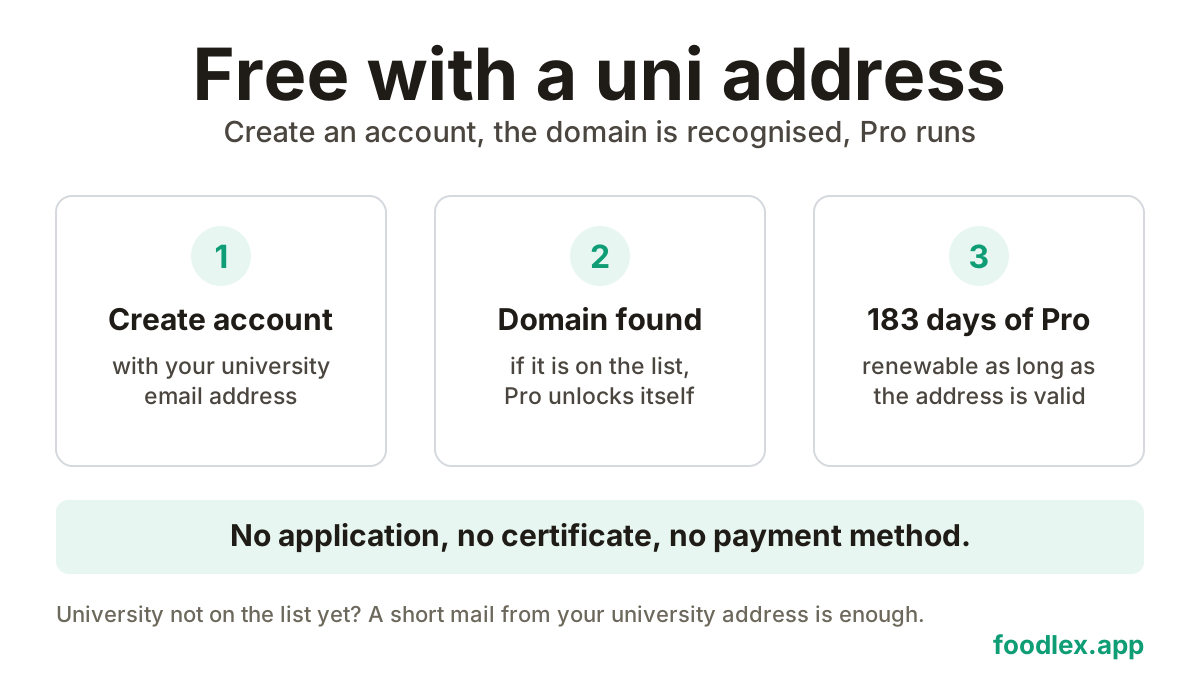
-
Create an account with your university email address — the one
you were given at the start of your studies, e.g.
firstname.lastname@unimelb.edu.au. - That’s it. If the domain is on the list below, full access unlocks automatically. No application, no questions, no proof of enrolment.
- 183 days, renewable. After that, unlock once more, as long as the address is still valid.
What students use it for
Set to the Australian market, Foodlex follows the Australia New Zealand Food Standards Code rather than the European rules:
- Nutrition information panel — the seven values Standard 1.2.8 requires, laid out the way Schedule 12 sets it out and rounded to three significant figures.
- Australian composition data. In the Australian market the default source is NPC 2026 from Food Standards Australia New Zealand, not the European tables.
- Allergen declarations under Standard 1.2.3 and the names Schedule 9 prescribes.
- Health Star Rating, worked out from the same recipe.
- Country of origin labelling, including the case of goods packed in Australia from imported ingredients.
- Print-ready label as a PDF — for coursework, placements and theses.
For lecturers and programme directors
The institution has nothing to do. There is no campus licence, no paperwork, no installation and no user administration. Students unlock access themselves; there are no costs and no administrative effort.
If you would like to use Foodlex in a course, you can reach me directly at kontakt@foodlex.app. I come from the industry — product management, product development and quality management — and built Foodlex myself. I am happy to answer questions about the calculation logic or about how individual requirements of the Code are interpreted.
Access applies to every address on an unlocked domain, so staff are included too. Anyone preparing the course needs the same range of functions as the students. The app itself is in English and German.
Try it without an account
One tool runs in the browser without signing in — good for a first look, or as an exercise during a class:
- Nutrition Information Panel calculator — enter the values per 100 g and the serving size, and the panel is laid out in the Schedule 12 format.
These Australian universities are unlocked
As of 2 October 2026 — 46 Australian universities and colleges. Institutions in Europe are listed on the European page.
- Adelaide University
- Australian Catholic University
- Australian National University
- Australian University of Theology
- Avondale University
- Bond University
- Central Queensland University
- Charles Darwin University
- Charles Sturt University
- Curtin University
- Deakin University
- Edith Cowan University
- Federation University Australia
- Flinders University
- Griffith University
- James Cook University
- La Trobe University
- Macquarie University
- Monash University
- Murdoch University
- Queensland University of Technology
- RMIT University
- Southern Cross University
- Swinburne University of Technology
- The University of Adelaide
- The University of Melbourne
- The University of Notre Dame Australia
- The University of Queensland
- The University of Sydney
- The University of Western Australia
- Torrens University Australia
- University of Canberra
- University of Divinity
- University of New England
- University of New South Wales
- University of Newcastle
- University of South Australia
- University of Southern Queensland (UniSQ)
- University of Tasmania
- University of Technology Sydney
- University of Wollongong
- University of the Sunshine Coast (UniSC)
- Victoria University
- Western Sydney University
- Endeavour College of Natural Health
- Le Cordon Bleu Australia
Yours missing? A short email from your university address to kontakt@foodlex.app is enough — the list is extended continuously.
Frequently asked questions
What does Foodlex cost for students?
Nothing. Students at an unlocked university get full Pro access for 183 days, renewable. No payment method is required.
How is access unlocked?
Create an account with your university email address. If the domain is on the list, access unlocks automatically — no application, no questions, no proof of enrolment.
Does the university have to set anything up or pay anything?
No. There is no campus licence, no paperwork and no installation. The institution has nothing to do; students unlock access themselves.
What if my university is not on the list?
A short email to kontakt@foodlex.app from your university address is enough. The domain is then added, and everyone there can unlock access themselves.