
Tool · Nutrition
Recipe nutrition calculator — free
Enter the ingredients of your recipe and their weight in grams — the calculator works out the nutrition table per 100 g (energy, fat, carbohydrate, protein, salt). Based on the official German Federal Food Code (Bundeslebensmittelschlüssel, BLS 4.0), free, no sign-up — everything stays in your browser.
Type and pick from the list. Calculated in your browser — nothing is sent anywhere.
No ingredients yet — search above for your first one.
Values per 100 g of edible raw portion from BLS 4.0, without cooking loss (water evaporating while baking or boiling). For loss correction, per-portion values, additives and the finished label, see the Foodlex app.
Looking up a single food
Often you do not need a whole recipe, only the figures for one food: how much fat is in butter, how much protein in an egg, how much sugar in honey. The calculator above answers that too — search for the ingredient, enter 100 as the amount, and the table shows that one food.
The table below takes thirty common ingredients in advance. Every figure is per 100 g of edible raw portion and comes unchanged from the Bundeslebensmittelschlüssel 4.0 — the same values the calculator above works with. Fat, saturates, carbohydrate, sugars and protein in grams, salt in grams as well.
| Food | kJ | kcal | Fat | of which saturates | Carbohydrate | of which sugars | Protein | Salt |
|---|---|---|---|---|---|---|---|---|
| Wheat flour, Type 405 | 1475 | 348 | 0.9 | 0.1 | 71.8 | 0.3 | 10.5 | 0.00 |
| Rye flour, Type 1150 | 1347 | 319 | 1.1 | 0.1 | 61.7 | 1.5 | 8.0 | 0.00 |
| Oat flakes | 1465 | 348 | 6.7 | 1.3 | 53.3 | 0.7 | 13.2 | 0.00 |
| White rice raw | 1488 | 351 | 0.6 | 0.1 | 77.1 | 0.3 | 7.9 | 0.04 |
| Pasta egg-free, raw | 1467 | 346 | 1.6 | 0.2 | 68.8 | 2.0 | 12.4 | 0.01 |
| Sugar white (refined sugar) | 1700 | 400 | 0.0 | 0.0 | 100.0 | 100.0 | 0.0 | 0.01 |
| Honey | 1293 | 305 | 0.0 | 0.0 | 74.1 | 70.8 | 0.4 | 0.01 |
| Bittersweet/semisweet chocolate | 2224 | 534 | 32.3 | 19.4 | 49.6 | 46.9 | 6.6 | 0.02 |
| Best quality butter | 3072 | 747 | 82.2 | 52.7 | 0.6 | 0.6 | 1.2 | 0.03 |
| Olive oil | 3696 | 899 | 99.9 | 12.0 | 0.0 | 0.0 | 0.0 | 0.00 |
| Sunflower oil | 3700 | 900 | 100.0 | 11.0 | 0.0 | 0.0 | 0.0 | 0.00 |
| Whole milk, fresh, 3.5 % fat, pasteurised | 259 | 62 | 3.5 | 2.2 | 4.0 | 4.0 | 3.5 | 0.09 |
| Yogurt mild, min. 3.5 % fat | 280 | 67 | 3.5 | 2.3 | 4.1 | 4.1 | 4.0 | 0.10 |
| Quark < 10 % fat in dry matter | 282 | 66 | 0.2 | 0.1 | 3.7 | 3.7 | 11.8 | 0.08 |
| Gouda cheese 48 % fat in dry matter | 1570 | 379 | 31.6 | 22.5 | 0.0 | 0.0 | 22.5 | 2.17 |
| Chicken egg raw | 563 | 135 | 9.0 | 2.4 | 0.3 | 0.3 | 13.2 | 0.39 |
| Chicken breast fillet, raw | 462 | 109 | 1.8 | 0.4 | 0.0 | 0.0 | 23.2 | 0.13 |
| Beef mince, raw | 931 | 224 | 16.4 | 7.4 | 0.0 | 0.0 | 19.1 | 0.14 |
| Salmon raw | 753 | 180 | 11.2 | 2.4 | 0.0 | 0.0 | 19.9 | 0.08 |
| Tofu | 482 | 115 | 5.6 | 0.9 | 0.0 | 0.0 | 15.5 | 0.03 |
| Lentil mature | 1362 | 323 | 1.7 | 0.2 | 44.8 | 1.3 | 23.4 | 0.02 |
| Sweet almond | 2250 | 544 | 46.6 | 4.0 | 3.9 | 3.6 | 22.3 | 0.01 |
| Walnut | 2973 | 721 | 70.6 | 6.5 | 3.0 | 2.7 | 16.1 | 0.00 |
| Potatoe peeled, raw | 352 | 83 | 0.1 | 0.0 | 17.9 | 0.9 | 1.9 | 0.01 |
| Carrot raw | 168 | 40 | 0.4 | 0.1 | 6.5 | 6.4 | 0.8 | 0.06 |
| Onion raw | 142 | 34 | 0.1 | 0.0 | 6.0 | 6.0 | 1.2 | 0.02 |
| Tomato raw | 91 | 22 | 0.1 | 0.0 | 3.2 | 3.2 | 0.9 | 0.01 |
| Apple raw | 245 | 58 | 0.5 | 0.2 | 11.7 | 10.5 | 0.4 | 0.00 |
| Banana raw | 335 | 79 | 0.4 | 0.1 | 15.9 | 13.9 | 1.3 | 0.00 |
| Rice drink unsweetened | 248 | 59 | 1.0 | 0.2 | 12.3 | 6.6 | 0.0 | 0.10 |
The table is an extract. The calculator above searches all 7,140 entries in BLS 4.0 — including cooked, dried and frozen forms that would not fit here.
How nutrition calculation works
The nutrition values of a recipe are the sum of its ingredients. For each ingredient: weight in grams ÷ 100 × the nutrient value per 100 g. Those shares are added up and divided by the total weight — which gives the nutrition table per 100 g that Regulation (EU) No 1169/2011 prescribes for labelling (Article 32(2)). The calculator does that arithmetic for you.
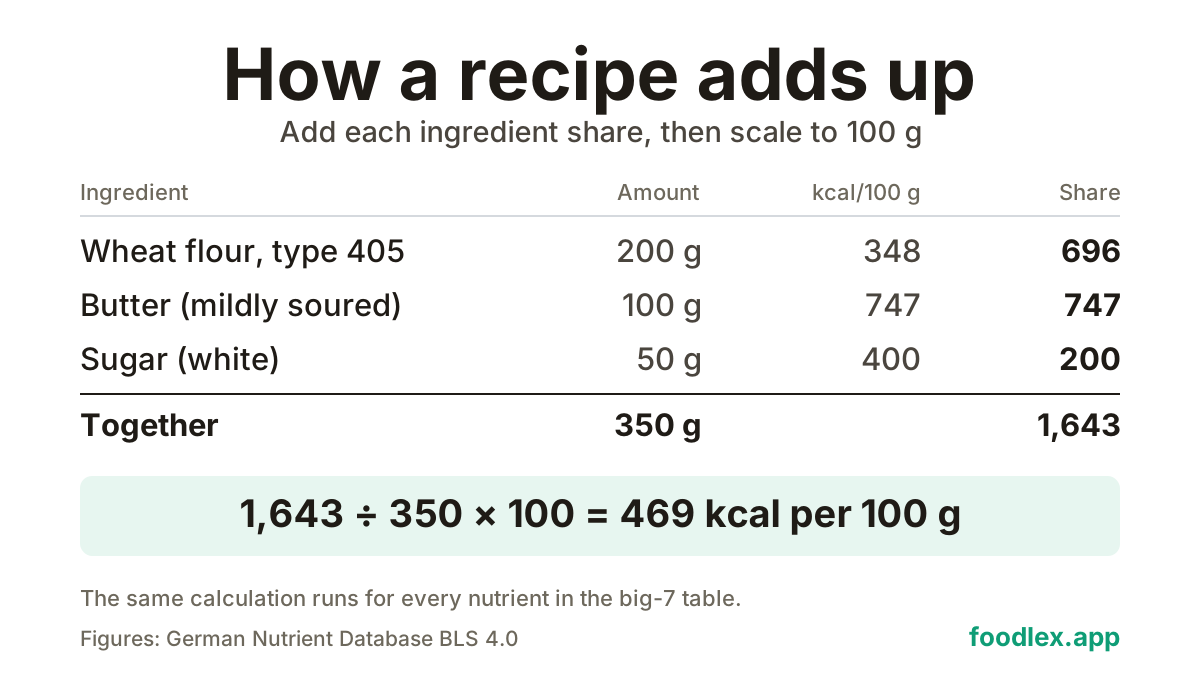
Diagram: Foodlex. Figures from the German Nutrient Database BLS 4.0.
Calculating nutrition for your own recipes
That is what the calculator is for: you enter every ingredient of your own recipe with its weight in grams — exactly as it goes into the bowl. The calculator adds up the values proportionally and shows you both: the figures per 100 g and the total for the whole recipe. Free, without signing up, and the arithmetic runs in your browser.
Two things to know before the figures go on a label
- Enter raw weights. The BLS values apply per 100 g of edible raw portion. Baking and boiling evaporate water, so the finished product weighs less and is correspondingly more concentrated. The free calculator does not account for that cooking loss.
- The calculator saves nothing. For several recipes side by side, your own ingredients, per-portion values and the finished label you need the Foodlex app.
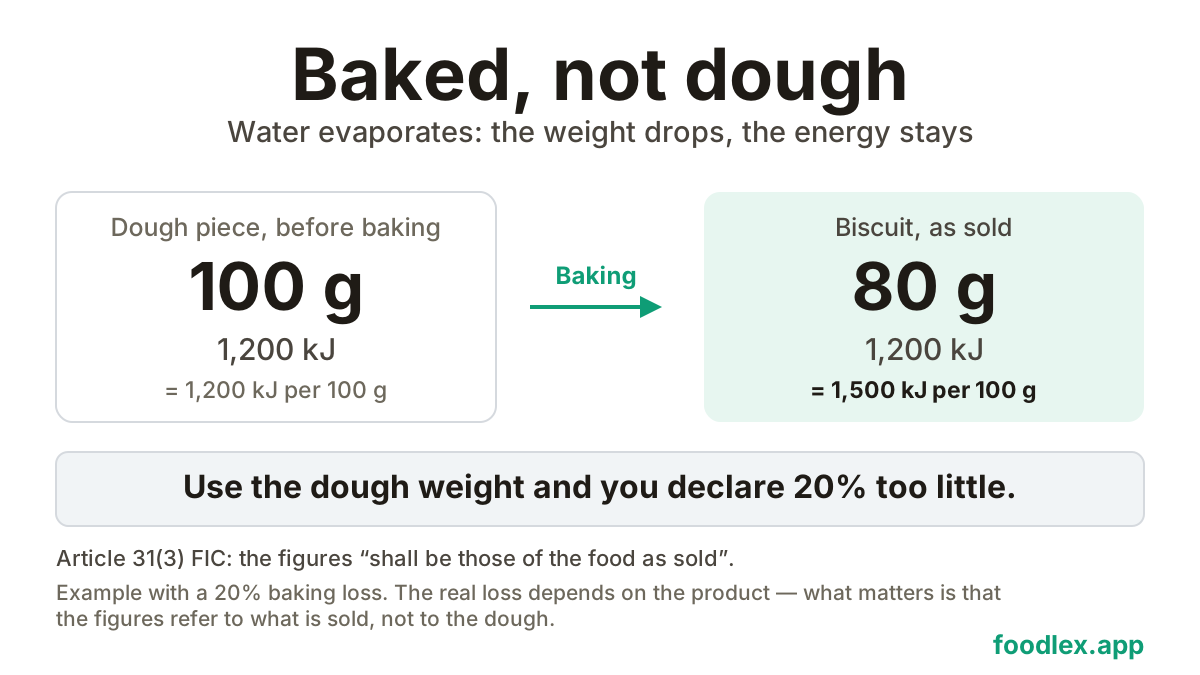
Diagram: Foodlex. Example with a 20% baking loss.
The big seven under Article 30
For prepacked food, Article 30 of the FIC prescribes seven mandatory values — the “big seven”: energy (kJ/kcal), fat, of which saturates, carbohydrate, of which sugars, protein and salt. Fibre is voluntary, though often worth adding. Those are exactly the values this calculator returns — per 100 g and as a total for the whole recipe. Only need the energy value converted? The kcal to kJ converter does that on its own.
How the energy value is produced — the conversion factors
Energy on a label is not measured, it is calculated. Annex XIV of Regulation (EU) No 1169/2011 sets the factors. In its own words:
“The energy value to be declared shall be calculated using the following conversion factors”
| Nutrient | per gram |
|---|---|
| Carbohydrate (except polyols) | 17 kJ — 4 kcal |
| Protein | 17 kJ — 4 kcal |
| Fat | 37 kJ — 9 kcal |
| Fibre | 8 kJ — 2 kcal |
| Polyols | 10 kJ — 2.4 kcal |
| Alcohol (ethanol) | 29 kJ — 7 kcal |
| Organic acid | 13 kJ — 3 kcal |
| Salatrims | 25 kJ — 6 kcal |
| Erythritol | 0 kJ — 0 kcal |
A worked example. Wheat flour type 405 has 0.93 g fat, 71.77 g carbohydrate, 10.46 g protein and 5.30 g fibre per 100 g:
| Nutrient | Amount | Factor | Share |
|---|---|---|---|
| Fat | 0.93 g | × 37 | 34.4 kJ |
| Carbohydrate | 71.77 g | × 17 | 1,220.1 kJ |
| Protein | 10.46 g | × 17 | 177.8 kJ |
| Fibre | 5.30 g | × 8 | 42.4 kJ |
| Total | 1,474.7 kJ |
Rounded, that is 1,475 kJ — exactly the figure in the database. The same sum with the kcal factors gives 347.9, so 348 kcal. Leave the fibre out and you land at 1,432 kJ, 43 kJ too low: declaring fibre is voluntary, its contribution to energy is not.
Why a label says salt and not sodium
Food composition databases hold sodium; labels require salt. That is not a contradiction but a conversion, laid down in Annex I point 11 — in its own words:
“‘salt’ means the salt equivalent content calculated using the formula: salt = sodium × 2,5”
The factor applies even where no salt was added: the sodium occurring naturally in milk, meat or vegetables counts. That is why carrot and raw egg in the table above still carry a salt figure above zero. The calculator does this conversion for you — the table above already shows the salt equivalent, not the sodium.
Four mistakes that keep coming up
1. Using the weight after baking
Ingredients enter the calculation at their raw weight, as they go into the bowl. The finished bake weighs less because water has evaporated. Applying raw values to the final weight gives figures per 100 g that are too low. Correcting for that cooking loss is a separate step, which this free calculator deliberately leaves out.
2. Forgetting water that stays in the recipe
Water has no nutritional value but it has weight. Five hundred grams of dough containing 200 g of water gives different figures per 100 g than 300 g of dough without. So water belongs in the ingredient list — precisely because it contributes nothing.
3. Picking the wrong state
The database holds many foods several times over: raw, cooked, dried, canned and drained. Between “Lentil ripe” and “Lentil ripe, cooked” lies roughly a factor of three, because the cooked form has taken up water. For a recipe the rule is: the state in which the ingredient is weighed.
4. Carrying rounded figures forward
Rounding intermediate results and calculating on from them collects the error across every ingredient. Round once, at the end, on the finished table. The calculator keeps full precision internally.
What the free calculator does — and what the app adds
This calculator is deliberately lean: a quick nutrition table for a mix of ingredients or a simple recipe. For daily work in a bakery, a kitchen or a small manufacturer, the Foodlex app goes considerably further:
- Cooking loss and per-portion values — the figures for the prepared food and per serving.
- Automatic allergen labelling — the 14 allergens derived from the ingredients and emphasised on the label.
- A print-ready label — ingredient list, nutrition table, durability date and the rest, at the press of a button.
- Nutri-Score — worked out from the calculated values, from the Pro plan.
- Your own ingredients and a cloud workspace — add supplier specifications, work as a team.
Where the data comes from
All 7,140 entries come from the Bundeslebensmittelschlüssel (BLS 4.0), the official German nutrient reference database. This page searches and displays the English names; the German version of this calculator uses the German ones. Search terms are English here — type oat flakes, not Haferflocken.
Frequently asked questions
How do you calculate the nutrition values of a recipe?
The values of each ingredient are added up in proportion to its amount (weight in grams divided by 100, times the value per 100 g) and then scaled to the total weight of the recipe. That gives the values per 100 g of the finished product. This calculator does exactly that for you.
Can I use it for my own recipes?
Yes. Enter every ingredient of your recipe with its raw weight in grams; the calculator shows the values per 100 g and as a total for the whole recipe. Free and without signing up. Not included are the cooking loss from boiling and baking, per-portion values and saving several recipes.
Which nutrient database does the calculator use?
The calculator runs on the Bundeslebensmittelschlüssel (BLS 4.0), the official German nutrient database with more than 7,000 foods. Those are the same values used for labels under Regulation (EU) No 1169/2011.
Is the nutrition calculator free?
Yes. The calculator is free and needs no account. The arithmetic runs entirely in your browser — nothing is uploaded.
How many calories are in 100 g of butter, flour or egg?
Butter has 747 kcal per 100 g, wheat flour type 405 has 348 kcal, a raw hen's egg 135 kcal. The table on this page lists these and twenty-seven more common ingredients; every value comes from the Bundeslebensmittelschlüssel 4.0 and applies per 100 g of edible raw portion.
How do you convert nutrients into kilocalories?
Annex XIV of Regulation (EU) No 1169/2011 sets fixed conversion factors: fat 37 kJ or 9 kcal per gram, carbohydrate and protein 17 kJ or 4 kcal each, fibre 8 kJ or 2 kcal, alcohol 29 kJ or 7 kcal. The energy value is the sum of those shares — it is not measured.
Why does a label say salt and not sodium?
Because the Regulation requires it. Annex I point 11 defines: salt means the salt equivalent content calculated using the formula salt = sodium × 2,5. The factor applies even where no salt was added — naturally occurring sodium counts.
Does fibre count towards energy even though declaring it is voluntary?
Yes. Declaring fibre is voluntary under Article 30(2), but its contribution to the energy value is not: Annex XIV gives 8 kJ or 2 kcal per gram. For wheat flour type 405 that is 42 of 1,475 kJ — leaving it out puts the figure too low.
Can I produce a finished EU label with it?
This calculator gives you the nutrition table per 100 g. For an EU-compliant label with the ingredient list, emphasised allergens, cooking loss and per-portion values, use the Foodlex app — free on the Free plan, whose exports carry a watermark. Without the watermark from Starter, the Nutri-Score from Pro.
Nutrient values unchanged from BLS 4.0. This page is general information and does not replace legal advice or a specialist review of your labelling.