
Guide · Additives
E numbers on a UK label — what the number means, and when you may leave it out
An E number is not a warning and not a secret. It is a short identifier for a substance that has been through an authorisation, and on a label it almost never stands alone: the law wants a category word in front of it. This guide sets out what must be written, what may be left out, and the handful of additives that drag an extra sentence onto the pack — quoted from the legislation as it applies in Great Britain.
What an E number is
Additives are grouped by what they do. Annex I to Regulation (EC) No 1333/2008 sets out 26 functional classes and defines each one in a single sentence — for example “‘preservatives’ are substances which prolong the shelf-life of foods by protecting them against deterioration caused by micro-organisms”, and “‘thickeners’ are substances which increase the viscosity of a foodstuff”. The number itself identifies the substance; the E marks it as authorised for use in food.
Where that authorisation is recorded changed in Great Britain on 1 April 2025. Annex II to the Regulation — headed “Domestic list of food additives approved for use in foods and conditions of use” — was omitted for England, Wales and Scotland by the Food and Feed (Regulated Products) Regulations 2025, and Article 4 was replaced on the same day. It now reads:
“Only food additives authorised for primary use may be placed on the market as such and used in foods under the conditions of use specified in the authorisation concerned.” — Article 4(1), as substituted with effect from 1 April 2025
For a label this changes nothing: the designation rules below are untouched. It does mean that a guide telling you to “look it up in Annex II” is describing a text that no longer sits in the Regulation for Great Britain.
On a label it is a pair, not a number
The designation rule is in Part C of Annex VII to Regulation (EU) No 1169/2011, whose heading says the whole thing: “DESIGNATION OF CERTAIN INGREDIENTS BY THE NAME OF THEIR CATEGORY FOLLOWED BY THEIR SPECIFIC NAME OR E NUMBER”. The operative sentence:
“Without prejudice to Article 21, food additives and food enzymes other than those specified in point (b) of Article 20 belonging to one of the categories listed in this Part must be designated by the name of that category, followed by their specific name or, if appropriate, E number. If an ingredient belongs to more than one of the categories, the category appropriate to the principal function in the case of the food in question shall be indicated.”
So there are two correct forms and one common mistake:
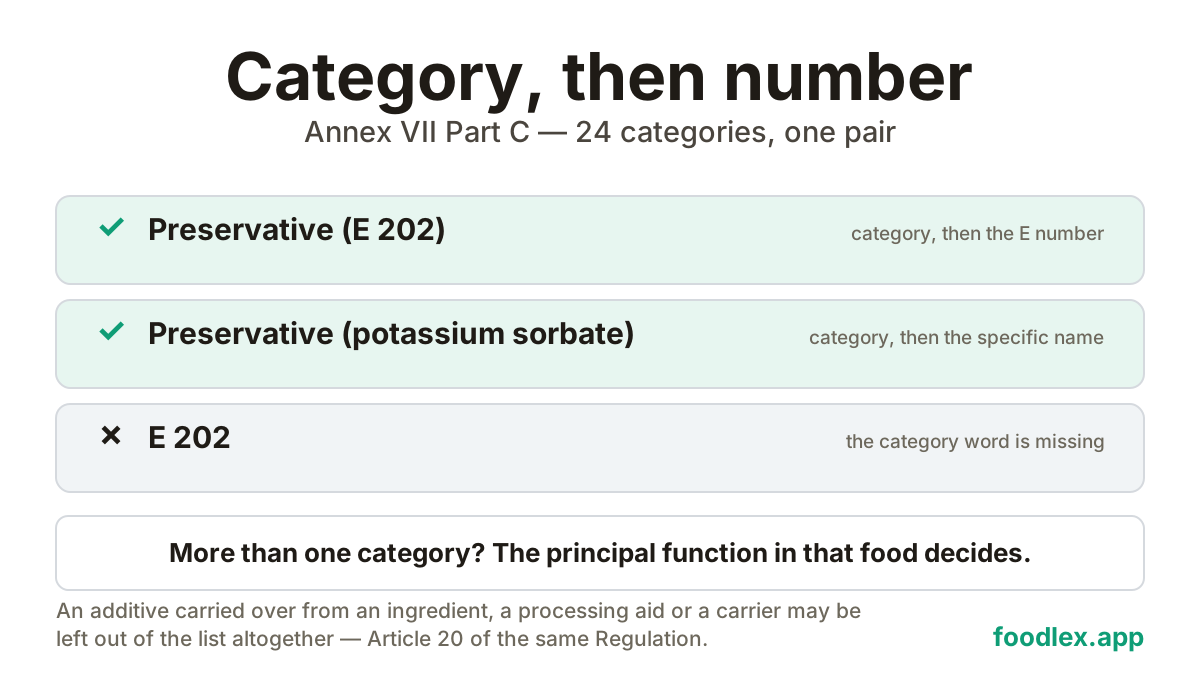
Diagram: Foodlex. Regulation (EU) No 1169/2011, Annex VII Part C, as it applies in Great Britain.
The categories are a closed list of 24, and only these words work as the category half of the pair:
| Categories in Part C of Annex VII |
|---|
| Acid · Acidity regulator · Anti-caking agent · Anti-foaming agent · Antioxidant · Bulking agent · Colour · Emulsifier · Emulsifying salts · Firming agent |
| Flavour enhancer · Flour treatment agent · Foaming agent · Gelling agent · Glazing agent · Humectant · Modified starch · Preservative · Propellent gas |
| Raising agent · Sequestrant · Stabiliser · Sweetener · Thickener |
Two of the 26 functional classes in Annex I are missing from that list, and not by accident. Carriers never appear as a category because Article 20(c) keeps them out of the ingredient list altogether, and packaging gases are declared a different way: under point 1.1 of Annex III, a food whose durability has been extended by packaging gases carries the words “packaged in a protective atmosphere” instead.
When an additive need not appear at all
Article 20 is headed “Omission of constituents of food from the list of ingredients”, and it opens with the words “Without prejudice to Article 21” — the allergen provision, which never gives way. Three of its paragraphs matter for additives:
- Carry-over. Additives and enzymes “whose presence in a given food is solely due to the fact that they were contained in one or more ingredients of that food, in accordance with the carry-over principle … provided that they serve no technological function in the finished product”. The condition is the whole point: if the carried-over additive still does something in your product, it is an ingredient of your product.
- Processing aids. Additives and enzymes “which are used as processing aids”.
- Carriers. “Carriers and substances which are not food additives but are used in the same way and with the same purpose as carriers, and which are used in the quantities strictly necessary”.
Part C picks this up from the other side: it applies to additives “other than those specified in point (b) of Article 20”. An additive you are entitled to omit needs no category word, because it is not on the label.
Six colours bring a sentence with them
Article 24 of Regulation (EC) No 1333/2008 requires additional information for the colours listed in Annex V to that Regulation. There are six, and the wording Annex V prescribes is one sentence:
“name or E number of the colour(s): may have an adverse effect on activity and attention in children.”
| Colour | E number |
|---|---|
| Sunset yellow | E 110 |
| Quinoline yellow | E 104 |
| Carmoisine | E 122 |
| Allura red | E 129 |
| Tartrazine | E 102 |
| Ponceau 4R | E 124 |
Annex V carves out two situations: foods “where the colour(s) has been used for the purposes of health or other marking on meat products or for stamping or decorative colouring on eggshells”, and “beverages containing more than 1,2 % by volume of alcohol”. Everything else carrying one of the six needs the sentence.
Four more additives that change the words near the name of the food
Annex III to Regulation (EU) No 1169/2011 lists foods whose labelling “must include one or more additional particulars”. Four of its entries are triggered by additives, and three of them attach to the name of the food, not to the ingredient list:
| Trigger | Required words |
|---|---|
| Contains an authorised sweetener | with sweetener(s) — accompanying the name of the food |
| Contains both added sugar(s) and sweetener(s) | with sugar(s) and sweetener(s) — accompanying the name of the food |
| Contains aspartame or aspartame-acesulfame salt | contains aspartame (a source of phenylalanine) |
| More than 10 % added polyols | excessive consumption may produce laxative effects |
A related entry is worth knowing even though it is not an additive: confectionery or beverages containing glycyrrhizinic acid or its ammonium salt at 100 mg/kg or 10 mg/l and above must carry “contains liquorice” immediately after the ingredient list, unless liquorice is already named there or in the name of the food.
Where the additive sits in the list
Additives are ingredients, and Article 18(1) governs the order: the list “shall be headed or preceded by a suitable heading which consists of or includes the word ‘ingredients’” and “shall include all the ingredients of the food, in descending order of weight, as recorded at the time of their use in the manufacture of the food”. An additive used at 0.02 % therefore belongs at the end of the list, not in a separate line underneath it.
One newer sentence in the same Article is easy to miss: under Article 18(3), ingredients present in the form of engineered nanomaterials must be clearly indicated, with “the word ‘nano’ in brackets” after the name.
How this sits next to the EU and Australia
Great Britain kept the substance of the EU labelling rules and rebuilt the machinery around them. Article 24(3) of the additives Regulation now refers to measures “prescribed by the appropriate authority” rather than to the Commission — a change made by the Food Additives, Flavourings, Enzymes and Extraction Solvents (Amendment etc.) (EU Exit) Regulations 2019 — and the authorisation route was replaced in 2025 as described above. The six colours, the 24 categories and the omission rules are the same text as in the EU.
Australia asks the same of a label with different furniture. Section
1.2.4—7(1) of the Australia New Zealand Food Standards Code requires the class
name from Schedule 7 “followed in brackets by the name or code
number of the substance as indicated in Schedule 8” — brackets
prescribed, and no E. The same preservative that is E 202 in Great
Britain is listed in Schedule 8 as Potassium sorbate, 202. If
you label for both markets, see
how the Food Standards Code is put
together.
Two closing notes on sources. The Food Standards Agency publishes approved-additive listings and explanatory pages; they are guidance, not law, and the legal position is the text quoted above. And where a label question involves an allergen, Article 21 overrides every omission in this article — the starting point there is Natasha’s Law and the PPDS label.
Frequently asked questions
Is it enough to write the E number on the label?
No. Part C of Annex VII requires the name of the category followed by the specific name or the E number. “Preservative (E 202)” and “Preservative (potassium sorbate)” both work; “E 202” alone does not.
Which additives can be left out of the ingredient list?
Carry-over additives that serve no technological function in the finished product, substances used as processing aids, and carriers used in the quantities strictly necessary. The allergen rules in Article 21 apply regardless.
Which colours need the warning about children?
Sunset yellow (E 110), Quinoline yellow (E 104), Carmoisine (E 122), Allura red (E 129), Tartrazine (E 102) and Ponceau 4R (E 124) — with the sentence “may have an adverse effect on activity and attention in children”.
Where is the list of additives approved in Great Britain?
Not in the Regulation any more. Annex II was omitted for England, Wales and Scotland on 1 April 2025, and Article 4 now turns on whether an additive is authorised for primary or secondary use under the regulated products regime.
This article is general information and does not replace legal advice. Quoted from legislation.gov.uk, latest available revised versions as they apply in Great Britain, retrieved 20 October 2026: Regulation (EU) No 1169/2011 Articles 18 and 20, Annex III and Annex VII Part C; Regulation (EC) No 1333/2008 Annex I, Article 4 (substituted 1 April 2025 by S.I. 2025/361, reg. 8(6)), Annex II (omitted on the same date by reg. 8(27)), Article 24 (amended by S.I. 2019/860) and Annex V. The Australian comparison is from the Australia New Zealand Food Standards Code, Standard 1.2.4 (F2015L00392, Compilation 2) and Schedule 8 (F2015L00478, Compilation 8). Where guidance of the Food Standards Agency is mentioned it is identified as guidance, which explains the law without being the law.