
Guide · Northern Ireland
‘Not for EU’ — what the marking requires in Northern Ireland, and why Great Britain only has a power
Three words, two legal systems, and a great deal of confusion about which applies where. The duty to print ‘Not for EU’ comes from an EU regulation and attaches to goods moved into Northern Ireland. In Great Britain there is no such duty — there is a reserve power that nobody has had to use. Both halves are quoted below from the legislation itself, because most of what is written about this subject describes a plan rather than a rule.
Where the duty comes from
The marking is part of the Retail Movement Scheme, the arrangement that lets retail goods move from Great Britain into Northern Ireland without full EU import checks. Its legal basis is Regulation (EU) 2023/1231, which applies in Northern Ireland under the Windsor Framework. It is not retained UK law, and that has a practical consequence: you will not find it on legislation.gov.uk. The authentic text is published by the EU.
Article 6(1) sets the duty, and it did so in three steps:
“(a) from 1 October 2023, all retail goods shall be marked in accordance with the requirements set out in points 2 and 3 of Annex IV, except for the following retail goods which shall bear an individual marking … (i) prepacked meat, prepacked meat products and meat packed on sales premises; (ii) prepacked milk, prepacked dairy products and dairy products packed on sales premises listed in Part 1 of Annex V; (b) from 1 October 2024, all milk and dairy products shall bear an individual marking …; (c) from 1 July 2025, all retail goods shall bear an individual marking … except for the retail goods listed in Part 2 of Annex V”
All three dates have passed. Article 19 gave each phase a run-off for stock already on the market — until 31 October 2023, 31 October 2024 and 31 July 2025 respectively — and those have expired too. The position today is the one in point (c): individual marking is the rule, box-level and shelf marking the exception.
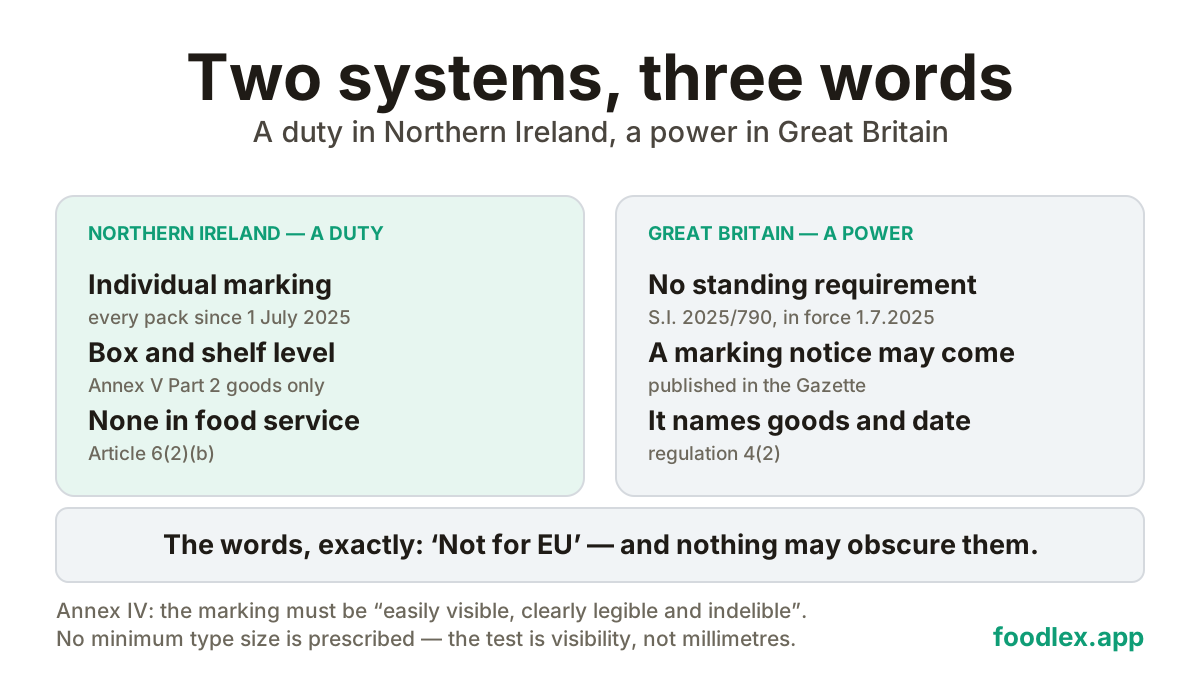
Diagram: Foodlex. Regulation (EU) 2023/1231, Articles 6 and 19 and Annex IV; Marking of Retail Goods Regulations 2025 (S.I. 2025/790).
What the marking has to look like
Annex IV is short and prescriptive. For an individual marking:
“The marking shall be attached to the packaging in a conspicuous place in such a way as to be easily visible, clearly legible and indelible. It shall not be in any way hidden, obscured, detracted from or interrupted by any other written or pictorial matter or any other intervening material. The marking shall state the following words: ‘Not for EU’”
Two further levels exist for the goods that do not need an individual marking. Point 2 requires the same wording on “the smallest container of the same prepacked retail goods”. Point 3 adds the retail floor: a sign with the words “shall be placed next to the price tag or equivalent on the shelves”, and “a sufficient number of posters shall be visibly displayed in the vicinity of the retail goods informing the consumers that those retail goods are only intended for sale to the final consumers in Northern Ireland and are not to be subsequently moved to a Member State”.
Note what Annex IV does not say: no minimum type size, no prescribed position on the pack, no language requirement beyond the three English words. The test is visibility and indelibility, not millimetres — unlike the x-height rule that governs the mandatory particulars under Article 13 of Regulation (EU) No 1169/2011.
Who does not have to mark
Article 6(2) carves out two situations, and they are the ones that matter for smaller food businesses:
- Sold loose or by weight. “Individual goods sold loose or by weight on the sales premises at the consumer’s request, including individual goods processed and sold on the sales premises by a retailer for direct consumption” are marked at box and shelf level instead — the deli counter does not label every slice.
- Food service. “Individual goods offered by a catering operator, at factory canteens, by institutional catering, by restaurants and by other similar food service operators for direct consumption on the spot shall not be required to bear a marking.”
Part 2 of Annex V lists the shelf-stable composite products that keep the lighter treatment — among them confectionery and chocolate, pasta, noodles and couscous not mixed or filled with meat product, and bread, cakes, biscuits and waffles.
Great Britain: a power, not a duty
This is where most published summaries go wrong. A GB-wide requirement was consulted on and announced, and it is easy to find articles saying it is “coming” or “postponed indefinitely”. What actually exists is the Marking of Retail Goods Regulations 2025 (S.I. 2025/790), in force since 1 July 2025 and extending to England, Wales and Scotland. Regulation 3 does not impose marking on anybody. It creates a trigger:
“This paragraph applies where the Secretary of State, after consultation with the Welsh Ministers and the Scottish Ministers, determines that the availability to consumers of certain retail goods in Northern Ireland is, or is likely to be, seriously adversely affected by relevant business operators, in respect of those goods, withdrawing from supplying those goods to Northern Ireland as a result of labelling requirements imposed by the SPS Regulation. … Where paragraph (1) applies, the Secretary of State must issue a notice (a ‘marking notice’) requiring that the retail goods specified in the notice bear an individual marking when they are first placed on the market.”
In other words: the power exists so that, if suppliers start pulling out of Northern Ireland rather than run a separate label, the government can level the field by requiring the marking in Great Britain too — for the goods named in the notice, not for everything. Regulation 3(3) lists what the Secretary of State may weigh: “trade flows or trade patterns”, “the resilience of the supply chains supporting the supply of retail goods to Northern Ireland” and “advice from the Independent Monitoring Panel”.
A notice is not a quiet administrative act. Regulation 4(1): it “must be in writing and must be published in the Gazette”; 4(2): it “must specify the date from which such goods must bear an individual marking”; and 4(3) requires the Secretary of State to “make a statement explaining why the decision to issue the marking notice was justified”.
🔎 So the practical question is whether a notice has been published. That is checkable, and it is where to look: the London and Edinburgh Gazettes. A search of the Gazette’s own feed for a marking notice concerning retail goods returned no results on 21 October 2026. A nil search result is an indication rather than proof — wording may differ — but it is the right place to verify before anyone changes artwork for the British market.
What this means for your label
| Goods moving into Northern Ireland | Goods sold in Great Britain | |
|---|---|---|
| Marking | Compulsory | Only if a marking notice names the goods |
| Level | Individual pack since 1 July 2025, except Annex V Part 2 | Individual, when a notice applies |
| Legal source | Regulation (EU) 2023/1231, Article 6 and Annex IV | S.I. 2025/790, regulations 3 and 4 |
| Where to check | The regulation and the scheme rules | The Gazette |
One consequence is worth stating plainly: the marking is a condition of movement, not a food information rule. It sits outside the mandatory particulars of Regulation (EU) No 1169/2011, so it changes nothing about the ingredient list, the allergen emphasis or the nutrition declaration — see UK food labelling regulations for the particulars themselves, and use by or best before for the one that most often travels with it.
The domestic scheme rules sit alongside the EU regulation: the Windsor Framework (Retail Movement Scheme: Public Health, Marketing and Organic Product Standards and Miscellaneous Provisions) Regulations 2023 (S.I. 2023/959) carry the British end of the arrangement.
Frequently asked questions
Is ‘Not for EU’ labelling required across Great Britain?
No. The duty attaches to retail goods moved into Northern Ireland under Article 6 of Regulation (EU) 2023/1231. For Great Britain, S.I. 2025/790 creates a power to require it by notice, not a standing requirement.
What exactly has to be printed?
The words ‘Not for EU’, in a conspicuous place, “easily visible, clearly legible and indelible”, and not obscured by anything else.
Which goods need an individual marking rather than a box label?
Since 1 July 2025 all retail goods, except the shelf-stable composite products in Part 2 of Annex V, which stay at box and shelf level.
Does food served in a restaurant need the marking?
No — Article 6(2)(b) exempts food offered for direct consumption on the spot. Goods sold loose or by weight are marked at box and shelf level instead.
This article is general information and does not replace legal advice. Quoted from Regulation (EU) 2023/1231, Articles 6 and 19 and Annexes IV and V, English text from the Publications Office of the European Union (CELEX 32023R1231), and from the Marking of Retail Goods Regulations 2025 (S.I. 2025/790, regulations 2 to 4, as made), on legislation.gov.uk. Both retrieved 21 October 2026. Whether a marking notice is in force in Great Britain must be checked in the London or Edinburgh Gazette, where regulation 4(1) requires it to be published.