
Basics · Health claims
Functional foods: which health claims are allowed
A bar with added fibre, a drink with B vitamins, a yoghurt for digestion: products that promise more than calories are called functional food in marketing. In food law the term does not exist. What is regulated is not the product — it is the sentence printed on it. This article shows which sentences are allowed, where they are listed, and which number a product has to reach before it may carry one.
“Functional food” is not a legal term
There is no EU regulation on functional food, no definition, no authorisation procedure and no labelling duty for this product group. Anyone looking for a legal basis for the term will not find one — and that is not an oversight by the legislator, it is deliberate. What is regulated is not what a product is, but what is claimed about it.
That is why the governing act is named after the statement rather than the product: Regulation (EC) No 1924/2006 on nutrition and health claims made on foods. It has applied since 2007 and it is the rulebook against which every functional food concept is measured in the end.
Two kinds of claims — and they work differently
The Regulation knows exactly two categories. Which one you are dealing with decides where you have to look things up.
| Nutrition claim | Health claim | |
|---|---|---|
| Example | “source of fibre”, “low energy”, “high protein” | “Niacin contributes to normal energy-yielding metabolism” |
| Where is the list? | In the Annex to Regulation 1924/2006 — exhaustive | In the EU Register, authorised mostly through Regulation (EU) No 432/2012 |
| What does it say? | Something about the composition | A relationship with health |
| Free wording? | Only variants with the same meaning | The authorised wording is the benchmark |
| Mandatory information alongside? | None — the claim only has to be listed in the Annex and meet its condition (Article 8(1)) | Yes — a statement on a varied and balanced diet, the quantity required, where appropriate a warning (Article 10(2)) |
Both lists are exhaustive. What is not on them must not go on the pack — not even when it sounds scientifically plausible.
Where the authorised health claims are listed
The European Commission keeps a public EU Register of nutrition and health claims. It holds every claim ever applied for — the authorised ones and the rejected ones, which is at least as useful.
An entry looks like this:
| Field | Content |
|---|---|
| Nutrient | Niacin |
| Claim type | Art. 13(1) — generally accepted science |
| Status | Authorised |
| Wording | “Niacin contributes to normal energy-yielding metabolism” |
| Conditions of use | only for food that is at least a source of niacin |
| Legal basis | Regulation (EU) No 432/2012 |
One thing is easy to get wrong when you sell across borders: the binding wording is the one in your own language version of the Annex to Regulation (EU) No 432/2012, not a translation of the English register line. The German text of the very same claim, for instance, reads “Niacin trägt zu einem normalen Energiestoffwechsel bei” — literally “Niacin contributes to a normal energy metabolism”, which is not the English wording above. Take each wording from the regulation in the language of the label.
From the claim to the number — and why there are two routes
This is where it gets practical, and where most people lose the thread. The conditions of use in the Register sometimes give a number — and sometimes they only refer on. Which of the two it is decides where the threshold sits and what quantity it relates to. Counted in the Annex to Regulation (EU) No 432/2012:
| The conditions of use … | Entries | So where is the number? |
|---|---|---|
| … refer to a nutrition claim — “at least a source of …”, “SUGARS-FREE”, “REDUCED …” | around 180 | in the Annex to Regulation (EC) No 1924/2006 — and possibly further on from there |
| … give a quantity of their own | around 40 | in the condition itself |
Our own count of the Annex as in force on 7 October 2026: a little over 220 entries carry conditions of use. Two independent counting methods gave 222 and 225 entries and 183 and 182 references — hence the rounded figures here. The large majority of those references (around 170) lead to a “source of” claim, the rest to some other nutrition claim.
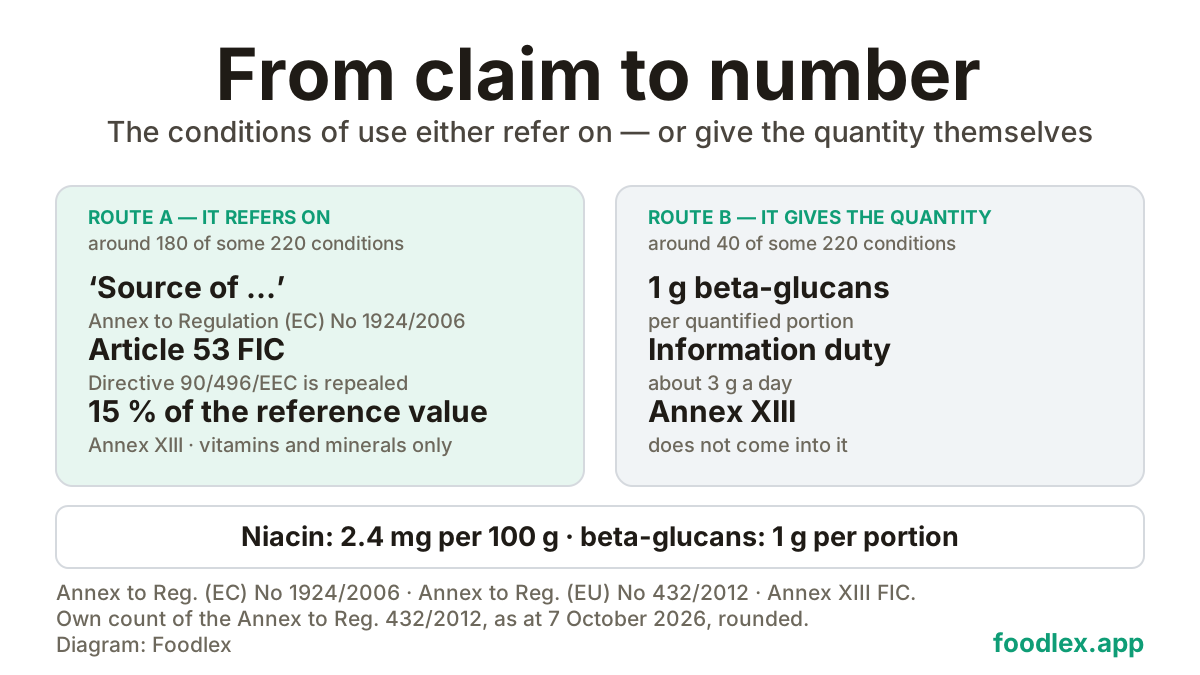
Diagram: Foodlex. Annex to Reg. (EC) No 1924/2006; Annex to Reg. (EU) No 432/2012; Reg. (EU) No 1169/2011 Article 53 and Annex XIII.
Route A: the condition refers on
This is the normal case for vitamins and minerals. The Annex to Regulation (EU) No 432/2012 phrases it identically for every single vitamin — here for niacin:
“The claim may be used only for food which is at least a source of niacin as referred to in the claim SOURCE OF [NAME OF VITAMIN/S] AND/OR [NAME OF MINERAL/S] as listed in the Annex to Regulation (EC) No 1924/2006.”
There is no number here. And the document it refers to refers on once more:
| # | Step | Source |
|---|---|---|
| 1 | The claim is authorised | EU Register, Art. 13(1), via Reg. (EU) No 432/2012 |
| 2 | Condition: the product must be at least a source of | Conditions of use in the Annex to Reg. (EU) No 432/2012 |
| 3 | “Source of” means a significant amount as defined in the Annex to Directive 90/496/EEC | Annex to Reg. (EC) No 1924/2006 |
| 4 | That Directive is repealed — the reference counts as a reference to the FIC Regulation | Article 53 FIC Regulation |
| 5 | Significant amount = 15 % of the reference value per 100 g/ml, 7,5 % per 100 ml for beverages — or 15 % per portion if the package contains only a single portion | Annex XIII Part A point 2 FIC Regulation |
These five steps apply to vitamins and minerals only. Where a condition refers to some other nutrition claim, the route ends at step 3 — because the number is already there: “sugars-free” means no more than 0,5 g of sugars per 100 g, “source of fibre” at least 3 g per 100 g. Annex XIII to the FIC Regulation does not come into it at all.
The catch in step 4
The 2006 Health Claims Regulation still refers to the Nutrition Labelling Directive 90/496/EEC. That Directive has not existed for over ten years. Article 53 of the FIC Regulation says:
“1. Directives 87/250/EEC, 90/496/EEC, 1999/10/EC, 2000/13/EC, 2002/67/EC and 2008/5/EC and Regulation (EC) No 608/2004 are repealed as from 13 December 2014. 2. References to the repealed acts shall be construed as references to this Regulation.”
Follow the chain without knowing that sentence and you end up at a dead end. With it, you end up in Annex XIII to the FIC Regulation — and that is where the number is.
A worked example for route A
The nutrient reference value for niacin in Annex XIII is 16 mg. Which gives:
| Type of product | Calculation | Threshold for “source of niacin” |
|---|---|---|
| Bar, yoghurt, bread (solid) | 15 % of 16 mg | 2,4 mg per 100 g |
| Beverage | 7,5 % of 16 mg | 1,2 mg per 100 ml |
| Single-portion package | 15 % of 16 mg per portion | 2,4 mg per portion |
The third row is easily missed and it is the decisive case for bars and sachets: if the package contains only one portion, the portion counts, not the 100 g. A 40 g bar then needs 2,4 mg per bar instead of 2,4 mg per 100 g — two and a half times as much.
Only once that amount is reached may the sentence “Niacin contributes to normal energy-yielding metabolism” go on the pack at all. The same arithmetic applies to every vitamin and mineral claim — only the reference value changes: vitamin C 80 mg, calcium 800 mg, vitamin B12 2,5 µg.
Route B: the condition gives its own quantity
For substances that have no nutrition claim at all — beta-glucans, plant stanol esters, chitosan, betaine, walnuts — the condition writes the quantity out itself. And it is built along entirely different lines:
“The claim may be used only for food which contains at least 1 g of beta-glucans from oats, oat bran, barley, barley bran, or from mixtures of these sources per quantified portion. In order to bear the claim information shall be given to the consumer that the beneficial effect is obtained with a daily intake of 3 g of beta-glucans …”
Three differences, and every one of them can sink a recipe:
| Niacin (route A) | Beta-glucans (route B) | |
|---|---|---|
| Threshold | 2,4 mg (solid) / 1,2 mg (beverage) | 1 g, no distinction |
| Reference quantity | per 100 g or 100 ml | per quantified portion |
| Where the number is | Annex XIII FIC Regulation, three references away | in the condition itself |
| Extra duty | none beyond Article 10 | inform the consumer about the 3 g daily intake |
The reference quantity is the most dangerous point. “Per quantified portion” means: make the portion smaller and you lose the claim — under route A it would be unaffected. And there are more reference quantities still: a second beta-glucan claim requires “at least 4 g … for each 30 g of available carbohydrates in a quantified portion”, the walnut claim “a daily intake of 30 g of walnuts”. There is no single reference quantity in this Regulation. Assume “per 100 g” because that is how it works for the vitamins, and your calculation misses the product.
What applies to every health claim on top
Whichever route produced the number: a health claim brings duties with it that a nutrition claim does not have. Article 10(2) of Regulation (EC) No 1924/2006:
“Health claims shall only be permitted if the following information is included in the labelling …: (a) a statement indicating the importance of a varied and balanced diet and a healthy lifestyle; (b) the quantity of the food and pattern of consumption required to obtain the claimed beneficial effect; (c) where appropriate, a statement addressed to persons who should avoid using the food; and (d) an appropriate warning for products that are likely to present a health risk if consumed to excess.”
That is label real estate, and it is not negotiable. Check the threshold, print the sentence, and you still have not made the claim correctly. “Source of fibre”, by contrast, needs none of it — nutrition claims only have to be listed in the Annex and meet their condition (Article 8(1)).
Three products off the shelf — and what they give away
That is the system. Three real examples show where it bites in practice — each one with a point the tables above do not yet cover.
1. A spread: one sentence, two claims
The German site of Becel carries this sentence:
„becel ist reich an Omega-3-Fettsäuren, die zur Aufrechterhaltung eines normalen Cholesterinspiegels beitragen.“
— “becel is rich in omega-3 fatty acids, which contribute to the maintenance of a normal cholesterol level.”
That is not one claim but two — and they live in different documents, with different thresholds:
| Part of the sentence | Kind | Source | Threshold |
|---|---|---|---|
| “rich in omega-3 fatty acids” | nutrition claim | Annex to Reg. 1924/2006, entry “HIGH OMEGA-3 FATTY ACIDS” | 0,6 g alpha-linolenic acid per 100 g and per 100 kcal |
| “which contribute to the maintenance of a normal cholesterol level” | health claim | Reg. (EU) No 432/2012, entry alpha-linolenic acid (ALA) | at least a “source of omega-3 fatty acids”: 0,3 g ALA per 100 g and per 100 kcal — plus information on 2 g ALA a day |
Two things here matter for the recipe. First, the stricter threshold wins: the health claim alone needs 0,3 g, the words “rich in” need 0,6 g. Put both in one sentence and 0,6 g is what you have to hit.
Second, this is a reference quantity the article has not met yet: “per 100 g and per 100 kcal”. Both conditions have to hold, and which one is the hard one depends on the energy density:
| Product | Energy | 0,6 g per 100 kcal means | 0,6 g per 100 g means | binding |
|---|---|---|---|---|
| Spread | 600 kcal/100 g | 3,6 g ALA per 100 g | 0,6 g per 100 g | per 100 kcal |
| Oat drink | 45 kcal/100 ml | 0,27 g per 100 ml | 0,6 g per 100 ml | per 100 g |
And one more thing: the ALA condition does not point into Annex XIII to the FIC Regulation but to the entry “SOURCE OF OMEGA-3 FATTY ACIDS” in the Annex to Regulation 1924/2006 — where the number already is. So route A ends short of Annex XIII here too. The five steps really do apply to vitamins and minerals only.
2. Oat beta-glucan: one substance, two claims
Beta-glucans have two authorised claims, and they are not even in the same regulation. One is the familiar entry in the Annex to Reg. 432/2012; the other is a claim on the reduction of a disease risk under Article 14(1)(a), authorised by a regulation of its own:
| Article 13 — Reg. (EU) No 432/2012 | Article 14(1)(a) — Reg. (EU) No 1160/2011 | |
|---|---|---|
| Wording | “Beta-glucans contribute to the maintenance of normal blood cholesterol levels” | “Oat beta-glucan has been shown to lower/reduce blood cholesterol. High cholesterol is a risk factor in the development of coronary heart disease.” |
| What it says | maintaining a normal level | lowering — and it names the risk factor |
| Raw material | oats, oat bran, barley or barley bran | oats only |
| Amount | at least 1 g per quantified portion | at least 1 g of oat beta-glucan per quantified portion |
| Information duty | 3 g a day | 3 g a day |
The amounts match, the statement does not — and anyone searching only the Annex to Reg. 432/2012 never finds the stronger sentence. Article 14 claims are authorised one at a time, each by its own regulation. The one place they all show up together is the EU Register.
3. The claim that does not exist
The very regulation that authorises the oat claim rejects two others in its Annex II — and names a product while doing so:
“ANNEX II — REJECTED HEALTH CLAIMS […] Actimel® Lactobacillus casei DN-114 001 plus yoghurt symbiosis — Fermented milk containing the probiotic Lactobacillus casei DN-114 001 and yoghurt symbiosis decreases presence of Clostridium difficile toxins in the gut (of susceptible ageing people). […]”
The same annex rejects soy protein with a cholesterol claim. A statement about the bacteria is therefore not permitted. What is left are the claims for the added vitamins, and those run through route A like any other:
| Authorised claim (Reg. 432/2012) | Condition | Number for a 100 g bottle |
|---|---|---|
| “Vitamin D contributes to the normal function of the immune system” | at least a “source of vitamin D” | reference value 5 µg → 15 % per portion = 0,75 µg |
| “Vitamin B6 contributes to the normal function of the immune system” | at least a “source of vitamin B6” | reference value 1,4 mg → 15 % per portion = 0,21 mg |
Because the bottle holds only one portion, the third variant from Annex XIII applies — 15 % per portion instead of per 100 g. Exactly the case from the worked example above.
Which leads to the most useful habit there is in product development: search the register for the refusals first. They sit there right beside the authorisations, and they save you a development that ends up allowed to claim nothing.
Three claims that need no register
Nutrition claims sit directly in the Annex to Regulation 1924/2006, with the condition next to them. Three that come up constantly in product development:
| Claim | Condition (solid foods) |
|---|---|
| Source of fibre | at least 3 g of fibre per 100 g |
| High fibre | at least 6 g of fibre per 100 g |
| Source of protein | at least 12 % of the energy value from protein (high protein: 20 %) |
What matters is the phrase that appears in every one of these entries: the condition applies to the claim “and any claim likely to have the same meaning for the consumer”. “Rich in fibre” is therefore the same claim as “high fibre” — and needs the same 6 g. Rewording does not help.
For product development: when calculation is enough — and when it is not
The nutrition declaration may be calculated. That is stated expressly in Article 31(4) of the FIC Regulation:
“The declared values shall, according to the individual case, be average values based on: (a) the manufacturer’s analysis of the food; (b) a calculation from the known or actual average values of the ingredients used; or (c) a calculation from generally established and accepted data.”
Analysis and calculation therefore stand side by side — calculation is not a fallback. For development it is in fact the better tool: it costs nothing, gives an answer in seconds and can be repeated as often as you like while you tune the recipe.
Where calculation hits its limit
A nutrition table is a piece of information. A claim is a promise — about the product as it stands on the shelf. If it is checked, an authority measures the finished product, not the recipe.
In between sits the process. A calculation starts from the values of the ingredients. Whatever is lost in baking, pasteurising, drying or over shelf life appears in no nutrition table — it depends on the temperature, the duration, the pH, the oxygen and the packaging of that particular product. The heat- and light-sensitive vitamins are hit hardest; for minerals and fibre the difference is usually small.
Retention factors: that much is measured, little follows from it
There is a figure for that loss. A retention factor is the share of a nutrient that survives preparation — 0.70 means 70 % is still there. The European basis for these comes from Karlsruhe: Antal Bognár, Tables on weight yield of food and retention factors of food constituents, report BFE-R-02-03 of the Bundesforschungsanstalt für Ernährung (Federal Research Centre for Nutrition, 2002) — the predecessor of the Max Rubner Institute, which also publishes the German Federal Food Key. An extract, root and tuber vegetables:
| Nutrient | boil (A) | boil (B) | steam (A) | fry |
|---|---|---|---|---|
| Vitamin C | 0.40 | 0.85 | 0.80 | 0.85 |
| Vitamin B1 (thiamin) | 0.70 | 0.90 | 0.80 | 0.90 |
| Folate | 0.50 | 0.70 | 0.60 | 0.70 |
| Protein | 0.90 | 1.00 | 0.95 | 1.00 |
| Dietary fibre | 0.93 | 1.00 | 0.94 | 1.00 |
| Calcium | 0.95 | 1.00 | 0.95 | 1.00 |
A = vegetable, edible part · B = total dish including cooking liquid. Source: Bognár 2002, table 26.
The gap between A and B is what this table really teaches. Vitamin C on boiling: 0.40 against 0.85. That is not measurement error, that is the cooking water. Pour it away and you lose 60 %; keep it in the dish and you lose 15 %. The nutrient is not destroyed, it moves — and whether it stays in the product is decided by the process, not the recipe. For potato products (table 32) the same pattern is milder: vitamin C 0.70 against 0.95, folate 0.75 against 0.80.
Also visible: protein, fibre and calcium sit between 0.90 and 1.00. The worry is about the vitamins, not about the whole table.
So these numbers show the principle, not your product:
| What they are good for | What they are not |
|---|---|
| Estimating the order of magnitude — is a 10 % loss looming, or a 60 % one? | Backing up a threshold that is only just met |
| Deciding which nutrient is worth analysing at all | Replacing the analysis |
| Weighing one process against another (drain the water or not) | Modelling industrial processes for which no data exist |
⚠️ The FIC Regulation does not contain retention factors. Article 31 names conversion factors — for the energy value (paragraph 1) and possibly, in future, for vitamins and minerals (paragraph 2) — but no retention factors and no duty to use them. What the Regulation does say plainly is in Article 31(3):
“The energy value and the amounts of nutrients referred to in Article 30(1) to (5) shall be those of the food as sold.”
That sets the direction: what is required is the value after the process. Whether you estimate it with retention factors or measure it in a lab, the Regulation leaves to the manufacturer — and the responsibility with them too.
On where the numbers come from, because the American table is often taken for the only one:
| Source | Origin | Role |
|---|---|---|
| Bognár 2002, report BFE-R-02-03 | 🇩🇪 Federal Research Centre for Nutrition, Karlsruhe | the European basis; EuroFIR simply calls them the “Bognar tables” |
| EuroFIR collection and guideline | 🇪🇺 EU research network | the harmonised version, with rules on which factor applies to which process |
| Bergström 1994 | 🇸🇪 Livsmedelsverket, Sweden | mainly yield factors (weight change) |
| USDA Table of Nutrient Retention Factors | 🇺🇸 USA | the American counterpart — not the basis of the European databases |
For a recipe in the EU, Bognár is therefore the closer source, not the USDA table. The EuroFIR guideline points to both European works — and sorts the factors into three process groups: dry heat (140–350 °C; baking, roasting, grilling), moist heat (100–125 °C; boiling, braising, steaming) and fat (140–200 °C; frying, deep frying).
Which leads to a simple division of labour:
| Phase | Tool | Why |
|---|---|---|
| Recipe development | Calculation | fast, repeatable, shows immediately how far the threshold is |
| Before committing to a claim on the pack | Lab analysis | measures the product after the process — the same thing the authority measures |
| After a recipe or process change | calculate first, then measure | the calculation tells you whether the analysis is worth it |
If you plan a claim that sits just above the threshold, be especially careful: with a calculated value of 2,5 mg and a threshold of 2,4 mg, process loss alone decides whether the claim holds. In cases like that the analysis is not optional — it is the only solid basis there is.
Frequently asked questions
What are functional foods?
“Functional food” is a marketing term, not a legal one — no EU act defines it. It is used for foods that promise an effect beyond nutrition. What the law regulates is not the product but the claim on it.
Where can I find the authorised health claims?
In the European Commission’s EU Register of nutrition and health claims. Every entry gives the nutrient, the wording, the status, the conditions of use and the regulation under which it was authorised — usually Regulation (EU) No 432/2012.
When may a product be called a “source of vitamin C”?
When it contains a significant amount: as a rule 15 % of the nutrient reference value per 100 g or 100 ml, 7,5 % per 100 ml for beverages, or 15 % per portion if the package contains only a single portion. The reference value for vitamin C is 80 mg, so a solid food needs about 12 mg per 100 g and a beverage about 6 mg per 100 ml.
Is a calculated nutrition value enough for a health claim?
For the nutrition declaration, Article 31(4) of the FIC Regulation allows calculation expressly. A claim is something more: a promise about the product as sold, and in case of doubt it is measured on the finished product. For heat-sensitive nutrients the analysed value is therefore often lower than the calculated one.
Does every condition of use contain a number?
No. Of the roughly 220 entries in the Annex to Regulation (EU) No 432/2012, around 180 refer to a nutrition claim — the number is then somewhere else. Around 40 give a quantity of their own, and often with a reference quantity other than 100 g: “per quantified portion”, “for each 30 g of available carbohydrates”, “a daily intake of”. The reference quantity therefore needs checking just as much as the threshold.
Can I word a claim myself?
Only within narrow limits. For health claims the authorised wording is the benchmark; any variation must have the same meaning for the consumer. A freely invented health relationship is not permitted, even if it happens to be true.
Does this apply to an online shop as well?
Yes. If you sell to consumers yourself, the mandatory particulars have to be available before the purchase — and a claim on the product page is the same claim as on the pack. More on that in food labelling.
What about botanicals and probiotics?
For many plant substances the applications in the Register have been “on hold” for years, for others they were rejected. In several Member States the word “probiotic” is itself treated as a health claim. A look in the Register before development regularly saves an expensive reformulation.
This article is general information and is not legal advice. What governs is the version of Regulation (EC) No 1924/2006, Regulation (EU) No 432/2012 and Regulation (EU) No 1169/2011 (FIC Regulation) in force at the time, together with the supplementary national provisions. As at: 7 October 2026.