Guide · Allergens
Gluten-free grains — which ones really are
The list of gluten-free grains is short and it is settled. What follows for a pack is not: a label may not say “gluten-free” because a grain naturally carries none, but only from a measured limit onwards. Both sides are below — the species, and the figure that decides the claim.
Which grains are naturally gluten-free?
These species carry no gluten — neither the grain nor the flour milled from it:
| Group | Species | What they become |
|---|---|---|
| Grains | rice, maize, millet, sorghum, teff | rice flour, polenta, millet flakes, injera |
| Pseudocereals | buckwheat, quinoa, amaranth | buckwheat flour, galettes, quinoa flakes |
| Other flours | chickpea, lupin, chestnut, almond, coconut | farinata, almond-flour baking |
Pseudocereals are botanically not grains. Buckwheat belongs to the knotweed family, quinoa and amaranth to the amaranth family. For the kitchen that makes no difference; for labelling it does: they are not in Annex II No 1 of the FIC Regulation and trigger no allergen declaration for gluten.
⚠️ Lupin is gluten-free and still an allergen. It is number 13 in Annex II — a gluten-free flour is therefore not automatically an uncritical one. More in our article on lupin as an allergen.
The other way round: which grains contain gluten
Annex II No 1 of Regulation (EU) No 1169/2011 names four grains and their crossbreds: wheat, rye, barley, oats. More important than the list is how far “wheat” reaches — across the whole genus: spelt, khorasan wheat (Kamut®), durum, einkorn, emmer and green spelt are wheat. Triticale is a cross of wheat and rye, and therefore a crossbred variety.
The full derivation, including how the ingredient list has to be written, is in the sister article cereals containing gluten — allergen No 1.
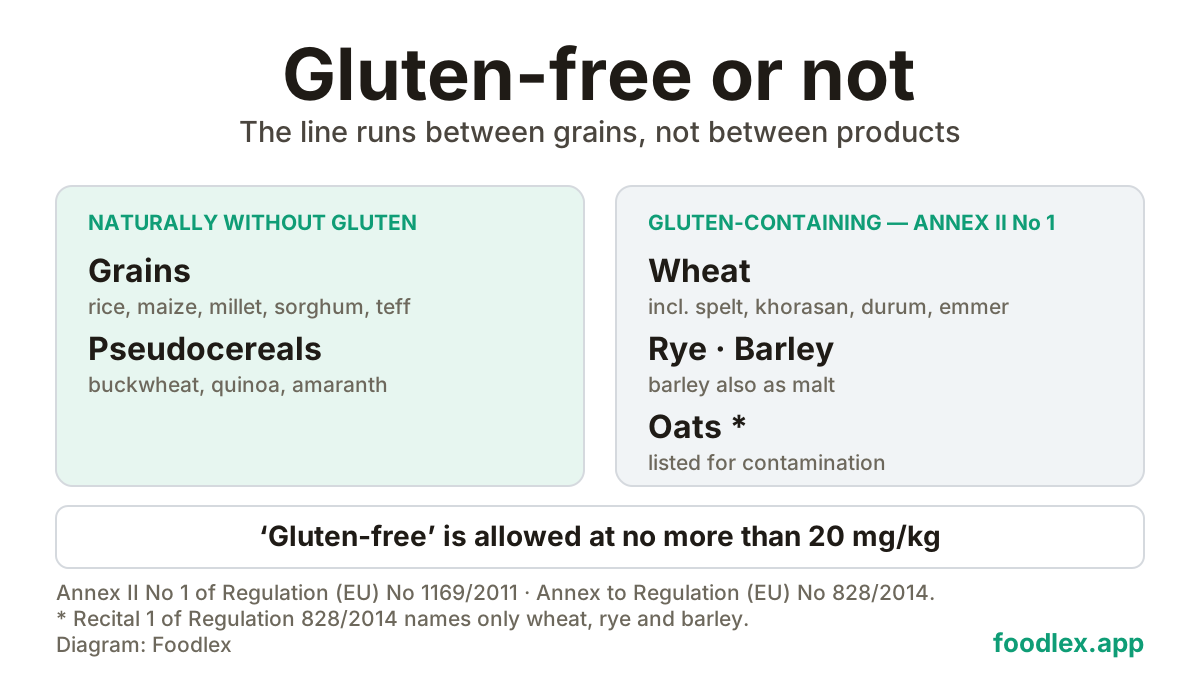
Diagram: Foodlex. Regulation (EU) No 1169/2011, Annex II No 1; Regulation (EU) No 828/2014, Annex.
Oats — the case that sits on both sides
Oats are the one entry where the two regulations differ, and that is not a contradiction but two different questions.
Annex II of the FIC Regulation lists oats as an allergen — because in practice they are almost always contaminated with wheat, rye or barley: shared fields, shared mills, shared transport.
Recital 1 of Regulation (EU) No 828/2014, by contrast, does not count them among the gluten-containing grains. It reads:
“Wheat (i.e. all Triticum species, such as durum wheat, spelt, and khorasan wheat), rye and barley have been identified as grains that are scientifically reported to contain gluten.”
Oats are missing from that list. That is why “gluten-free oats” exist at all — and why they have a section of their own, Part B, in the Annex:
“Oats contained in a food presented as gluten-free or very low gluten must have been specially produced, prepared and/or processed in a way to avoid contamination by wheat, rye, barley, or their crossbred varieties and the gluten content of such oats cannot exceed 20 mg/kg.”
🟡 One observation for anyone labelling in two languages: the English text uses “very low gluten” in both Part A and Part B. The German text does not — Part A says „sehr geringer Glutengehalt“, Part B „sehr niedriger Glutengehalt“. A German pack should carry the wording from Part A, which is where the permitted statements are set out. That is a reading of the text, not case law.
“Gluten-free” is not a word but a limit
This is where the diet question parts from the labelling question. A bread made only of rice flour carries no gluten — whether “gluten-free” may go on the pack is still decided by a measurement. The Annex to Regulation (EU) No 828/2014, Part A:
“The statement ‘gluten-free’ may only be made where the food as sold to the final consumer contains no more than 20 mg/kg of gluten.”
| Statement | Maximum | What it is meant for |
|---|---|---|
| “gluten-free” | 20 mg/kg | any food, including one made from naturally gluten-free ingredients |
| “very low gluten” | 100 mg/kg | only for foods made from specially processed wheat, rye, barley, oats or their crossbreds |
Three consequences that are regularly missed:
- What counts is the food as sold to the final consumer — not the recipe, not the ingredient. Flour dust in the bakery counts.
- “Very low gluten” is not the weaker option for any product. The wording ties it to ingredients from the four grains that were specially processed to reduce the gluten content.
- There is no “low in gluten”. The Regulation allows exactly the two statements above; a third form of words is not a milder grade but an unprovided-for claim.
Where gluten comes from when you do not expect it
A list of gluten-free grains only helps as long as the product stays that way. Four routes by which gluten reaches an otherwise gluten-free food:
- Malt. Malt, malt extract and malt flavouring come mostly from barley — including in maize cornflakes.
- Binders and carriers. Wheat starch, wheat gluten (seitan), semolina in ready-made sauces.
- Spice blends and flavourings that carry wheat flour as a free-flow agent.
- The shared line. The same mill, the same mixer, the same fryer.
The other way round, Annex II No 1 names four exceptions that need no allergen declaration despite coming from gluten-containing grain: wheat-based glucose syrups including dextrose, wheat-based maltodextrins, barley-based glucose syrups, and cereals used for making distillates including ethyl alcohol of agricultural origin.
Frequently asked questions
Which grains are gluten-free?
Naturally without gluten are rice, maize, millet, sorghum and teff, together with the pseudocereals buckwheat, quinoa and amaranth. Annex II No 1 lists as gluten-containing: wheat (including spelt, khorasan wheat, durum, einkorn and emmer), rye, barley, oats and their crossbred varieties.
Which grain has the least gluten?
Among the listed ones, oats: Recital 1 of Regulation (EU) No 828/2014 names only wheat, rye and barley as containing gluten. For a label a ranking by species does not help, though — what counts is the measured content of the finished food, not the species.
Is rye gluten-free?
No. Rye is in Annex II No 1 and Recital 1 of Regulation (EU) No 828/2014 names it expressly as gluten-containing. The same goes for rye flour, rye malt and rye sourdough.
When may a label say “gluten-free”?
When the food as sold to the final consumer contains no more than 20 mg/kg of gluten. “Very low gluten” is allowed up to 100 mg/kg, but only for foods made from specially processed gluten-containing grain.
Is buckwheat a grain?
Not botanically — buckwheat belongs to the knotweed family. That is why it is called a pseudocereal. For labelling that is exactly the point: it is not in Annex II No 1 and triggers no allergen declaration for gluten.
This article is general information and does not replace legal advice. What counts is the wording in force: Annex II No 1 of Regulation (EU) No 1169/2011, and Recital 1 and the Annex of Implementing Regulation (EU) No 828/2014. The quotations were checked in full text on 30 September 2026 through the EU Cellar (CELEX 32014R0828). Whether a food stays under the limit is answered by an analysis, not by the recipe.