
For teaching and study
Foodlex for universities — free for students
From a recipe, Foodlex works out the nutrition declaration under the retained Regulation 1169/2011, takes the allergen labelling from the same ingredient list and turns both into a finished label — including the PPDS label that Natasha’s Law requires. Students of nutrition, dietetics and food science use it free of charge, unlocked through their university email address.
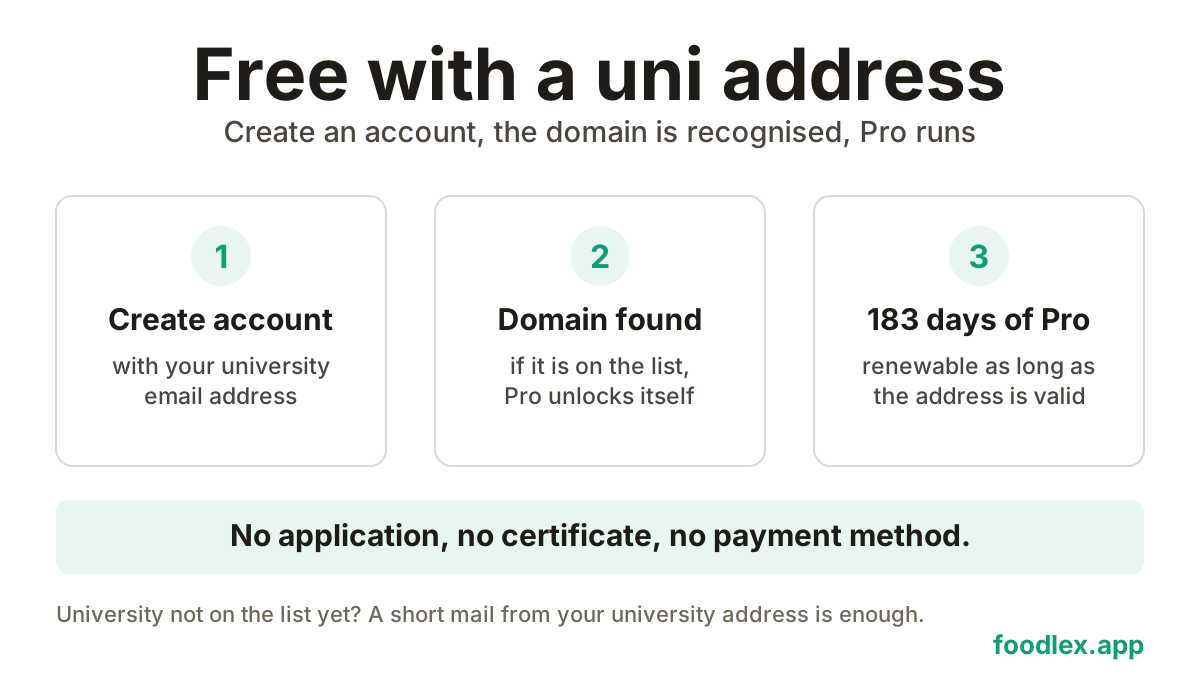
Unlocked in three steps
-
Create an account with your university email address — the one
you were given at the start of your course, e.g.
ab123456@student.reading.ac.uk. - That’s it. If your university’s domain is enabled, full access unlocks automatically. No application, no questions, no proof of enrolment.
- 183 days, renewable. After that, unlock once more, as long as the address is still valid.
What students use it for
Set to the UK market, Foodlex follows the British version of the food information rules and the British composition data:
- Nutrition declaration — the mandatory values of Article 30(1), per 100 g or 100 ml, energy in kJ and kcal, salt in grams.
- British composition data. In the UK market the default source is CoFID 2021 — McCance and Widdowson’s Composition of Foods Integrated Dataset — not the German or French tables.
- Allergen labelling under Article 9(1)(c) and Annex 2, with the allergen emphasised inside the list of ingredients as Article 21(1)(b) requires.
- PPDS labels under Natasha’s Law — name of the food plus the full list of ingredients, directly on the package.
- Front-of-pack traffic lights, worked out from the same recipe. They are voluntary; the thresholds are set out here.
- Print-ready label as a PDF — for coursework, placements and dissertations.
Where the UK label differs from the European one
Less than most people expect, and not where they expect it. The figures are the same; the differences sit around them. Four of them, each with the wording that creates it.
The nutrition declaration is unchanged
This is the useful surprise. Great Britain kept Regulation (EU) No 1169/2011 as domestic law, and the nutrition declaration came across word for word. Annex 15 of the retained version still reads “The units of measurement to be used in the nutrition declaration for energy (kilojoules (kJ) and kilocalories (kcal)) and mass (grams (g), milligrams (mg) or micrograms (μg))”, and the table it prescribes still begins “energy | kJ/kcal” and ends “salt | g”.
So both energy figures are mandatory, salt is given in grams rather than sodium in milligrams, and the reference intake stays at 8 400 kJ/2 000 kcal. Everything on the European page about those values applies on a British label too — which is exactly what makes the three differences below easy to miss.
Prepacked for direct sale: the UK went further than the EU
This is the big one, and it runs the other way from what you might assume: the British rule is stricter than the European one. Food packed on the premises where it is sold — the sandwich made in the back of the shop, the salad box, the cake slice in a clamshell — needs a full label. Regulation 5A of the Food Information Regulations 2014 says a food business operator “must provide directly on the package or on a label attached to the package the particulars required by… Article 9(1)(b) (list of ingredients)… [and] Article 9(1)(c) (labelling of certain substances or products causing allergies or intolerances), as read with Article 21(1) and Annex 2”.
Under the EU version, Article 44(1)(b) leaves that to each Member State: the particulars beyond allergen information are “not mandatory unless Member States adopt national measures”. The UK adopted them. What goes on such a label, and what counts as PPDS in the first place, is in our guide to Natasha’s Law.
Traffic lights are recommended, not required
Front-of-pack colour coding is the most visible thing on a British pack and the thing students most often assume is compulsory. It is not. Its legal basis is Article 35 of the retained Regulation, which allows additional forms of expression on conditions, and paragraph 2 goes no further than a recommendation: “The appropriate authority may recommend to food business operators the use of one or more additional forms of expression or presentation of the nutrition declaration”. The EU text of the same paragraph says “Member States may recommend” — the same permission, a different authority.
The two texts have already drifted apart
“The UK kept the EU regulation” is true and not quite enough: the retained text is British law now, and British instruments amend it. The drift is visible inside a single article — the allergen article. Paragraph 1 of Article 21, the duty that reaches a label, still says “the name of the substance or product as listed in Annex II”. Paragraph 2, the power to change that list, was rewritten and now says “the appropriate authority must systematically re-examine the list in Annex 2” (substituted by S.I. 2019/778). One article, two names for the same annex.
Counted across the British text: “Annex II” seven times, “Annex 2” twice — and both of the arabic ones sit in the power to amend the list, not in the duty that goes on a pack. A label in Great Britain therefore still cites Annex II. A second example runs the other way: the EU version of Article 44 has a third paragraph — “Member States shall communicate to the Commission the text of the measures… without delay” — and in the British version it is simply gone, “omitted (31.12.2020) by virtue of The Food (Amendment) (EU Exit) Regulations 2019 (S.I. 2019/529)”.
None of that changes what you print today. It is the reason to read the British version rather than the European one — a citation copied from the EU text is not automatically a citation of UK law — and the reason Northern Ireland needs its own answer. Our guide to the UK food labelling regulations sets out which text applies where.
Quoted wording taken from legislation.gov.uk: Regulation (EU) No 1169/2011 as it applies in Great Britain, Annex 15, Article 21, Article 35 and Article 44 (“Latest available (Revised)”, read 21 October 2026), and the Food Information Regulations 2014 (S.I. 2014/1855), regulation 5A as substituted by S.I. 2022/481. The European wording is the consolidated EU version of 1 January 2018 (CELEX 02011R1169-20180101).
For lecturers and programme directors
The institution has nothing to do. There is no campus licence, no paperwork, no installation and no user administration. Students unlock access themselves; there are no costs and no administrative effort.
If you would like to use Foodlex in a module, you can reach me directly at kontakt@foodlex.app. I come from the industry — product management, product development and quality management — and built Foodlex myself. I am happy to answer questions about the calculation logic or about how individual requirements of the regulations are interpreted.
Access applies to every address on an unlocked domain, so staff are included too. Anyone preparing the module needs the same range of functions as the students. The app itself is in English, German and French.
Try it without an account
Four tools run in the browser without signing in — good for a first look, or as an exercise during a class:
- Nutrition calculator — works the values out from a recipe, with CoFID as the composition data.
- Allergen checker — reads an ingredient list and finds the fourteen of Annex 2 in it.
- Nutrition information calculator — enter the values per 100 g and the serving size, and the back-of-pack table is laid out with both energy figures.
- kJ to kcal converter — the exact factor and the rounding the rules expect.
These UK universities are unlocked
As of 21 October 2026 — the 22 UK institutions with an IFST-accredited degree programme, reachable from 24 email domains. Institutions in Europe are listed on the European page, Australian ones on the Australian page and US ones on the US page.
- Abertay University
- Bath Spa University
- Cardiff Metropolitan University
- College of Agriculture, Food and Rural Enterprise (CAFRE)
- Coventry University
- Cranfield University
- Glasgow Caledonian University
- Harper Adams University
- London Metropolitan University
- Manchester Metropolitan University
- Northumbria University
- Nottingham Trent University
- Queen’s University Belfast
- Robert Gordon University
- Sheffield Hallam University
- Ulster University
- University of Greenwich
- University of Leeds
- University of Lincoln
- University of Nottingham
- University of Reading
- University of Surrey
Yours missing? A short email from your university address to kontakt@foodlex.app is enough — the list is extended continuously. It starts with the institutions that hold an IFST-accredited degree programme because that list is public and checkable, not because anywhere else is excluded: nutrition, dietetics, hospitality and culinary courses are just as welcome.
Use whichever address your university actually gave you. Most UK
student addresses sit under the institution’s own domain, so
name.name@student.shu.ac.uk, 12345678@stu.mmu.ac.uk and
username@my.londonmet.ac.uk all work. Greenwich is the exception worth
naming: it runs @gre.ac.uk and @greenwich.ac.uk side by side,
and both are unlocked.
Frequently asked questions
What does Foodlex cost for students?
Nothing. Students at an unlocked university get full Pro access for 183 days, renewable. No payment method is required.
How is access unlocked?
Create an account with your university email address. If the domain is on the list, access unlocks automatically — no application, no questions, no proof of enrolment.
Does the university have to set anything up or pay anything?
No. There is no campus licence, no paperwork and no installation. The institution has nothing to do; students unlock access themselves.
What if my university is not on the list?
A short email to kontakt@foodlex.app from your university address is enough. The domain is then added, and everyone there can unlock access themselves.
Does a UK label carry kilojoules or kilocalories?
Both, and that has not changed since Brexit. Annex 15 of the retained Regulation 1169/2011 gives the units as “kilojoules (kJ) and kilocalories (kcal)” and the table row as “energy | kJ/kcal”. Foodlex sets both figures, as it does for an EU label. The kJ to kcal converter does the same arithmetic without an account.
Does Foodlex produce a PPDS label under Natasha’s Law?
Yes. Regulation 5A of the Food Information Regulations 2014 requires the name of the food and a full list of ingredients with the allergens emphasised, directly on the package. Foodlex takes both from the recipe and lays out the label.
Can I use Foodlex for coursework, a placement or a dissertation?
Yes. The label and the nutrition declaration export as a print-ready PDF, which is what most coursework asks for. Foodlex is a tool, not an approval: it calculates and lays out according to the wording of the regulations, and a product that actually goes on sale still needs a qualified person to check its label.