
Guide · Packaging
PPWR labelling: which duty applies from when
The EU Packaging Regulation has applied since 12 August 2026 — and ever since, every timeline says the same thing: labelling from 2028. That is not what the regulation says. Article 12 names two dates and says the later one wins. Below you will find what is already required today, what is certain to come, and why 12 August 2028 is not a fixed date. Every quotation is copied from the regulation itself, not from a summary.
What the PPWR is — and since when it applies
PPWR stands for the Packaging and Packaging Waste Regulation: Regulation (EU) 2025/40 on packaging and packaging waste, published in the Official Journal on 22 January 2025. It replaces the old Packaging Directive 94/62/EC and — unlike a directive — applies directly in every Member State, with no national implementing law in between.
The date of application is in Article 71:
“This Regulation shall enter into force on the twentieth day following that of its publication in the Official Journal of the European Union. It shall apply from 12 August 2026. However, Article 67(5) shall apply from 12 February 2029.”
This is often read as meaning that packaging had to look different from that day on. It does not: the regulation is applicable, while the individual labelling duties start at various, mostly later dates. One of them, however, is already live.
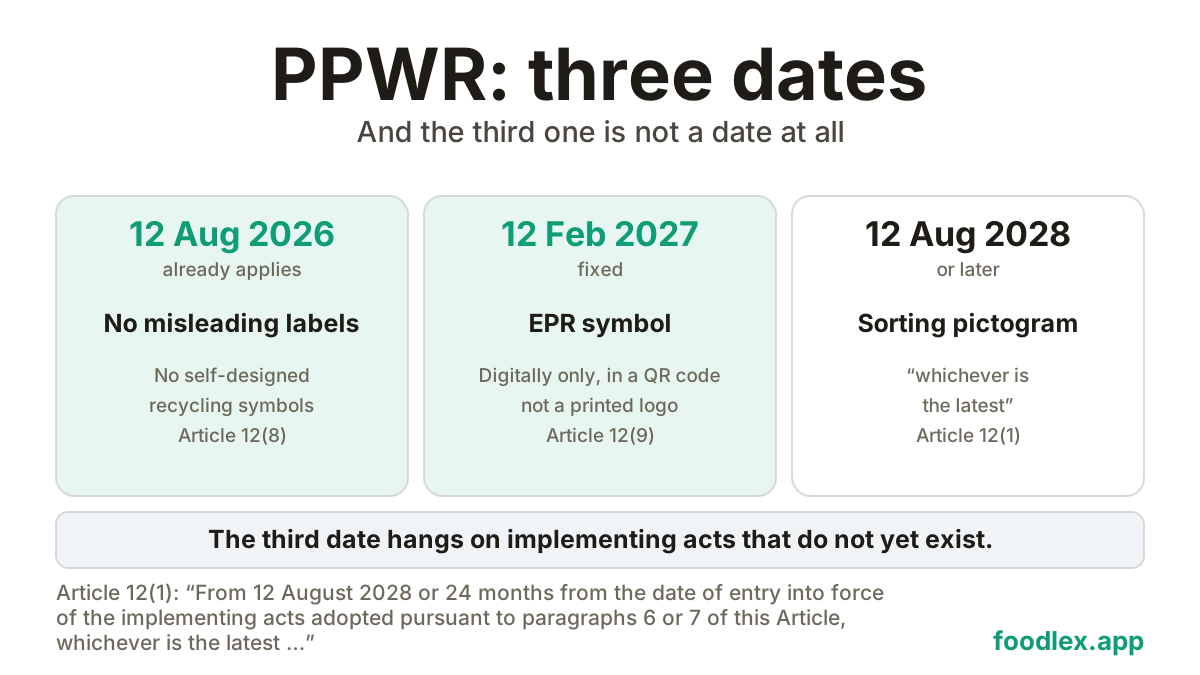
Regulation (EU) 2025/40, Article 12(1), (8) and (9). Diagram: Foodlex.
What already applies: the misleading-label ban
Article 12(8) carries no transition period. It became applicable with 12 August 2026:
“Without prejudice to requirements concerning other harmonised EU labels, economic operators shall not provide or display labels, marks, symbols or inscriptions that are likely to mislead or confuse consumers or other end users with respect to the sustainability requirements for packaging, other packaging characteristics or packaging waste management options for which harmonised labelling has been laid down in this Regulation.”
In practice: home-made recycling symbols, green arrows or an added “environmentally friendly packaging” on a pack are a risk today, not from 2028. The same direction comes from Article 14, which only permits environmental claims about packaging properties where they go “beyond the applicable minimum requirements set out in this Regulation” and state whether they refer to the packaging unit, to part of it, or to all packaging placed on the market.
What is certain: 12 February 2027
Article 12(9) names a date with no condition attached:
“By 12 February 2027, packaging included in an extended producer responsibility scheme may be identified throughout the territory of the Member States in which that scheme or system applies. Such identification shall be achieved only by means of a corresponding symbol in a QR code or other standardised, open, digital-marking technology in order to indicate that the producer fulfils its extended producer responsibility obligations.”
Note that this is a permission with a prescribed form, not a new duty: producers who want to show that they meet their EPR obligations may do so — but digitally only, not as a printed logo.
And now the point the timelines skip
The best-known PPWR duty is the sorting pictogram: a harmonised label showing material composition. Nearly every guide puts it at “from 12 August 2028”. The wording of Article 12(1) says something else:
“From 12 August 2028 or 24 months from the date of entry into force of the implementing acts adopted pursuant to paragraphs 6 or 7 of this Article, whichever is the latest, packaging placed on the market shall be marked with a harmonised label containing information on its material composition in order to facilitate consumer sorting. The label shall be based on pictograms and be easily understandable, including for persons with disabilities. […] With the exception of e-commerce packaging, this obligation does not apply to transport packaging or to packaging that is subject to a deposit and return system.”
Two things sit in there. First an exemption: transport packaging and packaging under a deposit and return system need no pictogram — e-commerce packaging does.
Second, and this is the real point: there are two dates, and the later one applies. The second depends on an act the Commission still has to adopt — with its own deadline, in Article 12(6):
“By 12 August 2026, the Commission shall adopt implementing acts to establish a harmonised label and specifications for the labelling requirements and formats, including where provided through digital means, for the labelling of packaging referred to in paragraphs 1, 2 and 4 of this Article.”
That yields a simple calculation. The moving date falls after the fixed one precisely when the implementing act enters into force after 12 August 2026 — which is to say, whenever the Commission misses its own deadline:
- Act in force on 12 August 2026 → 24 months later is exactly 12 August 2028.
- Act in force three months late → the duty starts three months later, in November 2028.
- Act in force in early 2027 → the duty starts in 2029.
Position on 8 October 2026: the implementing acts under Article 12(6) and (7) have not been adopted. This time that does not come from trade press but from the Commission's own register of planned acts, where the file sits as initiative 19243 (reference PLAN/2026/1562, Directorate-General for Environment), titled Commission Implementing Decision on harmonised packaging and packaging waste labels under Regulation (EU) 2025/40. The form foreseen is an implementing decision, with Articles 12 and 13 as its legal basis. It was registered on 14 September 2026, a month after the deadline passed. It stands at the planning stage, the public feedback period has not yet opened, and no adoption date is recorded.
That has a consequence the timelines do not yet show: 12 August 2028 is already superseded. Paragraph 1 lets the later of the two dates govern. Since no such act was in force on 8 October 2026, 24 months from its entry into force necessarily falls after October 2028 — and therefore after 12 August 2028. That holds no matter when the act arrives. Anyone planning now should reckon with late 2028 at the earliest and watch the implementing act, not the 2028 date.
Every Article 12 deadline at a glance
| From | What | Source | Fixed? |
|---|---|---|---|
| 12 Aug 2026 | Regulation applicable; ban on misleading sustainability labels | Art. 71, Art. 12(8) | yes — in force |
| 12 Feb 2027 | EPR identification permitted, QR code or equivalent only | Art. 12(9) | yes |
| 12 Aug 2028 | Sorting label (material composition, pictograms) | Art. 12(1) | no — or 24 months after the act |
| 12 Aug 2028 | Recycled content statement, where displayed | Art. 12(4) | no — or 24 months after the act |
| 12 Feb 2029 | Labelling of reusable packaging, with QR code | Art. 12(2) | no — or 30 months after the act |
For both 2028 dates and the 2029 date, the regulation uses the same “whichever is the latest” formula. For paragraph 2 the period is 30 months rather than 24.
Existing stock: three years to sell through
The first question a producer with a full warehouse asks is answered by Article 12(12) — and it appears in almost no timeline:
“Packaging as referred to in paragraphs 1, 2 and 4 that is manufactured in the Union or imported before the deadlines referred in those paragraphs and that does not comply with the criteria laid down in those paragraphs may be made available on the market until 3 years from the date of entry into force of the labelling requirements laid down in those paragraphs.”
The decisive words are manufactured or imported: what counts is the date of manufacture or import, not the date of sale. Anyone who produced before the cut-off does not have to destroy the stock — it may stay on the market for another three years. Packaging manufactured after the cut-off is not covered.
What the Commission itself says about this
Since 10 June 2026 there has been an official aid to interpretation: the Commission guidance on Regulation (EU) 2025/40 (reference 52026XC03084). Its section 13 deals with labelling and settles three points that do not follow from the regulation's wording alone.
First: Article 12 harmonises fully. National labels are phased out; they may not sit next to the EU label:
“Packaging labelling under the scope of Article 12 is exhaustive and fully harmonised, except as regards deposit and return schemes. National rules which add sorting instructions are not allowed based on the principle of primacy of EU law. Member States will not be allowed to keep their national labels next to EU harmonised labels after 12 August 2028 or 24 months from the date of entry into force of the implementing act specifying the labelling rules and pictograms.”
Second: for the EPR label, physical labelling is banned — not merely digital labelling permitted. That sharpens the 12 February 2027 date above:
“As regards labels for extended producer responsibility (EPR), the PPWR bans physical labels and allows such information or labels to be provided only in a digital format (Article 12(9)).”
Third: stating recycled content stays voluntary. The table above says “where applicable” — the guidance says what that means:
“As regards labels for recycled content and bio-based content under Article 12(4), they will be fully harmonised from 12 August 2028 or 24 months after the entry into force of the related implementing act, but the use of these labels is voluntary. This means that economic operators are not obliged to indicate the recycled content or bio-based content on their packaging, but if they wish to indicate this, they must use the EU harmonised technical specifications.”
So anyone who does not want to state recycled content need not do so in 2028 either. Anyone who does state it must then use the harmonised specifications.
How the label has to be applied
Article 12(5) governs the form — and contains a requirement that is easy to miss in online retail. The information must be
“affixed, printed or engraved visibly, legibly and firmly on the packaging, so that they cannot be easily erased. The information contained therein shall also be available to end users before the purchase of the product through online sales.”
Where that is not possible or not warranted on account of the nature and size of the packaging, the label moves to the outer packaging. The language is set by the Member State in which the packaging is made available, and must be one easily understood by end users.
PPWR or food information rules? What goes where
This is the confusion costing the most time right now. Two separate bodies of law, two separate objects — and both apply at the same time:
| Regulation (EU) No 1169/2011 | PPWR — Regulation (EU) 2025/40 | |
|---|---|---|
| Object | information about the food | the packaging as an object |
| Typical items | ingredients list, emphasised allergens, nutrition declaration, date of minimum durability, net quantity, the responsible operator | material pictogram, recycled content, re-use label, deposit, EPR symbol, substances of concern |
| Who enforces | food authorities | market surveillance under Regulation (EU) 2019/1020 |
| Foodlex covers it | yes — the label and the calculation | no |
To say it plainly: Foodlex produces the food information label, not the PPWR label. The packaging data comes from the packaging — from your supplier, from the scheme operator, from the implementing act once it exists. Confusing the two means looking for pictograms in the wrong software.
What makes sense now
- Audit what you already print. Anything that looks like an environmental claim or a recycling hint should be measured against Article 12(8) and Article 14 — that applies today.
- Watch the implementing act, not the 2028 date. It defines the pictograms; artwork planning only becomes possible afterwards.
- Talk to your packaging supplier. Material composition and recycled content are theirs to state, not your labelling software’s.
- Keep the food label separate. It is due independently and can be checked independently.
Frequently asked questions
Does the PPWR already apply?
Yes. Article 71 states: “It shall apply from 12 August 2026.” The individual labelling duties, however, start at different and mostly later dates. Already applicable is the ban on misleading sustainability labels in Article 12(8).
When does the sorting pictogram become mandatory?
Article 12(1) names 12 August 2028 or 24 months from the entry into force of the implementing acts, “whichever is the latest”. The Commission was to adopt those acts by 12 August 2026 and missed that deadline: on 8 October 2026 the file still stood at the planning stage in the Commission’s register (initiative 19243). 12 August 2028 is therefore already superseded — the duty starts in late 2028 at the earliest.
What is the difference between the PPWR and the EU food information rules?
Regulation (EU) No 1169/2011 governs information about the food — ingredients list, allergens, nutrition declaration, date of minimum durability. The PPWR governs the packaging as an object: material composition, re-use, deposit systems, extended producer responsibility. Both sets of duties apply side by side.
Which packaging is exempt from the sorting label?
Article 12(1) states that, with the exception of e-commerce packaging, the obligation does not apply to transport packaging or to packaging that is subject to a deposit and return system.
Can I sell through existing stock after the cut-off?
Yes, for up to three years. Article 12(12) allows packaging that was manufactured in the Union or imported before the deadlines, and that does not meet the labelling requirements, to be made available on the market until 3 years from the entry into force of those requirements. What counts is the date of manufacture or import, not the date of sale. Packaging manufactured after the cut-off is not covered.
Do I have to state the recycled content on the packaging?
No. The Commission guidance on Regulation (EU) 2025/40 (reference 52026XC03084, section 13) says it explicitly: “the use of these labels is voluntary”. Anyone who does not want to state the recycled or bio-based content need not do so after 2028 either. Anyone who does state it must then use the EU harmonised technical specifications.
This article is general information and does not replace legal advice. What counts is the wording of the regulation as it applies at the time (Articles 12 and 71 of Regulation (EU) 2025/40). The English text of the Regulation is quoted from the version published in the Official Journal on 22 January 2025 (CELEX 32025R0040). Information current as of 7 October 2026.